VM
CA202 144-202-000-235
$10700
In Stock
T/T
Xiamen
| Availability: | |
|---|---|
| Quantity: | |
The CA202 144-202-000-235 is the flagship long-cable configuration model within the Vibro-Meter (Meggitt Group) CA200 series of piezoelectric accelerometers. This model is the standard industrial version, distinguished by its core feature: a factory-preinstalled 20-meter integral cable. It is specifically designed for large-scale industrial equipment where measurement points are distant from signal processing units, wiring paths are complex, or distributed multi-point monitoring is required.
This sensor embodies all the core technology and ruggedness of the CA200 series, utilizing a symmetrical shear-mode piezoelectric sensing element and an all-stainless-steel hermetically welded construction. Its operating principle involves converting mechanical vibration directly into a high-fidelity charge signal, transmitted via a low-noise coaxial cable to subsequent charge amplifiers or vibration transmitters. The 20-meter cable length provides unparalleled installation flexibility, allowing monitoring system cabinets to be centrally located, significantly simplifying the cabling complexity and cost for long-distance, multi-point systems, while simultaneously avoiding the signal attenuation, noise, and reliability risks that can be introduced by field-terminated connectors.
The CA202-235 is intended for non-hazardous areas. Its exceptional wide-temperature performance (-55°C to +260°C), extremely high environmental protection rating (IP68 equivalent, resistant to oil, water, salt spray), and long-term stability make it the preferred solution for vibration monitoring of critical rotating machinery in sectors like power generation, petrochemicals, metallurgy, and marine propulsion, where reliability demands are paramount.
Ultra-Long Distance Integrated Signal Path: The 20-meter integrated cable is this model's most prominent advantage. The cable employs a twisted-pair shielded design, encased in a flexible stainless steel protection hose (BOA), and is welded into a sealed unit with the sensor body. This design ensures the signal path from the sensor to the termination point is complete and reliable, completely eliminating the potential failure points of intermediate connectors. It is especially suitable for long-distance cable runs that must traverse high-temperature, oily, or mechanically active areas.
Extreme Environmental Adaptability:
Ultra-Wide Operating Temperature: The sensor head withstands -55°C to +260°C, allowing installation on high-temperature surfaces like steam turbine casings or gas turbine intake sections, as well as outdoor equipment in cold climates.
Fully Sealed & Corrosion Resistant: The austenitic stainless steel (1.4441) housing and heat-resistant stainless steel (1.4541) cable hose are joined via full-path hermetic welding, creating a leak-proof "monolithic" unit. It resists 100% humidity, high-pressure water washdown, steam, lubricating oil, fuel, and salt spray corrosion, with a service life far exceeding that of typical glue-sealed or O-ring sealed products.
High Shock & Vibration Resistance: Capable of withstanding mechanical shock up to 1000g, while maintaining stable operation even in environments with strong vibration.
Excellent Electrical Performance:
High Sensitivity & Low Noise: A standard sensitivity of 100 pC/g, combined with low-noise cable, enables precise measurement of vibrations across a wide dynamic range, from minute to severe. Differential output effectively suppresses common-mode interference.
Internal Insulation & High Impedance: The sensor features complete electrical insulation between the signal terminals and the housing (insulation resistance > 1 GΩ), perfectly solving "ground loop" issues caused by differing equipment ground potentials. This is fundamental for the stable operation of multi-channel monitoring systems.
Superior Frequency Response: A flat frequency response range of 0.5 Hz to 6 kHz captures both the rotational frequency of slow-speed equipment and higher-order frequency components like gear meshing.
Ease of Installation & Maintenance:
No Insulation Required on Mounting Surface: Thanks to the internal insulation design, no insulating washers are needed between the sensor and the equipment during installation, simplifying the process and improving mounting rigidity and frequency response.
Pre-Calibrated & Maintenance-Free: Dynamically calibrated at the factory under standard conditions (5g, 120Hz) with a calibration certificate provided. Under normal operating conditions, the sensor itself requires no periodic calibration or maintenance, belonging to the "install and forget" category of equipment.
Flexible Mounting Accessories: Can be paired with accessories like the MA133 thermal insulation kit to protect the cable and ensure measurement accuracy when installed on extremely hot surfaces.
Leveraging its long cable and extreme durability, the CA202-235 is particularly suited for the following large-scale industrial scenarios with stringent reliability and cabling requirements:
Comprehensive Monitoring of Large Power Generation Units:
Complete Steam/Gas Turbine Trains: Vibration monitoring at multiple bearing pedestals from HP to LP cylinders, requiring cables to traverse long distances across hot platforms.
Generators & Exciters: Monitoring rotor dynamic eccentricity, thermal asymmetry, and bearing condition.
Power Plant Auxiliary Systems: Such as large induced draft fans, forced draft fans, boiler feed pumps, where measurement points are scattered and distant.
Core Petrochemical & Refining Process Units:
Large Centrifugal/Reciprocating Compressor Trains: Multi-casing, multi-bearing monitoring in environments with oil vapor and high temperatures.
Critical Pumps in Hydrotreating/FCC Units: Long cables facilitate bringing signals to centralized junction boxes in safe areas or control rooms.
Offshore Platforms: Its sealing withstands the high-salt, high-humidity marine environment; long cables simplify deck-to-deck cabling.
Heavy Metallurgical & Mining Equipment:
High-Speed Wire Rod/Strip Rolling Mills: Bearing monitoring on drive and operator sides of multiple stands, with complex cable routing.
Large Ball Mills, Rotary Kilns: Massive equipment with measurement points far from the control room, in dusty environments.
Marine & Offshore Engineering:
Main Propulsion Diesel Engines, Turbines & Reduction Gearboxes: High temperature, humidity, and vibration in engine rooms. Long cables reduce intermediate connectors, enhancing reliability.
Thrusters, Large Circulating Water Pumps.
Infrastructure & Large Test Rigs:
Wind Turbine Gearboxes & Generators (note non-hazardous area certification limitation).
Large Structural Fatigue Test Rigs, Engine Test Beds, requiring cabling from multiple remote measurement points to a central data acquisition system.
[Measurement Point x N] → CA202-235 (20m cable) → [Field Junction Box/Cable Tray] → Transmission Cable → IPC 70x Charge Amplifier → GSI XXX Isolator → VM600/MMS Monitoring System → DCS/PLC
Design Key Point: The 20m cable is typically connected directly to a central field junction box or cable tray, where it is combined with cables from other sensors and routed via a multi-core backbone transmission cable to a distant cabinet. This design maximizes the long-cable advantage while minimizing field terminations.
A. Sensor Mounting (Same as other models, emphasizing fundamentals):
Surface Preparation: Mounting surface must be clean and flat (recommended surface roughness Ra < 1.6 μm). Thoroughly clean to remove oil, grease, and metal chips.
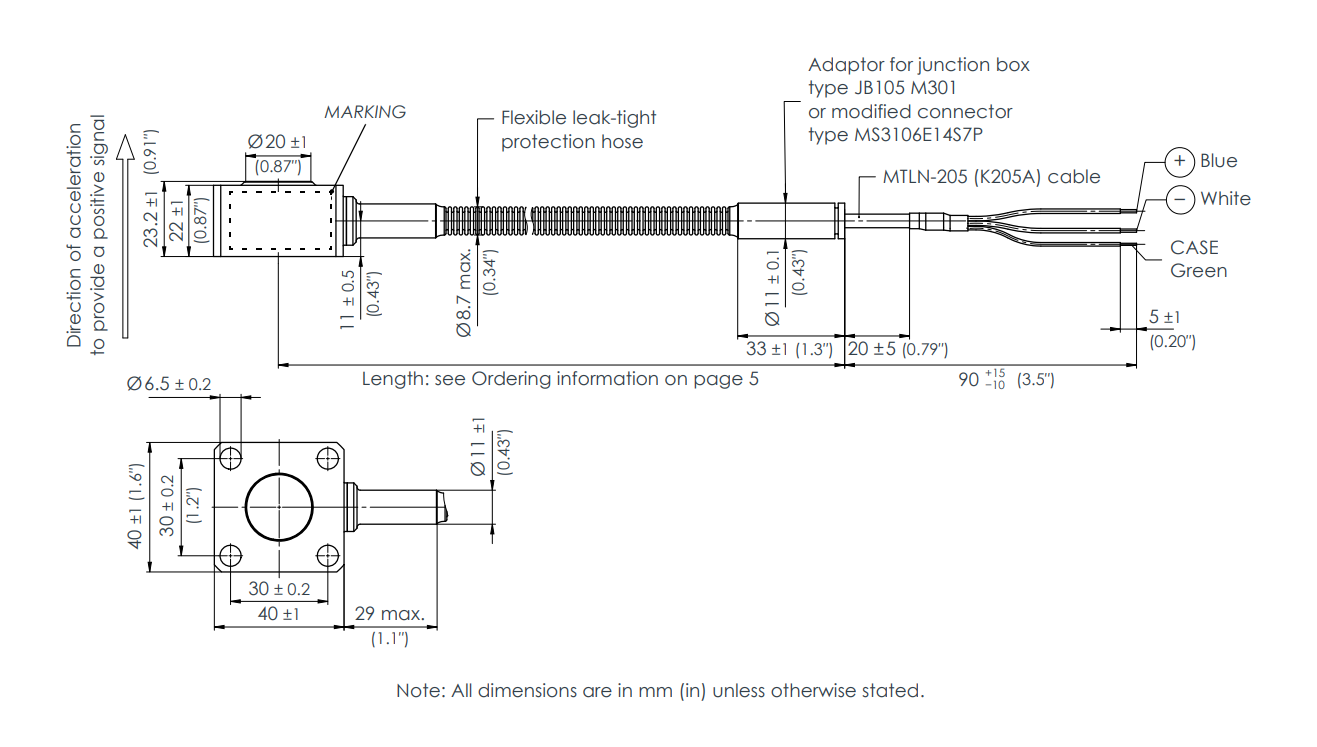
Drilling & Tapping: Accurately locate and drill/tap 4 x M6 threaded holes (14mm deep) strictly according to the drawing. Hole spacing tolerance must be controlled to avoid mounting stress.
Application & Tightening: Apply medium-strength thread-locking compound to screws. Use a torque wrench to tighten screws in a cross-pattern sequence in two steps to 15 N·m.
B. The Art of Routing the 20-meter Cable (Crucial!):
Path Planning:
Shortest & Smoothest Path: Plan a route that avoids sharp turns and acute-angle bends.
Away from Interference Sources: Maintain a minimum separation of 30 cm from power cables (especially VFD outputs). Keep parallel runs as short as possible. If crossing is necessary, ensure it is at a 90-degree angle.
Avoid Hot Spots: Although the cable is heat-resistant, avoid direct contact with surfaces >200°C or open flames. Use thermal sleeving if necessary.
Fixation & Support:
Fixation Interval: Use high-temperature resistant stainless steel cable clamps (suitable for Φ8mm tubing) to securely fix the cable every 1.0 - 1.5 meters. Never leave cables suspended or swinging freely.
Bend Radius: At any point, the static bend radius of the cable (including hose) must be ≥ 50mm (approx. 2 inches). The dynamic bend radius (during equipment operation) should be larger.
Stress Relief: At both the sensor exit and the point of entry into a junction box, a "service loop" (a loop of relaxed cable ~15-20cm in diameter) must be provided to absorb vibration and thermal expansion/contraction stresses, preventing fatigue failure at the root.
Grounding & Shield Handling (The Soul of System Stability):
Principle: Implement a single-point grounding scheme for the entire measurement system.
Implementation: Typically, at the charge amplifier (IPC) input, the CA202 cable shield is reliably connected to the IPC's shield terminal, which is then connected to the system safety ground. At the sensor end and the monitoring system end, the shield remains floating.
Long Cable Shielding: Ensure the shield of the 20m cable is continuous and undamaged. When making connections inside a junction box, the shield should maintain continuity via metal shield connectors or soldering/crimping, avoiding "pigtail" connections.
C. Electrical Connection:
To Junction Box/Amplifier: Connect the red/white signal wires to "SIG+" and "SIG-" respectively, and the shield to "SHLD/GND". Ensure connections are tight; insulated crimp terminals are recommended.
Waterproofing: Use the waterproof cable glands supplied with the amplifier or junction box to ensure a seal at the cable entry point, achieving at least IP65 protection.
Periodic Inspections:
Annual Walkdown: Inspect sensor for corrosion or impact damage; check cable hose, especially at friction points, for wear; check all clamps for tightness; verify junction box seal and grounding integrity.
System Health Check: Monitor background noise levels for each channel via the monitoring system and compare against historical baselines to detect cable or connection issues early.
Common Fault Diagnosis:
Complete Signal Loss: First, check IPC power supply. Then, measure sensor loop insulation and continuity from the IPC end. Check connection points inside junction boxes.
Significant Increase in Noise: 90% originate from grounding issues. Check if the single-point shield ground has failed, if the shield is accidentally grounded at the sensor end, or if coupling with power cables has occurred. Secondly, check if loose cable fixation is causing triboelectric noise.
Signal Drift or Instability: Check if the sensor is operating at extreme temperatures (outside compensation range); check the mounting base for thermal deformation or stress changes.
Strictly Prohibited Actions:
Absolutely FORBIDDEN to cut, splice, or extend the factory-supplied 20-meter integrated cable. This compromises sealing and signal integrity.
FORBIDDEN to use the cable for hanging or to bear any tensile load.
FORBIDDEN to expose the cable section to sustained temperatures exceeding +200°C without confirming environmental conditions.
FORBIDDEN for any unauthorized personnel to disassemble the sensor body.
Calibration & Service: The CA202 is designed as maintenance-free and field-calibration-free. If major doubts arise about measurement accuracy, the entire sensor should be returned to a Meggitt authorized service center for testing and calibration. Any field modifications will void the warranty.
The CA202 144-202-000-235 is the flagship long-cable configuration model within the Vibro-Meter (Meggitt Group) CA200 series of piezoelectric accelerometers. This model is the standard industrial version, distinguished by its core feature: a factory-preinstalled 20-meter integral cable. It is specifically designed for large-scale industrial equipment where measurement points are distant from signal processing units, wiring paths are complex, or distributed multi-point monitoring is required.
This sensor embodies all the core technology and ruggedness of the CA200 series, utilizing a symmetrical shear-mode piezoelectric sensing element and an all-stainless-steel hermetically welded construction. Its operating principle involves converting mechanical vibration directly into a high-fidelity charge signal, transmitted via a low-noise coaxial cable to subsequent charge amplifiers or vibration transmitters. The 20-meter cable length provides unparalleled installation flexibility, allowing monitoring system cabinets to be centrally located, significantly simplifying the cabling complexity and cost for long-distance, multi-point systems, while simultaneously avoiding the signal attenuation, noise, and reliability risks that can be introduced by field-terminated connectors.
The CA202-235 is intended for non-hazardous areas. Its exceptional wide-temperature performance (-55°C to +260°C), extremely high environmental protection rating (IP68 equivalent, resistant to oil, water, salt spray), and long-term stability make it the preferred solution for vibration monitoring of critical rotating machinery in sectors like power generation, petrochemicals, metallurgy, and marine propulsion, where reliability demands are paramount.
Ultra-Long Distance Integrated Signal Path: The 20-meter integrated cable is this model's most prominent advantage. The cable employs a twisted-pair shielded design, encased in a flexible stainless steel protection hose (BOA), and is welded into a sealed unit with the sensor body. This design ensures the signal path from the sensor to the termination point is complete and reliable, completely eliminating the potential failure points of intermediate connectors. It is especially suitable for long-distance cable runs that must traverse high-temperature, oily, or mechanically active areas.
Extreme Environmental Adaptability:
Ultra-Wide Operating Temperature: The sensor head withstands -55°C to +260°C, allowing installation on high-temperature surfaces like steam turbine casings or gas turbine intake sections, as well as outdoor equipment in cold climates.
Fully Sealed & Corrosion Resistant: The austenitic stainless steel (1.4441) housing and heat-resistant stainless steel (1.4541) cable hose are joined via full-path hermetic welding, creating a leak-proof "monolithic" unit. It resists 100% humidity, high-pressure water washdown, steam, lubricating oil, fuel, and salt spray corrosion, with a service life far exceeding that of typical glue-sealed or O-ring sealed products.
High Shock & Vibration Resistance: Capable of withstanding mechanical shock up to 1000g, while maintaining stable operation even in environments with strong vibration.
Excellent Electrical Performance:
High Sensitivity & Low Noise: A standard sensitivity of 100 pC/g, combined with low-noise cable, enables precise measurement of vibrations across a wide dynamic range, from minute to severe. Differential output effectively suppresses common-mode interference.
Internal Insulation & High Impedance: The sensor features complete electrical insulation between the signal terminals and the housing (insulation resistance > 1 GΩ), perfectly solving "ground loop" issues caused by differing equipment ground potentials. This is fundamental for the stable operation of multi-channel monitoring systems.
Superior Frequency Response: A flat frequency response range of 0.5 Hz to 6 kHz captures both the rotational frequency of slow-speed equipment and higher-order frequency components like gear meshing.
Ease of Installation & Maintenance:
No Insulation Required on Mounting Surface: Thanks to the internal insulation design, no insulating washers are needed between the sensor and the equipment during installation, simplifying the process and improving mounting rigidity and frequency response.
Pre-Calibrated & Maintenance-Free: Dynamically calibrated at the factory under standard conditions (5g, 120Hz) with a calibration certificate provided. Under normal operating conditions, the sensor itself requires no periodic calibration or maintenance, belonging to the "install and forget" category of equipment.
Flexible Mounting Accessories: Can be paired with accessories like the MA133 thermal insulation kit to protect the cable and ensure measurement accuracy when installed on extremely hot surfaces.
Leveraging its long cable and extreme durability, the CA202-235 is particularly suited for the following large-scale industrial scenarios with stringent reliability and cabling requirements:
Comprehensive Monitoring of Large Power Generation Units:
Complete Steam/Gas Turbine Trains: Vibration monitoring at multiple bearing pedestals from HP to LP cylinders, requiring cables to traverse long distances across hot platforms.
Generators & Exciters: Monitoring rotor dynamic eccentricity, thermal asymmetry, and bearing condition.
Power Plant Auxiliary Systems: Such as large induced draft fans, forced draft fans, boiler feed pumps, where measurement points are scattered and distant.
Core Petrochemical & Refining Process Units:
Large Centrifugal/Reciprocating Compressor Trains: Multi-casing, multi-bearing monitoring in environments with oil vapor and high temperatures.
Critical Pumps in Hydrotreating/FCC Units: Long cables facilitate bringing signals to centralized junction boxes in safe areas or control rooms.
Offshore Platforms: Its sealing withstands the high-salt, high-humidity marine environment; long cables simplify deck-to-deck cabling.
Heavy Metallurgical & Mining Equipment:
High-Speed Wire Rod/Strip Rolling Mills: Bearing monitoring on drive and operator sides of multiple stands, with complex cable routing.
Large Ball Mills, Rotary Kilns: Massive equipment with measurement points far from the control room, in dusty environments.
Marine & Offshore Engineering:
Main Propulsion Diesel Engines, Turbines & Reduction Gearboxes: High temperature, humidity, and vibration in engine rooms. Long cables reduce intermediate connectors, enhancing reliability.
Thrusters, Large Circulating Water Pumps.
Infrastructure & Large Test Rigs:
Wind Turbine Gearboxes & Generators (note non-hazardous area certification limitation).
Large Structural Fatigue Test Rigs, Engine Test Beds, requiring cabling from multiple remote measurement points to a central data acquisition system.
[Measurement Point x N] → CA202-235 (20m cable) → [Field Junction Box/Cable Tray] → Transmission Cable → IPC 70x Charge Amplifier → GSI XXX Isolator → VM600/MMS Monitoring System → DCS/PLC
Design Key Point: The 20m cable is typically connected directly to a central field junction box or cable tray, where it is combined with cables from other sensors and routed via a multi-core backbone transmission cable to a distant cabinet. This design maximizes the long-cable advantage while minimizing field terminations.
A. Sensor Mounting (Same as other models, emphasizing fundamentals):
Surface Preparation: Mounting surface must be clean and flat (recommended surface roughness Ra < 1.6 μm). Thoroughly clean to remove oil, grease, and metal chips.
Drilling & Tapping: Accurately locate and drill/tap 4 x M6 threaded holes (14mm deep) strictly according to the drawing. Hole spacing tolerance must be controlled to avoid mounting stress.
Application & Tightening: Apply medium-strength thread-locking compound to screws. Use a torque wrench to tighten screws in a cross-pattern sequence in two steps to 15 N·m.
B. The Art of Routing the 20-meter Cable (Crucial!):
Path Planning:
Shortest & Smoothest Path: Plan a route that avoids sharp turns and acute-angle bends.
Away from Interference Sources: Maintain a minimum separation of 30 cm from power cables (especially VFD outputs). Keep parallel runs as short as possible. If crossing is necessary, ensure it is at a 90-degree angle.
Avoid Hot Spots: Although the cable is heat-resistant, avoid direct contact with surfaces >200°C or open flames. Use thermal sleeving if necessary.
Fixation & Support:
Fixation Interval: Use high-temperature resistant stainless steel cable clamps (suitable for Φ8mm tubing) to securely fix the cable every 1.0 - 1.5 meters. Never leave cables suspended or swinging freely.
Bend Radius: At any point, the static bend radius of the cable (including hose) must be ≥ 50mm (approx. 2 inches). The dynamic bend radius (during equipment operation) should be larger.
Stress Relief: At both the sensor exit and the point of entry into a junction box, a "service loop" (a loop of relaxed cable ~15-20cm in diameter) must be provided to absorb vibration and thermal expansion/contraction stresses, preventing fatigue failure at the root.
Grounding & Shield Handling (The Soul of System Stability):
Principle: Implement a single-point grounding scheme for the entire measurement system.
Implementation: Typically, at the charge amplifier (IPC) input, the CA202 cable shield is reliably connected to the IPC's shield terminal, which is then connected to the system safety ground. At the sensor end and the monitoring system end, the shield remains floating.
Long Cable Shielding: Ensure the shield of the 20m cable is continuous and undamaged. When making connections inside a junction box, the shield should maintain continuity via metal shield connectors or soldering/crimping, avoiding "pigtail" connections.
C. Electrical Connection:
To Junction Box/Amplifier: Connect the red/white signal wires to "SIG+" and "SIG-" respectively, and the shield to "SHLD/GND". Ensure connections are tight; insulated crimp terminals are recommended.
Waterproofing: Use the waterproof cable glands supplied with the amplifier or junction box to ensure a seal at the cable entry point, achieving at least IP65 protection.
Periodic Inspections:
Annual Walkdown: Inspect sensor for corrosion or impact damage; check cable hose, especially at friction points, for wear; check all clamps for tightness; verify junction box seal and grounding integrity.
System Health Check: Monitor background noise levels for each channel via the monitoring system and compare against historical baselines to detect cable or connection issues early.
Common Fault Diagnosis:
Complete Signal Loss: First, check IPC power supply. Then, measure sensor loop insulation and continuity from the IPC end. Check connection points inside junction boxes.
Significant Increase in Noise: 90% originate from grounding issues. Check if the single-point shield ground has failed, if the shield is accidentally grounded at the sensor end, or if coupling with power cables has occurred. Secondly, check if loose cable fixation is causing triboelectric noise.
Signal Drift or Instability: Check if the sensor is operating at extreme temperatures (outside compensation range); check the mounting base for thermal deformation or stress changes.
Strictly Prohibited Actions:
Absolutely FORBIDDEN to cut, splice, or extend the factory-supplied 20-meter integrated cable. This compromises sealing and signal integrity.
FORBIDDEN to use the cable for hanging or to bear any tensile load.
FORBIDDEN to expose the cable section to sustained temperatures exceeding +200°C without confirming environmental conditions.
FORBIDDEN for any unauthorized personnel to disassemble the sensor body.
Calibration & Service: The CA202 is designed as maintenance-free and field-calibration-free. If major doubts arise about measurement accuracy, the entire sensor should be returned to a Meggitt authorized service center for testing and calibration. Any field modifications will void the warranty.
| Specification Category | Parameter | Detailed Specification | Conditions, Notes & Clarifications |
|---|---|---|---|
| Product Identification | Model | CA202 (Standard Industrial Version) | Meggitt vibro-meter Product Line |
| Ordering Number (PNR) | 144-202-000-235 | Key Identifier: Standard version, 20m cable | |
| Sensor Type | Piezoelectric, Shear Mode | Symmetrical Polycrystalline Measuring Element | |
| Electrical Output | Charge Signal | Differential Output, 2-wire, insulated from case | |
| Required Signal Conditioner | Must be used with external unit (e.g., IPC 70x) | Converts charge to 4-20mA or voltage signal | |
| Performance Parameters | Sensitivity (Nominal) | 100 pC/g | At 23°C, 120Hz, 5g conditions |
| Sensitivity Tolerance | ±5% | ||
| Measurement Range | 0.01 to 400 g (peak) | Linear operating range | |
| Overload Protection (Transient) | Up to 500 g (peak) | Resists accidental shock spikes | |
| Linearity | ±1% (0.01-20g peak) ±2% (20-400g peak) | Percentage of Full Scale | |
| Transverse Sensitivity Ratio | ≤ 3% | ||
| Mounted Resonant Frequency | > 22 kHz (typical) | Actual value depends on mounting stiffness | |
| Frequency Response (±5%) | 0.5 Hz to 6000 Hz | Lower cutoff determined by charge amplifier | |
| Typical Response Deviation (8kHz) | +10% | ||
| Insulation Resistance (Internal) | ≥ 1 x 10⁹ Ω | Signal terminal to case, minimum | |
| Capacitance | Sensor Body: Pole-Pole: ~5000 pF Pole-Case: ~10 pF Cable Addition (per meter): Pole-Pole: ~105 pF/m Pole-Case: ~210 pF/m | For 20m cable, total capacitance increases significantly and must be accounted for during system calibration. | |
| Environmental & Construction | Continuous Operating Temp. | Sensor Head: -55°C to +260°C Integral Cable: -55°C to +200°C | |
| Short-Term Survival Temp. | Sensor Head: -70°C to +280°C Integral Cable: -62°C to +250°C | Storage/Survival temperature in non-operating state | |
| Temperature Coefficient | -55 to +23°C: 0.25%/°C +23 to +260°C: 0.1%/°C | Rate of sensitivity change with temperature (ref. 23°C) | |
| Construction & Materials | Housing: Austenitic Stainless Steel 1.4441, Hermetically Welded Protection Hose: Heat-Resistant Stainless Steel 1.4541, Hermetically Welded Sealing: Resistant to moisture, water, oil, steam, salt spray, dust. | Entire unit is a welded sealed assembly, not modular | |
| Base Strain Sensitivity | 0.15 x 10⁻³ g / με | Equivalent acceleration error generated under 250 με strain | |
| Shock Resistance | ≤ 1000 g (peak) | Half-sine wave, 1 ms duration | |
| Explosion Proof Certification | This model (-235) is NOT certified. For hazardous areas, select Ex-certified versions starting with ordering number 144-202-000-1xx. | Certifications include ATEX, IECEx, cCSAus, etc. | |
| Physical & Mounting | Material | Stainless Steel | |
| Weight | Sensor: Approx. 250 grams Cable: Approx. 135 grams/meter | Total weight ~2.95 kg (sensor + 20m cable) | |
| Cable Length | 20 meters | Core Feature: Ultra-long factory-integrated cable | |
| Cable Construction | Twisted-pair shielded low-noise cable, sheathed in stainless steel flexible braided hose | ||
| Mounting | 4 x M6 x 35 socket head cap screws, with 4 x M6 spring lock washers Mounting Torque: 15 N·m (11.1 lb-ft) Note: Electrical insulation of mounting surface is not required. | ||
| Electrical Interface | Flying leads (stripped wire cores) at cable end | Typically red/white signal wires and shield | |
| Quality & Compliance | Factory Calibration | Dynamic calibration performed at 5g peak, 120Hz, 23°C. | Calibration data provided. No field calibration required under normal use. |
| Key Approvals & Compliance | Electromagnetic Compatibility (EMC): EN 61000-6-2, -6-4 Electrical Safety: EN 61010-1 Environmental Directive: RoHS (2011/65/EU) compliant Market Access: CE Marking, EAC Marking |
| Specification Category | Parameter | Detailed Specification | Conditions, Notes & Clarifications |
|---|---|---|---|
| Product Identification | Model | CA202 (Standard Industrial Version) | Meggitt vibro-meter Product Line |
| Ordering Number (PNR) | 144-202-000-235 | Key Identifier: Standard version, 20m cable | |
| Sensor Type | Piezoelectric, Shear Mode | Symmetrical Polycrystalline Measuring Element | |
| Electrical Output | Charge Signal | Differential Output, 2-wire, insulated from case | |
| Required Signal Conditioner | Must be used with external unit (e.g., IPC 70x) | Converts charge to 4-20mA or voltage signal | |
| Performance Parameters | Sensitivity (Nominal) | 100 pC/g | At 23°C, 120Hz, 5g conditions |
| Sensitivity Tolerance | ±5% | ||
| Measurement Range | 0.01 to 400 g (peak) | Linear operating range | |
| Overload Protection (Transient) | Up to 500 g (peak) | Resists accidental shock spikes | |
| Linearity | ±1% (0.01-20g peak) ±2% (20-400g peak) | Percentage of Full Scale | |
| Transverse Sensitivity Ratio | ≤ 3% | ||
| Mounted Resonant Frequency | > 22 kHz (typical) | Actual value depends on mounting stiffness | |
| Frequency Response (±5%) | 0.5 Hz to 6000 Hz | Lower cutoff determined by charge amplifier | |
| Typical Response Deviation (8kHz) | +10% | ||
| Insulation Resistance (Internal) | ≥ 1 x 10⁹ Ω | Signal terminal to case, minimum | |
| Capacitance | Sensor Body: Pole-Pole: ~5000 pF Pole-Case: ~10 pF Cable Addition (per meter): Pole-Pole: ~105 pF/m Pole-Case: ~210 pF/m | For 20m cable, total capacitance increases significantly and must be accounted for during system calibration. | |
| Environmental & Construction | Continuous Operating Temp. | Sensor Head: -55°C to +260°C Integral Cable: -55°C to +200°C | |
| Short-Term Survival Temp. | Sensor Head: -70°C to +280°C Integral Cable: -62°C to +250°C | Storage/Survival temperature in non-operating state | |
| Temperature Coefficient | -55 to +23°C: 0.25%/°C +23 to +260°C: 0.1%/°C | Rate of sensitivity change with temperature (ref. 23°C) | |
| Construction & Materials | Housing: Austenitic Stainless Steel 1.4441, Hermetically Welded Protection Hose: Heat-Resistant Stainless Steel 1.4541, Hermetically Welded Sealing: Resistant to moisture, water, oil, steam, salt spray, dust. | Entire unit is a welded sealed assembly, not modular | |
| Base Strain Sensitivity | 0.15 x 10⁻³ g / με | Equivalent acceleration error generated under 250 με strain | |
| Shock Resistance | ≤ 1000 g (peak) | Half-sine wave, 1 ms duration | |
| Explosion Proof Certification | This model (-235) is NOT certified. For hazardous areas, select Ex-certified versions starting with ordering number 144-202-000-1xx. | Certifications include ATEX, IECEx, cCSAus, etc. | |
| Physical & Mounting | Material | Stainless Steel | |
| Weight | Sensor: Approx. 250 grams Cable: Approx. 135 grams/meter | Total weight ~2.95 kg (sensor + 20m cable) | |
| Cable Length | 20 meters | Core Feature: Ultra-long factory-integrated cable | |
| Cable Construction | Twisted-pair shielded low-noise cable, sheathed in stainless steel flexible braided hose | ||
| Mounting | 4 x M6 x 35 socket head cap screws, with 4 x M6 spring lock washers Mounting Torque: 15 N·m (11.1 lb-ft) Note: Electrical insulation of mounting surface is not required. | ||
| Electrical Interface | Flying leads (stripped wire cores) at cable end | Typically red/white signal wires and shield | |
| Quality & Compliance | Factory Calibration | Dynamic calibration performed at 5g peak, 120Hz, 23°C. | Calibration data provided. No field calibration required under normal use. |
| Key Approvals & Compliance | Electromagnetic Compatibility (EMC): EN 61000-6-2, -6-4 Electrical Safety: EN 61010-1 Environmental Directive: RoHS (2011/65/EU) compliant Market Access: CE Marking, EAC Marking |

