VM
CA202 144-202-000-136
$11000
In Stock
T/T
Xiamen
| Availability: | |
|---|---|
| Quantity: | |
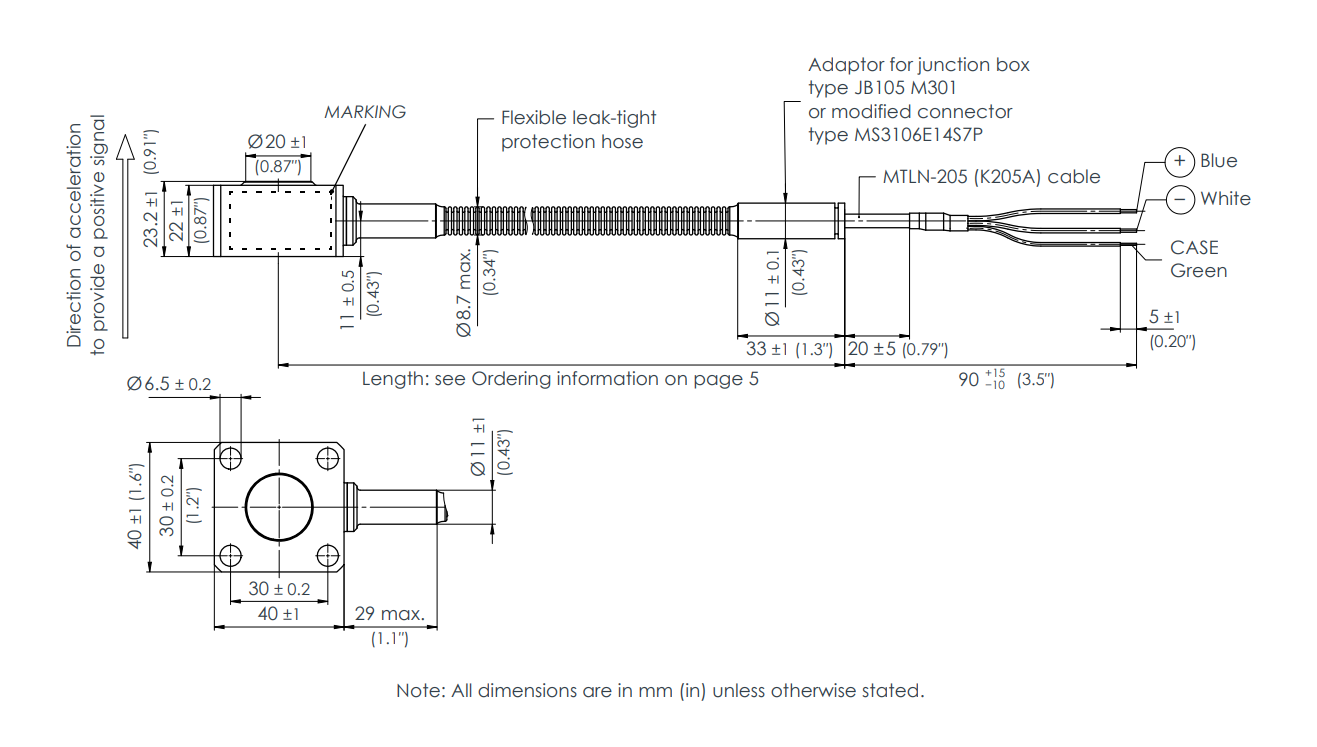
The CA202 piezoelectric accelerometer is a high-performance industrial vibration monitoring solution from vibro-meter, a Meggitt Sensing Systems product line. It is engineered for ultra-long distance, highly reliable continuous vibration measurement in harsh industrial environments with potentially explosive atmospheres. This report focuses on model 144-202-000-136, the Intrinsic Safety (Ex ia) certified version equipped with a 20-meter integral cable. This model is the ideal choice for monitoring large-scale industrial equipment in hazardous areas (Zone 0, 1, 2) where long-distance cabling is required, such as distributed compressor clusters in chemical plants, large gas turbine generator sets, multi-level equipment on offshore platforms, and pumping stations along long-distance pipelines. It enables signal transmission directly from the sensor to the safe-area control room without the need for intermediate junction boxes.
The sensor employs a proven shear-mode piezoelectric sensing technology combined with fully welded hermetic sealing to create a complete, robust measurement unit from the sensing head to the cable end. Its core feature is the 20-meter integral low-noise coaxial cable. This cable is sheathed in a flexible, high-temperature resistant stainless steel armored hose and seamlessly welded to the sensor housing, forming a sealed system resistant to extreme temperatures, mechanical stress, chemical corrosion, and moisture ingress. This design eliminates risks of signal attenuation or measurement failure common with traditional split-type sensors due to poor field connections, connector corrosion, or seal failure. It is particularly suitable for critical asset health management demanding exceptional long-term operational stability.
As the frontline "sentry" of an industrial condition monitoring network, the CA202-136 integrates seamlessly with vibro-meter® signal conditioners (IPC series), isolated safety barriers (GSI series), and intelligent monitoring platforms (e.g., MMS or VM600). This forms a complete solution chain from vibration sensing and anti-interference signal transmission to intelligent diagnostics, providing high-quality, high-confidence raw data for industrial digital transformation and predictive maintenance.
Ultra-Long Distance Integrated Signal Link:
No Intermediate Splicing: The 20-meter integral cable allows the sensor to be mounted directly on hard-to-reach or harsh measurement points while placing the more delicate charge amplifier tens of meters away in a safer, more serviceable location. This avoids quality hazards and explosion-proof certification risks associated with field welding or connections.
Signal Integrity Assurance: The factory-manufactured integral cable ensures consistency and optimization of electrical parameters (e.g., capacitance, insulation resistance) from the piezoelectric crystal to the amplifier input, minimizing signal loss and noise introduction in the initial long-distance transmission stage.
Exceptional Durability in Extreme Environments:
Full Temperature Chain Coverage: The sensing head withstands extreme temperatures from -55°C to +260°C, and the 20-meter cable body can operate continuously from -55°C to +200°C, ensuring reliable 24/7 operation in high-temperature areas like steelmaking or gas turbine exhaust sections, as well as in frigid outdoor environments.
Military-Grade Sealed Protection: The fully welded stainless steel structure provides protection exceeding IP68, offering inherent immunity to water, steam, oil, high-concentration corrosive chemicals, and dust, with a service life far exceeding devices relying on elastomeric seals.
Foundation for Accurate, Stable Measurement Performance:
High Output & Wide Bandwidth: A nominal sensitivity of 100 pC/g provides a good signal-to-noise ratio. Coupled with a wide flat frequency response of 0.5 Hz to 6 kHz (±5%), it can capture sub-harmonic vibrations of low-speed equipment and precisely analyze high-frequency fault signatures in high-speed gearboxes or rolling element bearings.
Excellent Dynamic Characteristics: A linear measurement range up to 400g and a resonant frequency >22kHz ensure the sensor's output signal remains undistorted under complex operating conditions with coexisting impacts and vibrations, truly reflecting equipment condition.
Globally Accepted Intrinsic Safety Certification: Model 144-202-000-136 has obtained Intrinsic Safety (Ex ia IIC) certifications covering major global explosion-proof systems, including ATEX, IECEx, UKEX, cCSAus, KGS, and EAC RU. This means a correctly calculated system can be safely deployed in the most hazardous areas (Zone 0) where Group IIC gases like hydrogen or acetylene may be present, meeting the highest safety compliance requirements for global projects.
Reduces Total Cost of Ownership:
Reduces Installation Complexity: The long cable reduces the amount of conduit, tray, and intermediate junction boxes needed, lowering installation labor and material costs.
Near-Zero Maintenance Requirements: The robust sealed construction fundamentally prevents failures due to environmental ingress, significantly reducing unplanned downtime and maintenance frequency.
Long Calibration Intervals: Piezoelectric crystal performance is extremely stable; on-site calibration is not required under normal operating conditions.
The CA202 represents the classic "sensing head + separate charge amplifier" architecture. Its sensing head is a pure electromechanical transducer: the internal seismic mass - piezoelectric crystal assembly converts mechanical vibration proportionally into a charge quantity. This conversion is nearly instantaneous with an extremely wide frequency response.
The 20-meter integral cable is the technical key to this model. It is not ordinary cable but a specially made low-noise coaxial cable. The dielectric between its center conductor and shield is optimized to minimize parasitic charge noise (triboelectric effect) induced by cable bending, vibration, or temperature changes. The welded connection between cable and sensing head ensures permanent connection reliability and sealing.
At the system level, the signal path is as follows:
Vibration → CA202 Sensing Head → High-impedance Charge Signal.
Charge signal travels via the 20m low-noise cable to the Charge Amplifier (IPC) installed in a safe area or better environment.
The Charge Amplifier performs two core functions: First, it provides a virtual ground for the high-impedance charge signal, converting it to a proportional voltage. Second, via a voltage-to-current converter circuit, it outputs a 2-wire 4-20 mA current loop signal. This technology grants the signal superior noise immunity and long-distance transmission capability.
The 4-20 mA current signal travels further via ordinary twisted pair to the control room, entering an Isolated Safety Barrier (GSI). The GSI provides energy limitation for the intrinsically safe loop (ensuring safety) and demodulates the current signal into a standard voltage signal (e.g., 0-5V, 0-10V) for input into a DCS/PLC or dedicated vibration monitoring system for analysis, recording, and alarming.
The strategic value of choosing the 20m cable model lies in simplified engineering design and enhanced long-term reliability. It allows sensor placement much closer to the optimal measurement point without being constrained by the availability of space for the amplifier nearby. This is particularly advantageous for large machine units with compact or extreme environments.
The ultra-long cable characteristic of the CA202-136 model gives it an irreplaceable advantage in the following large, complex, or distributed industrial facilities:
Large Rotating Machinery Cluster Monitoring:
Combined Cycle Power Plants: Vibration monitoring of multiple bearings on a single gas turbine and steam turbine; cables can be routed long distances along the unit to a unified junction box.
Large Air Separation Units: Production lines consisting of multiple large air compressors, boosters, and expanders requiring centralized monitoring.
Floating Production Storage and Offloading (FPSO) Vessels: Pumps and compressors distributed across process modules; long cables facilitate signal concentration to limited hazardous area junction boxes.
Long Pipelines or Distributed Infrastructure:
Natural Gas Pipeline Compressor Stations: Multiple compressors distributed across different explosion-proof zones within a station; long cables reduce cross-zone cable joints.
Large Water Treatment Plants/Pump Stations: Multiple high-pressure pump sets requiring monitoring signals to be transmitted to a central control room.
Underground Coal Mine Main Haulage Roadways: Monitoring of belt conveyors, water pumps; signals require long-distance transmission to surface safe areas.
Metallurgy & Heavy Manufacturing:
Steel Plant Sinter Machines, Blast Furnace Blowers: Large equipment with measurement points far from electrical rooms.
Bearing monitoring on multiple rolls of large paper machines.
Marine Propulsion System (e.g., main engine, reduction gearbox) monitoring.
Special Environments Requiring Remote Amplifier Placement:
Sensors mounted near high-temperature furnace bodies, with amplifiers needed in ambient temperature areas.
Equipment installed in high radiation areas, requiring electronic components to be placed away from the source.
System Compliance Design: A professional instrumentation engineer must perform intrinsic safety loop calculations based on the product's explosion-proof certificate and the site's hazardous area classification. This ensures the selected safety barrier and cable parameters, together with the CA202-136 and IPC amplifier, meet intrinsic safety requirements.
Cable Route Pre-Design: The 20m cable offers convenience but also presents routing challenges. Plan the path in advance to avoid sharp metal edges, hot surfaces (>200°C), strong interference sources, or frequently moving mechanical parts. Leave a service loop of about 1-2 meters for potential future sensor repositioning during equipment maintenance.
Surface Preparation: The mounting surface should be clean and flat. Creating a small local flat surface with a finish of Ra 3.2 μm or better is recommended for good mechanical coupling.
Mounting Orientation: The arrow on the sensor side indicates its maximum sensitivity axis. Align this with the intended vibration measurement direction (typically radial or axial).
Torque Control: Use a 15 N·m torque wrench to tighten the four M6 mounting screws in a crisscross pattern in two steps. Over-tightening can damage the sensor base or threads; under-tightening may cause poor contact, affecting high-frequency measurement.
Minimum Bending Radius: During installation, the cable's minimum static bending radius must not be less than 10 times its outer diameter (typically >100mm). Avoid sharp bends or kinks.
Support & Fixing:
Use corrosion-resistant cable ties or clamps, fixing the cable every 0.8-1.5 meters on straight runs.
A slack strain relief loop must be formed within approximately 0.5 meters of the sensor exit to prevent equipment vibration from directly pulling on the welded joint.
Route the cable within cable trays, conduit, or raceways; avoid leaving it suspended or subject to foot traffic.
Grounding: Follow the system diagram strictly for single-point grounding. Typically, the cable shield should be grounded at the Charge Amplifier (IPC) end, and the grounding conductor should be as short and thick as possible. The sensor mounting base is grounded via the machine body. Never ground the cable shield again at the sensor end to avoid ground loops and introduced noise.
Connection to IPC Amplifier: Correctly connect the CA202 cable's flying leads (typically red/white for signal, shield braid for ground) to the IPC amplifier's dedicated high-insulation terminals labeled "SENSOR INPUT". Ensure connections are secure and insulation is intact.
System Power-Up Check: After connection, verify the entire loop wiring is correct before powering up the safety barrier and monitoring system. Observe the status indicators on the IPC amplifier for normal operation.
Signal Verification: Observe the vibration signal for this channel on the monitoring system. A clear transient response waveform should be visible when gently tapping the sensor's mounting base, providing initial verification of a functional signal path.
Hazardous Area Work Permits: Installation or connection work in explosion-proof areas requires a hot work/electrical work permit, ensuring the area is safe via gas detection.
No Modifications: Absolutely forbid cutting, splicing, or attempting to lengthen/shorten the CA202's integral cable. Any damage to the cable permanently destroys its sealing and explosion-proof certification and may damage the sensor.
Professional Qualification: Installation, commissioning, and maintenance personnel must possess appropriate qualifications for working with explosion-proof equipment and electrical knowledge.
In-Service Maintenance:
Regular Visual Inspection: During routine equipment walks, check the sensor and cable for mechanical damage, severe corrosion, or loose fastenings.
Electrical Performance Spot Check: During major overhauls, measure the insulation resistance of the sensor loop to ground; it should remain in the GΩ range.
Troubleshooting: If a channel has no signal or abnormal signal:
Step 1: Disconnect wiring in the safe area. Use a multimeter to measure the insulation resistance (should be >1GΩ) and capacitance (should match nominal range) between the two signal wires at the CA202 cable end to preliminarily assess sensor/cable health.
Step 2: Check IPC amplifier power supply and output.
Step 3: Check safety barrier and system-side wiring.
Sensor failure rate is extremely low; most issues stem from wiring, grounding, or downstream equipment.
Calibration Services: Meggitt provides professional metrology calibration services. A recommended recalibration interval is 3-5 years, or when the sensor experiences severe overload shock or shows systematic deviation compared to other channels. Calibration must be performed at the factory or an authorized service center.
Global Technical Support: Meggitt SA has branches and authorized distributors worldwide, offering full-spectrum technical support from product selection and installation guidance to fault diagnosis. Users can visit the official website for the latest technical documents and application notes.
The CA202 piezoelectric accelerometer is a high-performance industrial vibration monitoring solution from vibro-meter, a Meggitt Sensing Systems product line. It is engineered for ultra-long distance, highly reliable continuous vibration measurement in harsh industrial environments with potentially explosive atmospheres. This report focuses on model 144-202-000-136, the Intrinsic Safety (Ex ia) certified version equipped with a 20-meter integral cable. This model is the ideal choice for monitoring large-scale industrial equipment in hazardous areas (Zone 0, 1, 2) where long-distance cabling is required, such as distributed compressor clusters in chemical plants, large gas turbine generator sets, multi-level equipment on offshore platforms, and pumping stations along long-distance pipelines. It enables signal transmission directly from the sensor to the safe-area control room without the need for intermediate junction boxes.
The sensor employs a proven shear-mode piezoelectric sensing technology combined with fully welded hermetic sealing to create a complete, robust measurement unit from the sensing head to the cable end. Its core feature is the 20-meter integral low-noise coaxial cable. This cable is sheathed in a flexible, high-temperature resistant stainless steel armored hose and seamlessly welded to the sensor housing, forming a sealed system resistant to extreme temperatures, mechanical stress, chemical corrosion, and moisture ingress. This design eliminates risks of signal attenuation or measurement failure common with traditional split-type sensors due to poor field connections, connector corrosion, or seal failure. It is particularly suitable for critical asset health management demanding exceptional long-term operational stability.
As the frontline "sentry" of an industrial condition monitoring network, the CA202-136 integrates seamlessly with vibro-meter® signal conditioners (IPC series), isolated safety barriers (GSI series), and intelligent monitoring platforms (e.g., MMS or VM600). This forms a complete solution chain from vibration sensing and anti-interference signal transmission to intelligent diagnostics, providing high-quality, high-confidence raw data for industrial digital transformation and predictive maintenance.
Ultra-Long Distance Integrated Signal Link:
No Intermediate Splicing: The 20-meter integral cable allows the sensor to be mounted directly on hard-to-reach or harsh measurement points while placing the more delicate charge amplifier tens of meters away in a safer, more serviceable location. This avoids quality hazards and explosion-proof certification risks associated with field welding or connections.
Signal Integrity Assurance: The factory-manufactured integral cable ensures consistency and optimization of electrical parameters (e.g., capacitance, insulation resistance) from the piezoelectric crystal to the amplifier input, minimizing signal loss and noise introduction in the initial long-distance transmission stage.
Exceptional Durability in Extreme Environments:
Full Temperature Chain Coverage: The sensing head withstands extreme temperatures from -55°C to +260°C, and the 20-meter cable body can operate continuously from -55°C to +200°C, ensuring reliable 24/7 operation in high-temperature areas like steelmaking or gas turbine exhaust sections, as well as in frigid outdoor environments.
Military-Grade Sealed Protection: The fully welded stainless steel structure provides protection exceeding IP68, offering inherent immunity to water, steam, oil, high-concentration corrosive chemicals, and dust, with a service life far exceeding devices relying on elastomeric seals.
Foundation for Accurate, Stable Measurement Performance:
High Output & Wide Bandwidth: A nominal sensitivity of 100 pC/g provides a good signal-to-noise ratio. Coupled with a wide flat frequency response of 0.5 Hz to 6 kHz (±5%), it can capture sub-harmonic vibrations of low-speed equipment and precisely analyze high-frequency fault signatures in high-speed gearboxes or rolling element bearings.
Excellent Dynamic Characteristics: A linear measurement range up to 400g and a resonant frequency >22kHz ensure the sensor's output signal remains undistorted under complex operating conditions with coexisting impacts and vibrations, truly reflecting equipment condition.
Globally Accepted Intrinsic Safety Certification: Model 144-202-000-136 has obtained Intrinsic Safety (Ex ia IIC) certifications covering major global explosion-proof systems, including ATEX, IECEx, UKEX, cCSAus, KGS, and EAC RU. This means a correctly calculated system can be safely deployed in the most hazardous areas (Zone 0) where Group IIC gases like hydrogen or acetylene may be present, meeting the highest safety compliance requirements for global projects.
Reduces Total Cost of Ownership:
Reduces Installation Complexity: The long cable reduces the amount of conduit, tray, and intermediate junction boxes needed, lowering installation labor and material costs.
Near-Zero Maintenance Requirements: The robust sealed construction fundamentally prevents failures due to environmental ingress, significantly reducing unplanned downtime and maintenance frequency.
Long Calibration Intervals: Piezoelectric crystal performance is extremely stable; on-site calibration is not required under normal operating conditions.
The CA202 represents the classic "sensing head + separate charge amplifier" architecture. Its sensing head is a pure electromechanical transducer: the internal seismic mass - piezoelectric crystal assembly converts mechanical vibration proportionally into a charge quantity. This conversion is nearly instantaneous with an extremely wide frequency response.
The 20-meter integral cable is the technical key to this model. It is not ordinary cable but a specially made low-noise coaxial cable. The dielectric between its center conductor and shield is optimized to minimize parasitic charge noise (triboelectric effect) induced by cable bending, vibration, or temperature changes. The welded connection between cable and sensing head ensures permanent connection reliability and sealing.
At the system level, the signal path is as follows:
Vibration → CA202 Sensing Head → High-impedance Charge Signal.
Charge signal travels via the 20m low-noise cable to the Charge Amplifier (IPC) installed in a safe area or better environment.
The Charge Amplifier performs two core functions: First, it provides a virtual ground for the high-impedance charge signal, converting it to a proportional voltage. Second, via a voltage-to-current converter circuit, it outputs a 2-wire 4-20 mA current loop signal. This technology grants the signal superior noise immunity and long-distance transmission capability.
The 4-20 mA current signal travels further via ordinary twisted pair to the control room, entering an Isolated Safety Barrier (GSI). The GSI provides energy limitation for the intrinsically safe loop (ensuring safety) and demodulates the current signal into a standard voltage signal (e.g., 0-5V, 0-10V) for input into a DCS/PLC or dedicated vibration monitoring system for analysis, recording, and alarming.
The strategic value of choosing the 20m cable model lies in simplified engineering design and enhanced long-term reliability. It allows sensor placement much closer to the optimal measurement point without being constrained by the availability of space for the amplifier nearby. This is particularly advantageous for large machine units with compact or extreme environments.
The ultra-long cable characteristic of the CA202-136 model gives it an irreplaceable advantage in the following large, complex, or distributed industrial facilities:
Large Rotating Machinery Cluster Monitoring:
Combined Cycle Power Plants: Vibration monitoring of multiple bearings on a single gas turbine and steam turbine; cables can be routed long distances along the unit to a unified junction box.
Large Air Separation Units: Production lines consisting of multiple large air compressors, boosters, and expanders requiring centralized monitoring.
Floating Production Storage and Offloading (FPSO) Vessels: Pumps and compressors distributed across process modules; long cables facilitate signal concentration to limited hazardous area junction boxes.
Long Pipelines or Distributed Infrastructure:
Natural Gas Pipeline Compressor Stations: Multiple compressors distributed across different explosion-proof zones within a station; long cables reduce cross-zone cable joints.
Large Water Treatment Plants/Pump Stations: Multiple high-pressure pump sets requiring monitoring signals to be transmitted to a central control room.
Underground Coal Mine Main Haulage Roadways: Monitoring of belt conveyors, water pumps; signals require long-distance transmission to surface safe areas.
Metallurgy & Heavy Manufacturing:
Steel Plant Sinter Machines, Blast Furnace Blowers: Large equipment with measurement points far from electrical rooms.
Bearing monitoring on multiple rolls of large paper machines.
Marine Propulsion System (e.g., main engine, reduction gearbox) monitoring.
Special Environments Requiring Remote Amplifier Placement:
Sensors mounted near high-temperature furnace bodies, with amplifiers needed in ambient temperature areas.
Equipment installed in high radiation areas, requiring electronic components to be placed away from the source.
System Compliance Design: A professional instrumentation engineer must perform intrinsic safety loop calculations based on the product's explosion-proof certificate and the site's hazardous area classification. This ensures the selected safety barrier and cable parameters, together with the CA202-136 and IPC amplifier, meet intrinsic safety requirements.
Cable Route Pre-Design: The 20m cable offers convenience but also presents routing challenges. Plan the path in advance to avoid sharp metal edges, hot surfaces (>200°C), strong interference sources, or frequently moving mechanical parts. Leave a service loop of about 1-2 meters for potential future sensor repositioning during equipment maintenance.
Surface Preparation: The mounting surface should be clean and flat. Creating a small local flat surface with a finish of Ra 3.2 μm or better is recommended for good mechanical coupling.
Mounting Orientation: The arrow on the sensor side indicates its maximum sensitivity axis. Align this with the intended vibration measurement direction (typically radial or axial).
Torque Control: Use a 15 N·m torque wrench to tighten the four M6 mounting screws in a crisscross pattern in two steps. Over-tightening can damage the sensor base or threads; under-tightening may cause poor contact, affecting high-frequency measurement.
Minimum Bending Radius: During installation, the cable's minimum static bending radius must not be less than 10 times its outer diameter (typically >100mm). Avoid sharp bends or kinks.
Support & Fixing:
Use corrosion-resistant cable ties or clamps, fixing the cable every 0.8-1.5 meters on straight runs.
A slack strain relief loop must be formed within approximately 0.5 meters of the sensor exit to prevent equipment vibration from directly pulling on the welded joint.
Route the cable within cable trays, conduit, or raceways; avoid leaving it suspended or subject to foot traffic.
Grounding: Follow the system diagram strictly for single-point grounding. Typically, the cable shield should be grounded at the Charge Amplifier (IPC) end, and the grounding conductor should be as short and thick as possible. The sensor mounting base is grounded via the machine body. Never ground the cable shield again at the sensor end to avoid ground loops and introduced noise.
Connection to IPC Amplifier: Correctly connect the CA202 cable's flying leads (typically red/white for signal, shield braid for ground) to the IPC amplifier's dedicated high-insulation terminals labeled "SENSOR INPUT". Ensure connections are secure and insulation is intact.
System Power-Up Check: After connection, verify the entire loop wiring is correct before powering up the safety barrier and monitoring system. Observe the status indicators on the IPC amplifier for normal operation.
Signal Verification: Observe the vibration signal for this channel on the monitoring system. A clear transient response waveform should be visible when gently tapping the sensor's mounting base, providing initial verification of a functional signal path.
Hazardous Area Work Permits: Installation or connection work in explosion-proof areas requires a hot work/electrical work permit, ensuring the area is safe via gas detection.
No Modifications: Absolutely forbid cutting, splicing, or attempting to lengthen/shorten the CA202's integral cable. Any damage to the cable permanently destroys its sealing and explosion-proof certification and may damage the sensor.
Professional Qualification: Installation, commissioning, and maintenance personnel must possess appropriate qualifications for working with explosion-proof equipment and electrical knowledge.
In-Service Maintenance:
Regular Visual Inspection: During routine equipment walks, check the sensor and cable for mechanical damage, severe corrosion, or loose fastenings.
Electrical Performance Spot Check: During major overhauls, measure the insulation resistance of the sensor loop to ground; it should remain in the GΩ range.
Troubleshooting: If a channel has no signal or abnormal signal:
Step 1: Disconnect wiring in the safe area. Use a multimeter to measure the insulation resistance (should be >1GΩ) and capacitance (should match nominal range) between the two signal wires at the CA202 cable end to preliminarily assess sensor/cable health.
Step 2: Check IPC amplifier power supply and output.
Step 3: Check safety barrier and system-side wiring.
Sensor failure rate is extremely low; most issues stem from wiring, grounding, or downstream equipment.
Calibration Services: Meggitt provides professional metrology calibration services. A recommended recalibration interval is 3-5 years, or when the sensor experiences severe overload shock or shows systematic deviation compared to other channels. Calibration must be performed at the factory or an authorized service center.
Global Technical Support: Meggitt SA has branches and authorized distributors worldwide, offering full-spectrum technical support from product selection and installation guidance to fault diagnosis. Users can visit the official website for the latest technical documents and application notes.
| Category | Parameter | Technical Specification Details | Conditions, Notes & Clarifications |
|---|---|---|---|
| Identity & Principle | Full Model | CA202 (Intrinsic Safety, 20m Integral Cable) | Order Part Number: 144-202-000-136 |
| Operating Principle | Shear-mode piezoelectric effect, High-impedance charge output | Internal sensing element electrically isolated from housing. Symmetrical differential design for strong common-mode rejection. | |
| Output Signal Type | Charge signal, Unit: picoCoulomb per g (pC/g) | Must be used with an external charge amplifier (e.g., vibro-meter® IPC 704/705) to convert to standard current or voltage signal. | |
| Electrical Performance | Charge Sensitivity | 100 pC/g ±5% | Calibrated at 23°C, 120Hz, 5g peak acceleration. |
| Linear Measurement Range | 0.01 g to 400 g (peak) | Non-linearity error ≤ ±1% within this range. | |
| Maximum Transient Overload | 500 g (peak) | Non-destructive shock withstand limit. | |
| Frequency Response Range | 0.5 Hz to 6000 Hz (±5%) | Lower limit determined by HPF of connected charge amp; upper -3dB point typically >8kHz. | |
| Resonant Frequency | > 22 kHz (nominal) | Sensor's first-order mechanical natural frequency. | |
| Transverse Sensitivity Ratio | ≤ 3% | Ratio of maximum transverse sensitivity to main axis sensitivity. | |
| Insulation Resistance | ≥ 1 x 10^9 Ω | Inside sensor, between measuring electrodes (@ 50 V DC). | |
| Capacitance | Sensor Body: Electrode-to-electrode ~5000 pF; Electrode-to-case ~10 pF Integral Cable (per meter, typical): Core-to-core ~105 pF; Core-to-shield ~210 pF | Total capacitance is sum of sensor and cable capacitance. 20m cable adds significantly; must be considered in amplifier range setting. | |
| Environmental & Mechanical | Continuous Operating Temp. | Sensing Head: -55°C to +260°C Integral Cable & Sheath: -55°C to +200°C | Sensor can be continuously exposed and operate within this range. |
| Short-Term Survival Temp. | Sensing Head: -70°C to +280°C Integral Cable: -62°C to +250°C | Limit for short exposure without permanent degradation/damage. | |
| Sensitivity Temp. Coefficient | -55°C to +23°C range: +0.25% / °C +23°C to +260°C range: +0.10% / °C | Sensitivity change rate relative to 23°C reference. | |
| Mechanical Shock Limit | 1000 g (peak) | Half-sine, 1 ms duration, Mil-spec compliant. | |
| Base Strain Sensitivity | 0.15 x 10^-3 g/με | Measured at 250 με peak-to-peak strain; negligible effect. | |
| Housing Material & Process | Austenitic Stainless Steel (Grade 1.4441), fully sealed via TIG welding. | Provides excellent strength and corrosion resistance. | |
| Cable Sheath Material | Heat-Resistant Stainless Steel Braided Armor (Grade 1.4541) | Flexible and abrasion-resistant, welded to sensor housing. | |
| Overall Protection | Hermetically sealed; Explosion-proof, waterproof, oil-proof, chemical corrosion resistant, dustproof. | Suitable for most severe industrial environments; no extra enclosure needed. | |
| Physical & Mounting | Weight | Sensing Head: approx. 250 g Integral Cable: approx. 135 g/m | Total weight for 20m cable approx. 2.95 kg (incl. sensor). |
| Mounting Interface | Four-hole flange mount, thru-hole Ø6.6 mm, for M6 bolts. | Mounting holes in square symmetric pattern. | |
| Recommended Hardware | M6 x 35 Socket Head Cap Screws with M6 Spring Lock Washers. | ||
| Max. Mounting Torque | 15 N·m | Use torque wrench. Tighten in crisscross pattern stepwise to avoid uneven force. | |
| Total Cable Length | 20 meters | Defined length for Model 136, manufactured as an inseparable unit. | |
| Cable Termination | Flying leads, typically two insulated signal wires and exposed shield braid. | For easy field connection to terminal blocks or connectors. | |
| Certifications & Compliance | Explosion-Proof Cert. (Core) | Intrinsic Safety (Ex ia): ATEX (II 1G Ex ia IIC T6…T2 Ga), IECEx, UKCA/UKEX, cCSAus (Cl. I Div. 1 & Zone 0), KGS, EAC RU, etc. | Covers major global markets. Permitted for Zone 0/1/2. See certificate schedules for specific conditions. |
| Electromagnetic Compatibility | Complies with EN 61000-6-2:2005 (Immunity for Industrial Env.) Complies with EN 61000-6-4:2007+A1:2011 (Emission for Industrial Env.) | ||
| Electrical Safety Standard | Complies with EN 61010-1:2010 | General safety requirements for electrical equipment. | |
| Environmental Directive | Complies with EU RoHS Directive (2011/65/EU) recast. | Restriction of Hazardous Substances in EEE. | |
| Factory Calibration | End-to-end dynamic calibration under lab conditions (5g, 120Hz). | Calibration certificate provided with sensitivity, frequency response data. Ensures out-of-box accuracy. |
| Category | Parameter | Technical Specification Details | Conditions, Notes & Clarifications |
|---|---|---|---|
| Identity & Principle | Full Model | CA202 (Intrinsic Safety, 20m Integral Cable) | Order Part Number: 144-202-000-136 |
| Operating Principle | Shear-mode piezoelectric effect, High-impedance charge output | Internal sensing element electrically isolated from housing. Symmetrical differential design for strong common-mode rejection. | |
| Output Signal Type | Charge signal, Unit: picoCoulomb per g (pC/g) | Must be used with an external charge amplifier (e.g., vibro-meter® IPC 704/705) to convert to standard current or voltage signal. | |
| Electrical Performance | Charge Sensitivity | 100 pC/g ±5% | Calibrated at 23°C, 120Hz, 5g peak acceleration. |
| Linear Measurement Range | 0.01 g to 400 g (peak) | Non-linearity error ≤ ±1% within this range. | |
| Maximum Transient Overload | 500 g (peak) | Non-destructive shock withstand limit. | |
| Frequency Response Range | 0.5 Hz to 6000 Hz (±5%) | Lower limit determined by HPF of connected charge amp; upper -3dB point typically >8kHz. | |
| Resonant Frequency | > 22 kHz (nominal) | Sensor's first-order mechanical natural frequency. | |
| Transverse Sensitivity Ratio | ≤ 3% | Ratio of maximum transverse sensitivity to main axis sensitivity. | |
| Insulation Resistance | ≥ 1 x 10^9 Ω | Inside sensor, between measuring electrodes (@ 50 V DC). | |
| Capacitance | Sensor Body: Electrode-to-electrode ~5000 pF; Electrode-to-case ~10 pF Integral Cable (per meter, typical): Core-to-core ~105 pF; Core-to-shield ~210 pF | Total capacitance is sum of sensor and cable capacitance. 20m cable adds significantly; must be considered in amplifier range setting. | |
| Environmental & Mechanical | Continuous Operating Temp. | Sensing Head: -55°C to +260°C Integral Cable & Sheath: -55°C to +200°C | Sensor can be continuously exposed and operate within this range. |
| Short-Term Survival Temp. | Sensing Head: -70°C to +280°C Integral Cable: -62°C to +250°C | Limit for short exposure without permanent degradation/damage. | |
| Sensitivity Temp. Coefficient | -55°C to +23°C range: +0.25% / °C +23°C to +260°C range: +0.10% / °C | Sensitivity change rate relative to 23°C reference. | |
| Mechanical Shock Limit | 1000 g (peak) | Half-sine, 1 ms duration, Mil-spec compliant. | |
| Base Strain Sensitivity | 0.15 x 10^-3 g/με | Measured at 250 με peak-to-peak strain; negligible effect. | |
| Housing Material & Process | Austenitic Stainless Steel (Grade 1.4441), fully sealed via TIG welding. | Provides excellent strength and corrosion resistance. | |
| Cable Sheath Material | Heat-Resistant Stainless Steel Braided Armor (Grade 1.4541) | Flexible and abrasion-resistant, welded to sensor housing. | |
| Overall Protection | Hermetically sealed; Explosion-proof, waterproof, oil-proof, chemical corrosion resistant, dustproof. | Suitable for most severe industrial environments; no extra enclosure needed. | |
| Physical & Mounting | Weight | Sensing Head: approx. 250 g Integral Cable: approx. 135 g/m | Total weight for 20m cable approx. 2.95 kg (incl. sensor). |
| Mounting Interface | Four-hole flange mount, thru-hole Ø6.6 mm, for M6 bolts. | Mounting holes in square symmetric pattern. | |
| Recommended Hardware | M6 x 35 Socket Head Cap Screws with M6 Spring Lock Washers. | ||
| Max. Mounting Torque | 15 N·m | Use torque wrench. Tighten in crisscross pattern stepwise to avoid uneven force. | |
| Total Cable Length | 20 meters | Defined length for Model 136, manufactured as an inseparable unit. | |
| Cable Termination | Flying leads, typically two insulated signal wires and exposed shield braid. | For easy field connection to terminal blocks or connectors. | |
| Certifications & Compliance | Explosion-Proof Cert. (Core) | Intrinsic Safety (Ex ia): ATEX (II 1G Ex ia IIC T6…T2 Ga), IECEx, UKCA/UKEX, cCSAus (Cl. I Div. 1 & Zone 0), KGS, EAC RU, etc. | Covers major global markets. Permitted for Zone 0/1/2. See certificate schedules for specific conditions. |
| Electromagnetic Compatibility | Complies with EN 61000-6-2:2005 (Immunity for Industrial Env.) Complies with EN 61000-6-4:2007+A1:2011 (Emission for Industrial Env.) | ||
| Electrical Safety Standard | Complies with EN 61010-1:2010 | General safety requirements for electrical equipment. | |
| Environmental Directive | Complies with EU RoHS Directive (2011/65/EU) recast. | Restriction of Hazardous Substances in EEE. | |
| Factory Calibration | End-to-end dynamic calibration under lab conditions (5g, 120Hz). | Calibration certificate provided with sensitivity, frequency response data. Ensures out-of-box accuracy. |