VM
CA202 144-202-000-105
$6000
In Stock
T/T
Xiamen
| Availability: | |
|---|---|
| Quantity: | |
The CA202 144-202-000-105 is a core safety model within the Vibro-Meter (Meggitt Group) CA200 series of explosion-proof piezoelectric accelerometers. This model is the Ex ia Intrinsic Safety explosion-proof version, equipped with a 3-meter integral cable, specifically designed for use in potentially explosive gas atmospheres (hazardous areas) and complies with the world's most stringent intrinsic safety standards. It serves as the foundational safety component for vibration monitoring of critical mechanical equipment in industrial production environments such as petrochemicals, natural gas, pharmaceuticals, and painting, where flammable and explosive gases or vapors may be present.
Building upon all the high-performance features inherited from the standard CA202 series (such as the symmetrical shear-mode sensing element, all-stainless-steel welded seal, and wide-temperature operation), this sensor incorporates the explosion-proof design philosophy of Intrinsic Safety (Ex ia). Its core principle lies in restricting the electrical spark or thermal energy that the sensor and its associated circuit could potentially generate under normal or fault conditions to a level below what is sufficient to ignite a specific explosive gas mixture, thereby preventing explosions at their source.
The model designation "105" signifies the combination of explosion-proof (Ex) version and 3-meter cable length. The 3-meter cable length is suitable for the typical distance within a hazardous area from the sensor to the nearest safe junction box or barrier, offering sufficient installation flexibility while minimizing the complexity and potential risks of cable routing within the hazardous area. It is not only a high-performance vibration sensor but also a Safety Instrumented Device compliant with multiple international certifications such as ATEX, IECEx, and cCSAus, making it the primary choice for building safe and reliable plant predictive maintenance systems.
Intrinsic Safety Explosion Protection (Ex ia IIC):
Highest Safety Level: Complies with Ex ia level, suitable for the most hazardous explosive gas atmospheres such as Zone 0, 1, 2 (Gas) or Class I, Division 1 & 2. Ensures no ignition of surrounding gas even in the event of two independent faults occurring in the sensor or its connecting cable.
Broad Gas Group Coverage: Certification covers Group IIC, meaning it can be used in environments containing most flammable and explosive gases, including hydrogen and acetylene, offering the widest application range.
High Temperature Class: Temperature class covers T6 down to T2, indicating its maximum surface temperature is limited below the requirements of the corresponding class (e.g., T6 corresponds to a maximum surface temperature ≤85°C), ensuring safety in high-temperature environments.
Global Authoritative Certification System:
Europe (ATEX): EC Type Examination Certificate, compliant with Directive 2014/34/EU (ATEX), certificate number LCIE 02 ATEX 6179 X.
International (IECEx): IECEx Certificate of Conformity, globally recognized explosion-proof standard.
North America (cCSAus): Also meets cCSAus certification, complying with US/Canadian standards for Class I, Division 2, Groups A,B,C,D and Zone 2.
Other Regions: Also holds relevant explosion-proof certifications for regions such as Korea, Russia, and the UK (UKEX), ensuring product compliance and market access in major global markets.
Rugged Industrial-Grade Core Performance:
Sealing and Durability: Same as the standard version, featuring an austenitic stainless steel hermetically welded housing and cable hose, providing IP68 equivalent protection against harsh industrial environments.
Electrical Isolation: Maintains complete electrical insulation between internal signal terminals and the housing, preventing ground loops and meeting isolation requirements for explosion-proof circuits.
High-Performance Sensing: 100 pC/g sensitivity, 0.5 Hz - 6 kHz wide frequency response, -55°C to +260°C operating temperature – performance without compromise.
Convenience of Safe Integration:
Plug-and-Play Safety Front End: As the "field device" in an intrinsic safety loop, it can be easily integrated into DCS or Safety Instrumented Systems (SIS) when paired with certified safety barriers or isolated safety relays.
Clear Safety Parameters: Provides definitive explosion-proof certification parameters (e.g., Ui, Ii, Pi, Ci, Li), facilitating system engineers in performing intrinsic safety loop calculations and validation.
The CA202-105 is specifically designed for monitoring critical equipment in the following industries with explosive gas atmospheres:
Oil & Gas Upstream, Midstream & Refining:
Offshore drilling platforms, FPSOs: Vibration monitoring of main power generation sets, oil/gas transfer compressors, pump packages in Zone 1 areas.
Onshore oil & gas fields: Rotating equipment within gas compressor stations, fueling stations, processing plants.
Refineries & Chemical Plants: Compressors, fans, pumps in areas of hydrocracking, fluid catalytic cracking, ethylene cracking units. Reactor feed pumps, recycle gas compressors, etc.
Chemical & Pharmaceutical Industries:
Vibration monitoring of reactor agitator drive systems, centrifuges, dryers, solvent recovery compressors involving flammable solvents (e.g., ethanol, acetone, benzene).
Ventilation and exhaust fans on painting/coating lines.
Energy & Utilities:
Gas turbine generator sets (especially where combustible gases may accumulate inside enclosures or in intake filter areas).
Coal mine gas drainage pump stations, gas booster stations.
Pre-treatment and conveying equipment in biogas power plants.
Others:
Dust explosion-protected areas in grain processing, feed mills (Note: This certification is primarily for gases; dust environments require separate evaluation).
Aerospace fuel testing facilities.
Rotating equipment such as motors, pumps, gearboxes located in any area classified as Class I, Division 1 or Zone 1.
Using the CA202-105 in a hazardous area is not simply replacing a standard sensor. It must be installed as part of an Intrinsic Safety (IS) loop. Any error can invalidate the explosion-proof certification, posing significant safety risks.
[Hazardous Area Zone 1] [Safe Area] CA202-105 (Field Device Ex ia) → 3m IS Cable → [Ex-proof Junction Box] → Certified IS Cable → **Safety Barrier (IS Barrier)** or **Isolated Safety Relay** → Charge Amplifier / Monitoring System
Core Principle: The safety barrier is the "guardian" of the system, limiting the energy passed from the safe area to the hazardous area.
A. Planning & Certification Verification:
Confirm Area Classification: Have a qualified engineer confirm the hazardous area classification (Zone 0/1/2) and gas group of the sensor installation point.
System Certification: Ensure all associated equipment connected to the CA202-105 (safety barriers, junction boxes, and even subsequent signal conditioners if located in the hazardous area) possess corresponding and compatible explosion-proof certifications. The entire loop must be certified or validated as a system.
Parameter Matching (Critical!): Extract the CA202-105's Ui, Ii, Pi, Ci, Li parameters from the Ex certificate. The selected safety barrier's output parameters (Uo, Io, Po, Co, Lo) must satisfy the following relationships:
Uo ≤ Ui
Io ≤ Ii
Po ≤ Pi
Ccable + Ci ≤ Co (Ccable is the cable distributed capacitance)
Lcable + Li ≤ Lo (Lcable is the cable distributed inductance)
Written calculations must be performed and records retained.
B. Installation within the Hazardous Area:
Sensor Mounting: The mechanical mounting is identical to the standard version (torque 15 N·m). Ensure the mounting surface is clean.
Cabling:
Cable Type: Must use Intrinsically Safe certified cables with defined distributed parameters (C, L) or cables meeting installation requirements.
Separation & Identification: IS cables must be routed separately from power cables and non-IS signal cables, maintaining sufficient distance (typically >50mm) or using partitions. Cables should have blue sheathing or prominent labeling identifying them as IS circuits.
Grounding: The shield of the IS loop should be grounded at a single point only on the safe area side, via the safety barrier or a dedicated terminal. Within the hazardous area, the shield must remain insulated and not be grounded.
Wiring:
Perform in Ex-proof Junction Boxes: All cable connections within the hazardous area must be made inside junction boxes with appropriate explosion-proof ratings (e.g., Ex d, Ex e).
Terminal Requirements: Use suitable terminals to ensure secure connections, preventing loose connections that could generate sparks. IS conductors of different potentials should be separated or insulated.
C. Safe Area Interface:
Safety Barrier Installation: Safety barriers must be installed in the safe area, or inside cabinets located in Zone 2 areas with appropriate Ex protection.
Final Connection: The output of the safety barrier is connected to a standard charge amplifier (e.g., IPC 70x) and the monitoring system.
The "X" following the certificate number indicates the device has "special conditions for safe use." For the CA202-105, this typically means:
Ambient Temperature Limitations: The relationship between the Temperature Class (T-Code) and the Ambient Temperature (Ta) must be strictly followed. For example, if ambient temperature exceeds 85°C, the temperature class may be derated from T6 to T5, requiring reassessment of suitability.
Connection Limitations: The device may only be connected to certified, parameter-matched associated apparatus.
Installation & Maintenance: Installation, wiring, and maintenance must be performed by trained, competent personnel.
Documentation: The user must possess and adhere to all stipulations within the complete EC Type Examination Certificate and its annexes.
Periodic Inspection:
Inspect the physical integrity of the sensor and cable hose.
Check all cable clamps, junction box covers, and cable gland seals for integrity.
It is strictly forbidden to open junction boxes or disconnect sensor connections within the hazardous area while the circuit is live, unless under confirmed "safe work" conditions (e.g., gas-free, work permit).
Troubleshooting:
Troubleshooting should first be conducted from the safe area, checking the safety barrier, power supply, and monitoring system.
If inspection within the hazardous area is necessary, the plant's hot work and permit-to-work safety procedures must be strictly followed, which may require gas testing and specific permits.
Repair & Replacement:
Any repair work must be performed by the manufacturer or an authorized service center familiar with explosion-proof requirements.
When replacing a sensor, ensure the new device has identical or compatible explosion-proof certification and parameters.
After replacement, a qualified person must reconfirm the parameter compliance of the entire Intrinsic Safety loop.
Documentation & Records:
Permanently retain the device's Explosion-Proof Certificate, system loop calculation sheets, and installation drawings.
Document all installation, inspection, and maintenance activities.
The CA202 144-202-000-105 is a core safety model within the Vibro-Meter (Meggitt Group) CA200 series of explosion-proof piezoelectric accelerometers. This model is the Ex ia Intrinsic Safety explosion-proof version, equipped with a 3-meter integral cable, specifically designed for use in potentially explosive gas atmospheres (hazardous areas) and complies with the world's most stringent intrinsic safety standards. It serves as the foundational safety component for vibration monitoring of critical mechanical equipment in industrial production environments such as petrochemicals, natural gas, pharmaceuticals, and painting, where flammable and explosive gases or vapors may be present.
Building upon all the high-performance features inherited from the standard CA202 series (such as the symmetrical shear-mode sensing element, all-stainless-steel welded seal, and wide-temperature operation), this sensor incorporates the explosion-proof design philosophy of Intrinsic Safety (Ex ia). Its core principle lies in restricting the electrical spark or thermal energy that the sensor and its associated circuit could potentially generate under normal or fault conditions to a level below what is sufficient to ignite a specific explosive gas mixture, thereby preventing explosions at their source.
The model designation "105" signifies the combination of explosion-proof (Ex) version and 3-meter cable length. The 3-meter cable length is suitable for the typical distance within a hazardous area from the sensor to the nearest safe junction box or barrier, offering sufficient installation flexibility while minimizing the complexity and potential risks of cable routing within the hazardous area. It is not only a high-performance vibration sensor but also a Safety Instrumented Device compliant with multiple international certifications such as ATEX, IECEx, and cCSAus, making it the primary choice for building safe and reliable plant predictive maintenance systems.
Intrinsic Safety Explosion Protection (Ex ia IIC):
Highest Safety Level: Complies with Ex ia level, suitable for the most hazardous explosive gas atmospheres such as Zone 0, 1, 2 (Gas) or Class I, Division 1 & 2. Ensures no ignition of surrounding gas even in the event of two independent faults occurring in the sensor or its connecting cable.
Broad Gas Group Coverage: Certification covers Group IIC, meaning it can be used in environments containing most flammable and explosive gases, including hydrogen and acetylene, offering the widest application range.
High Temperature Class: Temperature class covers T6 down to T2, indicating its maximum surface temperature is limited below the requirements of the corresponding class (e.g., T6 corresponds to a maximum surface temperature ≤85°C), ensuring safety in high-temperature environments.
Global Authoritative Certification System:
Europe (ATEX): EC Type Examination Certificate, compliant with Directive 2014/34/EU (ATEX), certificate number LCIE 02 ATEX 6179 X.
International (IECEx): IECEx Certificate of Conformity, globally recognized explosion-proof standard.
North America (cCSAus): Also meets cCSAus certification, complying with US/Canadian standards for Class I, Division 2, Groups A,B,C,D and Zone 2.
Other Regions: Also holds relevant explosion-proof certifications for regions such as Korea, Russia, and the UK (UKEX), ensuring product compliance and market access in major global markets.
Rugged Industrial-Grade Core Performance:
Sealing and Durability: Same as the standard version, featuring an austenitic stainless steel hermetically welded housing and cable hose, providing IP68 equivalent protection against harsh industrial environments.
Electrical Isolation: Maintains complete electrical insulation between internal signal terminals and the housing, preventing ground loops and meeting isolation requirements for explosion-proof circuits.
High-Performance Sensing: 100 pC/g sensitivity, 0.5 Hz - 6 kHz wide frequency response, -55°C to +260°C operating temperature – performance without compromise.
Convenience of Safe Integration:
Plug-and-Play Safety Front End: As the "field device" in an intrinsic safety loop, it can be easily integrated into DCS or Safety Instrumented Systems (SIS) when paired with certified safety barriers or isolated safety relays.
Clear Safety Parameters: Provides definitive explosion-proof certification parameters (e.g., Ui, Ii, Pi, Ci, Li), facilitating system engineers in performing intrinsic safety loop calculations and validation.
The CA202-105 is specifically designed for monitoring critical equipment in the following industries with explosive gas atmospheres:
Oil & Gas Upstream, Midstream & Refining:
Offshore drilling platforms, FPSOs: Vibration monitoring of main power generation sets, oil/gas transfer compressors, pump packages in Zone 1 areas.
Onshore oil & gas fields: Rotating equipment within gas compressor stations, fueling stations, processing plants.
Refineries & Chemical Plants: Compressors, fans, pumps in areas of hydrocracking, fluid catalytic cracking, ethylene cracking units. Reactor feed pumps, recycle gas compressors, etc.
Chemical & Pharmaceutical Industries:
Vibration monitoring of reactor agitator drive systems, centrifuges, dryers, solvent recovery compressors involving flammable solvents (e.g., ethanol, acetone, benzene).
Ventilation and exhaust fans on painting/coating lines.
Energy & Utilities:
Gas turbine generator sets (especially where combustible gases may accumulate inside enclosures or in intake filter areas).
Coal mine gas drainage pump stations, gas booster stations.
Pre-treatment and conveying equipment in biogas power plants.
Others:
Dust explosion-protected areas in grain processing, feed mills (Note: This certification is primarily for gases; dust environments require separate evaluation).
Aerospace fuel testing facilities.
Rotating equipment such as motors, pumps, gearboxes located in any area classified as Class I, Division 1 or Zone 1.
Using the CA202-105 in a hazardous area is not simply replacing a standard sensor. It must be installed as part of an Intrinsic Safety (IS) loop. Any error can invalidate the explosion-proof certification, posing significant safety risks.
[Hazardous Area Zone 1] [Safe Area] CA202-105 (Field Device Ex ia) → 3m IS Cable → [Ex-proof Junction Box] → Certified IS Cable → **Safety Barrier (IS Barrier)** or **Isolated Safety Relay** → Charge Amplifier / Monitoring System
Core Principle: The safety barrier is the "guardian" of the system, limiting the energy passed from the safe area to the hazardous area.
A. Planning & Certification Verification:
Confirm Area Classification: Have a qualified engineer confirm the hazardous area classification (Zone 0/1/2) and gas group of the sensor installation point.
System Certification: Ensure all associated equipment connected to the CA202-105 (safety barriers, junction boxes, and even subsequent signal conditioners if located in the hazardous area) possess corresponding and compatible explosion-proof certifications. The entire loop must be certified or validated as a system.
Parameter Matching (Critical!): Extract the CA202-105's Ui, Ii, Pi, Ci, Li parameters from the Ex certificate. The selected safety barrier's output parameters (Uo, Io, Po, Co, Lo) must satisfy the following relationships:
Uo ≤ Ui
Io ≤ Ii
Po ≤ Pi
Ccable + Ci ≤ Co (Ccable is the cable distributed capacitance)
Lcable + Li ≤ Lo (Lcable is the cable distributed inductance)
Written calculations must be performed and records retained.
B. Installation within the Hazardous Area:
Sensor Mounting: The mechanical mounting is identical to the standard version (torque 15 N·m). Ensure the mounting surface is clean.
Cabling:
Cable Type: Must use Intrinsically Safe certified cables with defined distributed parameters (C, L) or cables meeting installation requirements.
Separation & Identification: IS cables must be routed separately from power cables and non-IS signal cables, maintaining sufficient distance (typically >50mm) or using partitions. Cables should have blue sheathing or prominent labeling identifying them as IS circuits.
Grounding: The shield of the IS loop should be grounded at a single point only on the safe area side, via the safety barrier or a dedicated terminal. Within the hazardous area, the shield must remain insulated and not be grounded.
Wiring:
Perform in Ex-proof Junction Boxes: All cable connections within the hazardous area must be made inside junction boxes with appropriate explosion-proof ratings (e.g., Ex d, Ex e).
Terminal Requirements: Use suitable terminals to ensure secure connections, preventing loose connections that could generate sparks. IS conductors of different potentials should be separated or insulated.
C. Safe Area Interface:
Safety Barrier Installation: Safety barriers must be installed in the safe area, or inside cabinets located in Zone 2 areas with appropriate Ex protection.
Final Connection: The output of the safety barrier is connected to a standard charge amplifier (e.g., IPC 70x) and the monitoring system.
The "X" following the certificate number indicates the device has "special conditions for safe use." For the CA202-105, this typically means:
Ambient Temperature Limitations: The relationship between the Temperature Class (T-Code) and the Ambient Temperature (Ta) must be strictly followed. For example, if ambient temperature exceeds 85°C, the temperature class may be derated from T6 to T5, requiring reassessment of suitability.
Connection Limitations: The device may only be connected to certified, parameter-matched associated apparatus.
Installation & Maintenance: Installation, wiring, and maintenance must be performed by trained, competent personnel.
Documentation: The user must possess and adhere to all stipulations within the complete EC Type Examination Certificate and its annexes.
Periodic Inspection:
Inspect the physical integrity of the sensor and cable hose.
Check all cable clamps, junction box covers, and cable gland seals for integrity.
It is strictly forbidden to open junction boxes or disconnect sensor connections within the hazardous area while the circuit is live, unless under confirmed "safe work" conditions (e.g., gas-free, work permit).
Troubleshooting:
Troubleshooting should first be conducted from the safe area, checking the safety barrier, power supply, and monitoring system.
If inspection within the hazardous area is necessary, the plant's hot work and permit-to-work safety procedures must be strictly followed, which may require gas testing and specific permits.
Repair & Replacement:
Any repair work must be performed by the manufacturer or an authorized service center familiar with explosion-proof requirements.
When replacing a sensor, ensure the new device has identical or compatible explosion-proof certification and parameters.
After replacement, a qualified person must reconfirm the parameter compliance of the entire Intrinsic Safety loop.
Documentation & Records:
Permanently retain the device's Explosion-Proof Certificate, system loop calculation sheets, and installation drawings.
Document all installation, inspection, and maintenance activities.
| Specification Category | Parameter | Detailed Specification | Conditions, Remarks & Safety Notes |
|---|---|---|---|
| Product Identification | Model | CA202 (Explosion-Proof Intrinsic Safety Ex ia) | Meggitt vibro-meter Product Line |
| Ordering Number (PNR) | 144-202-000-105 | Key Identifier: Ex ia Explosion-Proof Version, 3m Cable | |
| Explosion Protection Type | Intrinsic Safety “ia” | Permitted for use in Zone 0, 1, 2 (Gas) | |
| Equipment Protection Level (EPL) | Ga (for Gas Atmospheres) | Provides a very high level of protection | |
| Electrical Output | Charge Signal | Differential output, 2-wire, insulated from case, Intrinsically Safe | |
| Associated Apparatus Requirement | Must be connected to a certified intrinsic safety barrier (e.g., Meggitt GSI series) or an IS-rated charge amplifier located in a safe area. | Forms a complete Intrinsic Safety loop | |
| Performance Parameters | Sensitivity (Nominal) | 100 pC/g | At 23°C, 120Hz, 5g conditions |
| Sensitivity Tolerance | ±5% | ||
| Measurement Range | 0.01 to 400 g (peak) | ||
| Overload Protection (Transient) | Up to 500 g (peak) | ||
| Linearity | ±1% (0.01-20g peak) ±2% (20-400g peak) | ||
| Transverse Sensitivity Ratio | ≤ 3% | ||
| Mounted Resonant Frequency | > 22 kHz (typical) | ||
| Frequency Response (±5%) | 0.5 Hz to 6000 Hz | ||
| Insulation Resistance (Internal) | ≥ 1 x 10⁹ Ω | Signal terminal to case, minimum | |
| Capacitance | Sensor Body (Ci): Pole-Pole: ~5000 pF Pole-Case: ~10 pF Cable Distributed Capacitance (Cc, per meter): Pole-Pole: ~105 pF/m Pole-Case: ~210 pF/m | Ci and Cc are critical parameters for Intrinsic Safety loop calculation and must match the barrier parameters. | |
| Environmental, Ex-Proof & Construction | Ambient Temperature (Ta) | Sensor Head: -55°C to +260°C Integral Cable: -55°C to +200°C | Note: Ambient temperature affects the temperature class (T-Code). |
| Temperature Class (T-Code) | T6 to T2 (depending on ambient temperature Ta) | T6: Ta ≤ 85°C, T5: Ta ≤ 100°C, T4: Ta ≤ 135°C, T3: Ta ≤ 200°C, T2: Ta ≤ 260°C | |
| Construction & Materials | Housing/Hose: Stainless Steel, hermetically welded Sealing: Resistant to moisture, water, oil, corrosion. | ||
| Equipment Category/Zone | II 1G (per ATEX) | Suitable for Gas Atmospheres Zone 0, 1, 2 | |
| Gas Group | IIC | Includes hydrogen, acetylene, etc. | |
| Ex Marking (Example) | Ex ia IIC T6...T2 Ga | ||
| Primary Ex Certifications | ATEX: LCIE 02 ATEX 6179 X IECEx: IECEx LCI 10.0018X North America: cCSAus 70004630 (Class I, Div 2 & Zone 2, AEx na) UK UKEX: CML 22 UKEX 2746 X Russia: EA3C RU C-CH.AA07.B.03042/21 | The "X" marking indicates special conditions for safe use which must be strictly followed as per certificate annex. | |
| Physical & Mounting | Material | Stainless Steel | |
| Weight | Sensor: Approx. 250 grams Cable: Approx. 135 grams/meter | ||
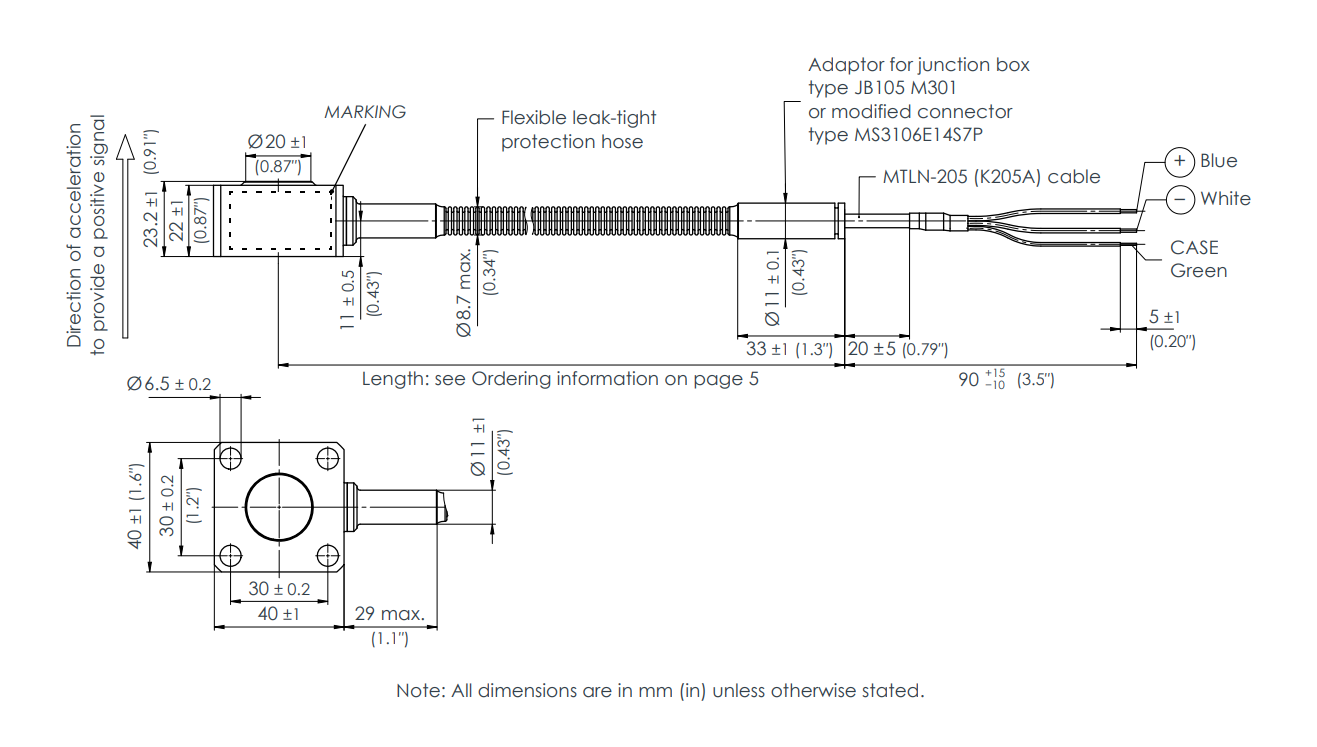
| Cable Length | 3 meters | Suitable for typical hazardous area wiring to a junction box | |
| Cable Construction | Twisted-pair shielded low-noise cable, sheathed in stainless steel flexible braided hose | ||
| Mounting | 4 x M6 x 35 socket head cap screws, with 4 x M6 spring lock washers Mounting Torque: 15 N·m Note: Electrical insulation of mounting surface is not required. | ||
| Electrical Interface | Flying leads (stripped wire cores) at cable end | For Intrinsic Safety loop connection; use appropriate terminals. | |
| Safety Parameters (Typical, refer to certificate) | Maximum Input Voltage (Ui) | e.g., 30 Vdc | Maximum voltage that can be applied from safe area |
| Maximum Input Current (Ii) | e.g., 100 mA | ||
| Maximum Input Power (Pi) | e.g., 0.75 W | ||
| Internal Capacitance (Ci) | See "Capacitance" row | ||
| Internal Inductance (Li) | Negligible (≤1 µH) | ||
| Permitted Cable Parameters | Max. Cable Capacitance (Cc): Determined by barrier parameter calculation Max. Cable Inductance (Lc): Determined by barrier parameter calculation | Loop calculation is mandatory to ensure total stored energy is safe. | |
| Quality & Compliance | Factory Calibration | Dynamic calibration performed at 5g peak, 120Hz, 23°C. | |
| Other Compliance | EMC: EN 61000-6-2, -6-4 Electrical Safety: EN 61010-1 Environmental: RoHS Compliant |
| Specification Category | Parameter | Detailed Specification | Conditions, Remarks & Safety Notes |
|---|---|---|---|
| Product Identification | Model | CA202 (Explosion-Proof Intrinsic Safety Ex ia) | Meggitt vibro-meter Product Line |
| Ordering Number (PNR) | 144-202-000-105 | Key Identifier: Ex ia Explosion-Proof Version, 3m Cable | |
| Explosion Protection Type | Intrinsic Safety “ia” | Permitted for use in Zone 0, 1, 2 (Gas) | |
| Equipment Protection Level (EPL) | Ga (for Gas Atmospheres) | Provides a very high level of protection | |
| Electrical Output | Charge Signal | Differential output, 2-wire, insulated from case, Intrinsically Safe | |
| Associated Apparatus Requirement | Must be connected to a certified intrinsic safety barrier (e.g., Meggitt GSI series) or an IS-rated charge amplifier located in a safe area. | Forms a complete Intrinsic Safety loop | |
| Performance Parameters | Sensitivity (Nominal) | 100 pC/g | At 23°C, 120Hz, 5g conditions |
| Sensitivity Tolerance | ±5% | ||
| Measurement Range | 0.01 to 400 g (peak) | ||
| Overload Protection (Transient) | Up to 500 g (peak) | ||
| Linearity | ±1% (0.01-20g peak) ±2% (20-400g peak) | ||
| Transverse Sensitivity Ratio | ≤ 3% | ||
| Mounted Resonant Frequency | > 22 kHz (typical) | ||
| Frequency Response (±5%) | 0.5 Hz to 6000 Hz | ||
| Insulation Resistance (Internal) | ≥ 1 x 10⁹ Ω | Signal terminal to case, minimum | |
| Capacitance | Sensor Body (Ci): Pole-Pole: ~5000 pF Pole-Case: ~10 pF Cable Distributed Capacitance (Cc, per meter): Pole-Pole: ~105 pF/m Pole-Case: ~210 pF/m | Ci and Cc are critical parameters for Intrinsic Safety loop calculation and must match the barrier parameters. | |
| Environmental, Ex-Proof & Construction | Ambient Temperature (Ta) | Sensor Head: -55°C to +260°C Integral Cable: -55°C to +200°C | Note: Ambient temperature affects the temperature class (T-Code). |
| Temperature Class (T-Code) | T6 to T2 (depending on ambient temperature Ta) | T6: Ta ≤ 85°C, T5: Ta ≤ 100°C, T4: Ta ≤ 135°C, T3: Ta ≤ 200°C, T2: Ta ≤ 260°C | |
| Construction & Materials | Housing/Hose: Stainless Steel, hermetically welded Sealing: Resistant to moisture, water, oil, corrosion. | ||
| Equipment Category/Zone | II 1G (per ATEX) | Suitable for Gas Atmospheres Zone 0, 1, 2 | |
| Gas Group | IIC | Includes hydrogen, acetylene, etc. | |
| Ex Marking (Example) | Ex ia IIC T6...T2 Ga | ||
| Primary Ex Certifications | ATEX: LCIE 02 ATEX 6179 X IECEx: IECEx LCI 10.0018X North America: cCSAus 70004630 (Class I, Div 2 & Zone 2, AEx na) UK UKEX: CML 22 UKEX 2746 X Russia: EA3C RU C-CH.AA07.B.03042/21 | The "X" marking indicates special conditions for safe use which must be strictly followed as per certificate annex. | |
| Physical & Mounting | Material | Stainless Steel | |
| Weight | Sensor: Approx. 250 grams Cable: Approx. 135 grams/meter | ||
| Cable Length | 3 meters | Suitable for typical hazardous area wiring to a junction box | |
| Cable Construction | Twisted-pair shielded low-noise cable, sheathed in stainless steel flexible braided hose | ||
| Mounting | 4 x M6 x 35 socket head cap screws, with 4 x M6 spring lock washers Mounting Torque: 15 N·m Note: Electrical insulation of mounting surface is not required. | ||
| Electrical Interface | Flying leads (stripped wire cores) at cable end | For Intrinsic Safety loop connection; use appropriate terminals. | |
| Safety Parameters (Typical, refer to certificate) | Maximum Input Voltage (Ui) | e.g., 30 Vdc | Maximum voltage that can be applied from safe area |
| Maximum Input Current (Ii) | e.g., 100 mA | ||
| Maximum Input Power (Pi) | e.g., 0.75 W | ||
| Internal Capacitance (Ci) | See "Capacitance" row | ||
| Internal Inductance (Li) | Negligible (≤1 µH) | ||
| Permitted Cable Parameters | Max. Cable Capacitance (Cc): Determined by barrier parameter calculation Max. Cable Inductance (Lc): Determined by barrier parameter calculation | Loop calculation is mandatory to ensure total stored energy is safe. | |
| Quality & Compliance | Factory Calibration | Dynamic calibration performed at 5g peak, 120Hz, 23°C. | |
| Other Compliance | EMC: EN 61000-6-2, -6-4 Electrical Safety: EN 61010-1 Environmental: RoHS Compliant |

