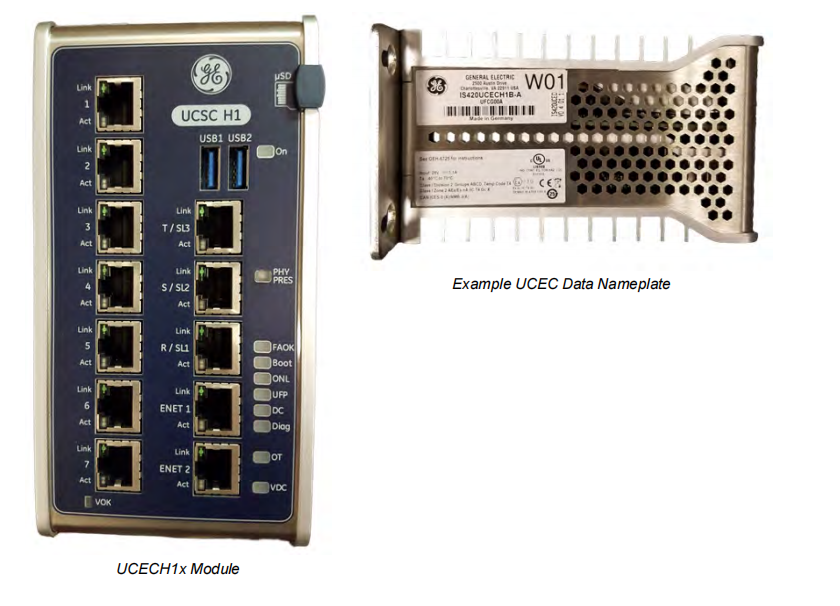
The UCSCH1A controller is a core component of GE's Mark VIe control system and a high-end model within the UCSC controller family. It is a compact, self-contained modular controller designed for high-speed, high-reliability industrial applications, widely used in gas turbines, steam turbines, wind turbines, combined-cycle power plants, and various factory automation scenarios.
Compared to basic controllers, the core advantage of the UCSCH1A lies in its integrated and virtualized architecture. It is not only a powerful real-time control engine but also, through its internally integrated Embedded PROFINET Gateway (Embedded PPNG) module, achieves native communication capability with PROFINET I/O devices. This "All-in-One" design philosophy simplifies the system architecture, reduces dependence on external hardware, and enhances the overall system's integration and reliability.
The UCSCH1A utilizes advanced real-time hypervisor technology to create and run multiple independent Virtual Machines (VMs) on a single physical controller, enabling it to simultaneously host critical functions such as the Mark VIe control application, the Embedded Field Agent (EFA), and the Embedded PROFINET Gateway. It is an ideal platform for building modern, intelligent, and networked control systems.
II. Detailed Core Functions and Operational Principles
The functionality and principles of the UCSCH1A are key to its differentiation from other controllers. Its design philosophy is to achieve functional integration and security isolation through virtualization technology on a single hardware platform. The following sections provide an in-depth analysis of its core functions and underlying operational mechanisms.
1. Virtualized Architecture and Real-Time Operating System
Functional Description:
The UCSCH1A is a quad-core controller that uses real-time hypervisor technology to virtualize and partition physical hardware resources (CPU, memory, network interfaces), thereby creating multiple isolated virtual machine environments. Each VM can run an independent operating system and application, as if running on multiple separate computers.
Operational Principle:
Hardware Abstraction Layer: The hypervisor, as the lowest-level software, runs directly on the controller hardware and is responsible for scheduling CPU cores, allocating memory, and managing hardware interrupts. It provides a consistent, virtualized view of the hardware to the upper-layer VMs.
Virtual Machine Isolation: On the UCSCH1A, a typical configuration runs the following VMs:
Mark VIe Control VM: Runs QNX Neutrino RTOS, a recognized, highly reliable real-time operating system. QNX is responsible for executing all critical process control logic. Its microkernel architecture and deterministic task scheduling ensure that control tasks are completed within strictly defined time cycles, meeting the extreme real-time requirements of industrial control.
Embedded PROFINET Gateway VM: Runs another operating system environment optimized specifically for the PROFINET protocol stack, dedicated to handling communication with the PROFINET network.
Embedded Field Agent VM: Runs a Linux system to host the EFA application.
Virtual Network: To enable data exchange between these VMs, a virtual network is established inside the UCSCH1A. This network is not a physical Ethernet cable but a high-speed data channel implemented in memory through shared memory and virtual switch technology. For example, when the Mark VIe control application needs data read from PROFINET devices for control calculations, this data is transferred from the PPNG VM to the Mark VIe VM via the internal virtual network, which is far more efficient than traditional physical network communication.
Core Value: The virtualized architecture achieves "multiple machines in one," reducing hardware costs and system complexity. Simultaneously, fault isolation is crucial—even if the EFA VM experiences a software issue, the critical control logic running on QNX remains unaffected and continues to execute stably, significantly enhancing system resilience and availability.
2. IONet and Deterministic Control
Functional Description:
As a Mark VIe controller, the UCSCH1A communicates with distributed I/O modules via IONet, a dedicated, deterministic industrial Ethernet network, to accomplish process data acquisition and control command output.
Operational Principle:
Dedicated Network: IONet is a closed, private network that only allows GE's Mark series I/O modules and controllers to connect. This closed nature prevents unauthorized access and broadcast storms from enterprise IT networks or external devices, ensuring the purity and security of the control network.
Precision Clock Synchronization: IONet uses the IEEE 1588 Precision Time Protocol (PTP). The controller acts as the master clock, periodically sending synchronization messages over the network to synchronize the clocks of all connected I/O modules with itself, with an error controlled within ±100 microseconds. This extremely high level of timing consistency is the foundation for:
Synchronous Data Acquisition: All I/O modules can "snapshot" input signals at the same moment, providing the control system with a globally consistent data view in time, which is crucial for analyzing complex interlocking events.
Deterministic Control Loops: The controller's scan cycle and I/O data update cycles are all aligned with this synchronized clock, ensuring strict periodicity for control logic execution and data exchange, eliminating the uncertainty caused by timing jitter in traditional asynchronous systems.
Redundant Data Paths: In redundant configurations (Dual or TMR), all I/O networks (R, S, T) are connected simultaneously to every controller. This means each controller independently receives all input data. This architecture ensures that no input data is lost when a single controller is powered down for maintenance or fails, achieving no single point of input loss and guaranteeing control continuity at the communication level.
3. Embedded PROFINET Gateway
Functional Description:
This is a signature feature of the UCSCH1A. It can function as a PROFINET IO-RT V2.2 Class A I/O Controller without requiring an external gateway hardware, directly connecting to and managing third-party I/O devices that support the PROFINET protocol (such as RSTI-EP Slice I/O).
Operational Principle:
Data Mapping and Exchange: The PPNG VM acts as a protocol translator. It maps data points from external PROFINET I/O devices (e.g., digital inputs, analog outputs) into the Mark VIe controller's internal variable space. After control engineers configure this mapping relationship in the ToolboxST software, they can directly reference these PROFINET data points in the control logic just like native I/O variables.
Asynchronous Data Flow: The data update cycle of the PROFINET network is asynchronous with the Mark VIe controller's scan cycle. The PPNG VM independently performs cyclic data exchange with PROFINET devices at a configurable update rate (1ms to 512ms). It then batches the latest data to the Mark VIe control VM via the aforementioned internal virtual network. This asynchronous design prevents slower PROFINET devices from delaying critical control loops.
Communication Relationship Establishment: Before communication begins, the PPNG establishes three types of Communication Relationships (CRs) with each PROFINET device:
Record Data CRs: Used for non-real-time data transfer, such as device parameter configuration and diagnostic information reading.
IO Data CRs: Used for real-time, cyclic exchange of process data (inputs/outputs), which is the core of the control function.
Alarm Data CRs: Used for transmitting real-time alarms and event information from the device.
Network Separation: Starting from ControlST V07.04, the UCSCH1A supports physical separation of the IONet and PROFINET networks. The PPNG VM communicates with the Mark VIe control VM via internal IONet switches, while externally it uses the dedicated ENET2 port to connect to the PROFINET network. This separation enhances network security and manageability.
4. Embedded Field Agent
Functional Description:
The EFA is the bridge connecting the industrial edge to the Predix cloud platform. It runs in a Linux VM on the UCSCH1A, responsible for securely collecting machine data and transmitting it to the cloud, while also serving as an edge computing platform for locally running cloud-based applications.
Operational Principle:
Secure Data Collection and Upload:
Data Access: The EFA securely obtains real-time data from the Mark VIe control VM in a read-only manner via the internal virtual network. Firewall rules ensure the control network cannot be accessed in reverse by the EFA.
Data Processing: The EFA caches, compresses, and encrypts the collected data, preserving its timestamp and quality identifier.
Secure Transmission: Data is securely transmitted to Predix cloud platform datastores and services via encrypted protocols like HTTPS, using the bottom IICS Cloud Port.
Edge Computing: The EFA allows so-called "Predix edge apps" to run locally on the controller. These apps can perform real-time analysis, inference, or execute lightweight optimization algorithms directly at the data source. This enables the "Intelligent Edge," distributing computing load to the most appropriate location—low-latency logic executes at the edge, while big data analytics and long-term historical storage occur in the cloud.
Remote Access Channel: The EFA provides authorized users with a secure channel to access controller data via the internet, supporting remote monitoring and diagnostics using laptops or mobile devices.
5. Redundancy and High Availability Principles
Functional Description:
The UCSCH1A supports Simplex, Dual, and TMR configurations to meet the stringent availability requirements of different applications.
Operational Principle: