GE
IS200TBAOH1C(IS200TBAOH1CCB)
$4300
In Stock
T/T
Xiamen
| Availability: | |
|---|---|
| Quantity: | |
The IS200TBAOH1C is an analog output terminal board specifically designed for industrial control systems. It is used in conjunction with the PAOC Analog Output Module to provide 16 independent 0–20 mA current output channels. This terminal board is compatible with the Mark VIe and Mark VIeS control systems and is widely used in industrial automation fields such as power generation, process control, and heavy machinery. It offers high reliability, high precision, and excellent noise immunity.
The IS200TBAOH1C features a modular design, supports Simplex operation (non-redundant), has a compact structure, allows flexible installation suitable for standard control cabinets, and provides reliable field wiring interfaces via barrier-type terminal blocks.
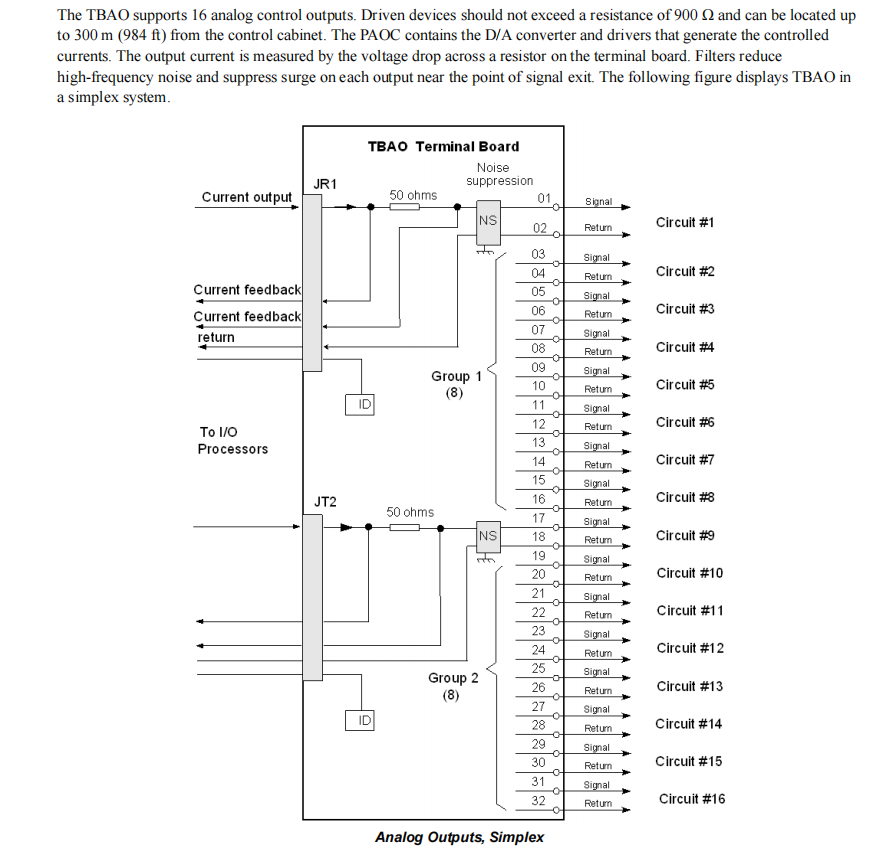
The IS200TBAOH1C provides 16 independent 0–20 mA analog current output channels. Each output is single-ended (one side connected to common) and is suitable for driving various industrial devices such as actuators, variable frequency drives, and recorders.
Each output channel supports a load resistance of up to 900 Ω, with an output voltage compliance of 18 V. This ensures stable output of the standard current signal even over long distances or with high-impedance loads.
Each output channel is equipped with high-frequency noise filtering and surge suppression circuits. This effectively prevents transient overvoltages caused by electromagnetic interference, lightning, or switching operations in the field, enhancing system reliability in harsh industrial environments.
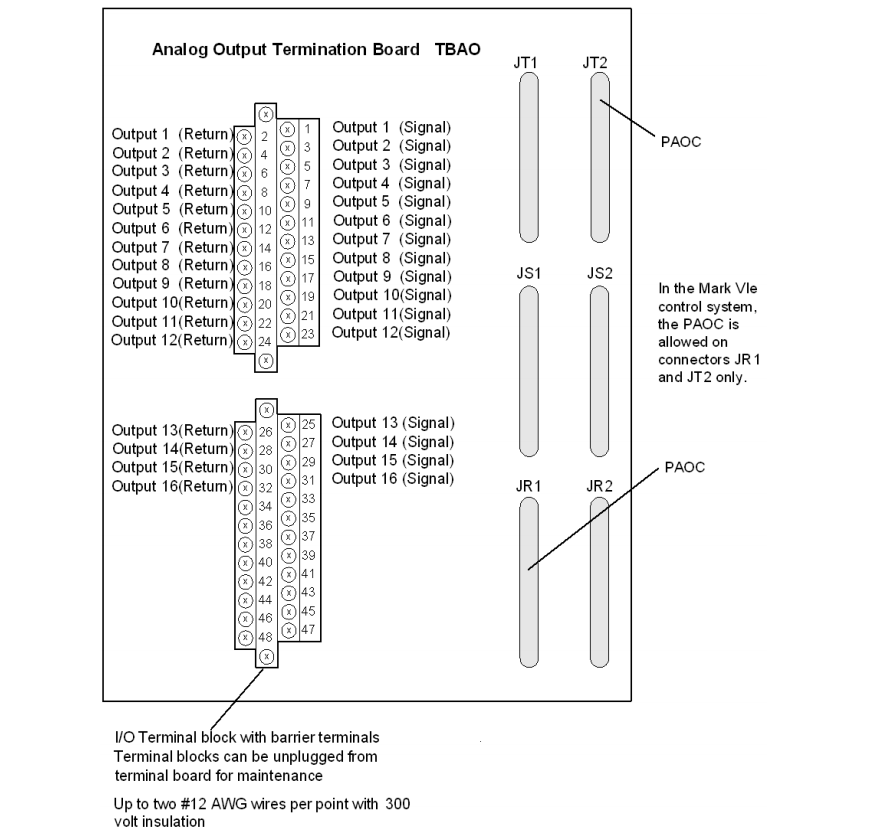
The IS200TBAOH1C is equipped with two barrier-type terminal blocks. Each block provides 24 connection points, supporting the signal and return lines for up to 16 output channels. Each connection point can accommodate two 3.0 mm² (#12 AWG) wires with 300 V insulation, accepting ring or fork terminals.
A shield grounding terminal is located immediately to the left of each terminal block for connecting cable shields, effectively suppressing common-mode noise and improving signal integrity.
The board interfaces directly with PAOC I/O modules via six D-type connectors (e.g., JR1, JT2), enabling quick installation and replacement. The connectors incorporate ID chips for automatic system identification and diagnostics.
The IS200TBAOH1C itself does not generate signals; its core function is to act as a signal conditioning and interface hub between the upstream PAOC module and field actuators. The operational principle is as follows:
Signal Source: The PAOC module generates the 0–20 mA current signals via its internal 16-bit Digital-to-Analog Converter (DAC).
Signal Transmission: The current signals are transmitted to the IS200TBAOH1C terminal board via the DC-37 pin connector.
Output Drive: The IS200TBAOH1C routes the current signals to field devices via the barrier terminals.
Feedback Monitoring: Each output channel has a 50 Ω precision resistor in series on the terminal board. This resistor converts the output current into a voltage signal, which is then monitored in real-time by the PAOC module's 16-bit Analog-to-Digital Converter (ADC) for closed-loop verification.
The PAOC module calculates the actual output current in real-time by measuring the voltage drop across the 50 Ω resistor. If the deviation between the measured current and the commanded value exceeds a set threshold (configured via the D/A_ErrLimit parameter), the system triggers a "Feedback Unhealthy" alarm (e.g., Alarms 32–39). Depending on the configuration, the "Suicide Relay" may be activated to disable the output, preventing erroneous operation or device damage.
Each output channel is equipped with a Normally Open (NO) mechanical relay, known as a "Suicide Relay." Its functions are:
Normal Operation: The relay is closed, completing the output circuit.
Fault Condition: Upon detection of an output fault (e.g., overcurrent, communication loss, hardware error), the relay opens, disconnecting that output channel to prevent hazardous signals from reaching the field device.
Status Feedback: The relay includes an auxiliary contact used to provide feedback on its actual state to the PAOC module, allowing the system to confirm whether the relay has operated correctly.
The IS200TBAOH1C incorporates LC filters at each output, consisting of inductor-capacitor networks forming low-pass filters to suppress high-frequency noise. Additionally, Transient Voltage Suppressors (TVS) are installed on the board to absorb surge voltages and protect downstream circuits.
Each connector is integrated with a read-only ID chip storing the following information:
Terminal Board Serial Number
Board Type (e.g., IS200TBAOH1C)
Revision Number
Connector Location Identifier (e.g., JR1, JT2)
The PAOC module reads this information during startup and compares it against the system configuration. A mismatch triggers a "Hardware Incompatibility" fault, preventing the use of incorrect hardware.
Communication: The IS200TBAOH1C communicates with the controller via the PAOC module over Ethernet (IONet), supporting single or dual network connections (ENET1/ENET2).
Power Supply: The PAOC module receives 28 V DC power through a 3-pin power connector and supplies the necessary operating voltage to the terminal board.
Mount the IS200TBAOH1C securely onto a vertical mounting plate.
Use the dedicated side mounting brackets to install the PAOC module(s), ensuring the DC-37 connectors are aligned and fully seated.
Secure the I/O module(s) using the threaded studs, avoiding any right-angle force on the connector.
Use the barrier terminal blocks to connect the 16 analog output signals.
Each output channel requires connections to both the "Signal" and "Return" terminals.
Shielded twisted pair cable is recommended, with the shield connected to the nearby shield grounding terminal.
Maximum Wiring Distance: 300 meters (984 feet), suitable for most industrial applications.
The output current is monitored in real-time via the 50 Ω sense resistor, with the PAOC module continuously comparing the actual value against the command.
If the current is abnormal (e.g., exceeds 30 mA), the system triggers an "Excessive Output Current" alarm (e.g., Alarms 54–61) and may automatically disable the output.
A discrepancy between the suicide relay command and its feedback status triggers a "Relay Non-Functional" alarm (e.g., Alarms 62–69), indicating a potential relay failure.
The PAOC module contains an internal temperature sensor. If the module temperature exceeds the safe threshold (e.g., 90°C for PAOCH1B), a temperature alarm (Alarm 78) is triggered, prompting a check of cooling or environmental controls.
The IS200TBAOH1C is an analog output terminal board specifically designed for industrial control systems. It is used in conjunction with the PAOC Analog Output Module to provide 16 independent 0–20 mA current output channels. This terminal board is compatible with the Mark VIe and Mark VIeS control systems and is widely used in industrial automation fields such as power generation, process control, and heavy machinery. It offers high reliability, high precision, and excellent noise immunity.
The IS200TBAOH1C features a modular design, supports Simplex operation (non-redundant), has a compact structure, allows flexible installation suitable for standard control cabinets, and provides reliable field wiring interfaces via barrier-type terminal blocks.
The IS200TBAOH1C provides 16 independent 0–20 mA analog current output channels. Each output is single-ended (one side connected to common) and is suitable for driving various industrial devices such as actuators, variable frequency drives, and recorders.
Each output channel supports a load resistance of up to 900 Ω, with an output voltage compliance of 18 V. This ensures stable output of the standard current signal even over long distances or with high-impedance loads.
Each output channel is equipped with high-frequency noise filtering and surge suppression circuits. This effectively prevents transient overvoltages caused by electromagnetic interference, lightning, or switching operations in the field, enhancing system reliability in harsh industrial environments.
The IS200TBAOH1C is equipped with two barrier-type terminal blocks. Each block provides 24 connection points, supporting the signal and return lines for up to 16 output channels. Each connection point can accommodate two 3.0 mm² (#12 AWG) wires with 300 V insulation, accepting ring or fork terminals.
A shield grounding terminal is located immediately to the left of each terminal block for connecting cable shields, effectively suppressing common-mode noise and improving signal integrity.
The board interfaces directly with PAOC I/O modules via six D-type connectors (e.g., JR1, JT2), enabling quick installation and replacement. The connectors incorporate ID chips for automatic system identification and diagnostics.
The IS200TBAOH1C itself does not generate signals; its core function is to act as a signal conditioning and interface hub between the upstream PAOC module and field actuators. The operational principle is as follows:
Signal Source: The PAOC module generates the 0–20 mA current signals via its internal 16-bit Digital-to-Analog Converter (DAC).
Signal Transmission: The current signals are transmitted to the IS200TBAOH1C terminal board via the DC-37 pin connector.
Output Drive: The IS200TBAOH1C routes the current signals to field devices via the barrier terminals.
Feedback Monitoring: Each output channel has a 50 Ω precision resistor in series on the terminal board. This resistor converts the output current into a voltage signal, which is then monitored in real-time by the PAOC module's 16-bit Analog-to-Digital Converter (ADC) for closed-loop verification.
The PAOC module calculates the actual output current in real-time by measuring the voltage drop across the 50 Ω resistor. If the deviation between the measured current and the commanded value exceeds a set threshold (configured via the D/A_ErrLimit parameter), the system triggers a "Feedback Unhealthy" alarm (e.g., Alarms 32–39). Depending on the configuration, the "Suicide Relay" may be activated to disable the output, preventing erroneous operation or device damage.
Each output channel is equipped with a Normally Open (NO) mechanical relay, known as a "Suicide Relay." Its functions are:
Normal Operation: The relay is closed, completing the output circuit.
Fault Condition: Upon detection of an output fault (e.g., overcurrent, communication loss, hardware error), the relay opens, disconnecting that output channel to prevent hazardous signals from reaching the field device.
Status Feedback: The relay includes an auxiliary contact used to provide feedback on its actual state to the PAOC module, allowing the system to confirm whether the relay has operated correctly.
The IS200TBAOH1C incorporates LC filters at each output, consisting of inductor-capacitor networks forming low-pass filters to suppress high-frequency noise. Additionally, Transient Voltage Suppressors (TVS) are installed on the board to absorb surge voltages and protect downstream circuits.
Each connector is integrated with a read-only ID chip storing the following information:
Terminal Board Serial Number
Board Type (e.g., IS200TBAOH1C)
Revision Number
Connector Location Identifier (e.g., JR1, JT2)
The PAOC module reads this information during startup and compares it against the system configuration. A mismatch triggers a "Hardware Incompatibility" fault, preventing the use of incorrect hardware.
Communication: The IS200TBAOH1C communicates with the controller via the PAOC module over Ethernet (IONet), supporting single or dual network connections (ENET1/ENET2).
Power Supply: The PAOC module receives 28 V DC power through a 3-pin power connector and supplies the necessary operating voltage to the terminal board.
Mount the IS200TBAOH1C securely onto a vertical mounting plate.
Use the dedicated side mounting brackets to install the PAOC module(s), ensuring the DC-37 connectors are aligned and fully seated.
Secure the I/O module(s) using the threaded studs, avoiding any right-angle force on the connector.
Use the barrier terminal blocks to connect the 16 analog output signals.
Each output channel requires connections to both the "Signal" and "Return" terminals.
Shielded twisted pair cable is recommended, with the shield connected to the nearby shield grounding terminal.
Maximum Wiring Distance: 300 meters (984 feet), suitable for most industrial applications.
The output current is monitored in real-time via the 50 Ω sense resistor, with the PAOC module continuously comparing the actual value against the command.
If the current is abnormal (e.g., exceeds 30 mA), the system triggers an "Excessive Output Current" alarm (e.g., Alarms 54–61) and may automatically disable the output.
A discrepancy between the suicide relay command and its feedback status triggers a "Relay Non-Functional" alarm (e.g., Alarms 62–69), indicating a potential relay failure.
The PAOC module contains an internal temperature sensor. If the module temperature exceeds the safe threshold (e.g., 90°C for PAOCH1B), a temperature alarm (Alarm 78) is triggered, prompting a check of cooling or environmental controls.
| Item | Specification |
|---|---|
| Number of Channels | 16 current output channels, single-ended |
| Analog Output Current | 0–20 mA |
| Customer Load Resistance | Up to 900 Ω burden (18 V compliance with PAOC) |
| Output Accuracy | ±0.5% over -30 to 65°C (-22 to 149°F) and 0 to 900 Ω load ±0.25% typical at 25°C (77°F) and 500 Ω load |
| D/A Converter Resolution | 16-bit (in PAOC module) |
| Frame Rate | 100 Hz on all outputs (via PAOC module) |
| Wiring | Barrier terminal blocks, accepts 2x #12 AWG wires per point, 300 V insulation |
| Shield Connection | Dedicated shield grounding terminals |
| Connectors | Six D-type connectors for PAOC modules (e.g., JR1, JT2) |
| Dimensions (H x W) | 33.02 cm high x 10.16 cm wide (13.0 in x 4.0 in) |
| Compatible I/O Pack | PAOC (requires 2 packs for 16 outputs) |
| Redundancy | Simplex only |
| Mounting | Vertical mounting plate |
| Item | Specification |
|---|---|
| Number of Channels | 16 current output channels, single-ended |
| Analog Output Current | 0–20 mA |
| Customer Load Resistance | Up to 900 Ω burden (18 V compliance with PAOC) |
| Output Accuracy | ±0.5% over -30 to 65°C (-22 to 149°F) and 0 to 900 Ω load ±0.25% typical at 25°C (77°F) and 500 Ω load |
| D/A Converter Resolution | 16-bit (in PAOC module) |
| Frame Rate | 100 Hz on all outputs (via PAOC module) |
| Wiring | Barrier terminal blocks, accepts 2x #12 AWG wires per point, 300 V insulation |
| Shield Connection | Dedicated shield grounding terminals |
| Connectors | Six D-type connectors for PAOC modules (e.g., JR1, JT2) |
| Dimensions (H x W) | 33.02 cm high x 10.16 cm wide (13.0 in x 4.0 in) |
| Compatible I/O Pack | PAOC (requires 2 packs for 16 outputs) |
| Redundancy | Simplex only |
| Mounting | Vertical mounting plate |