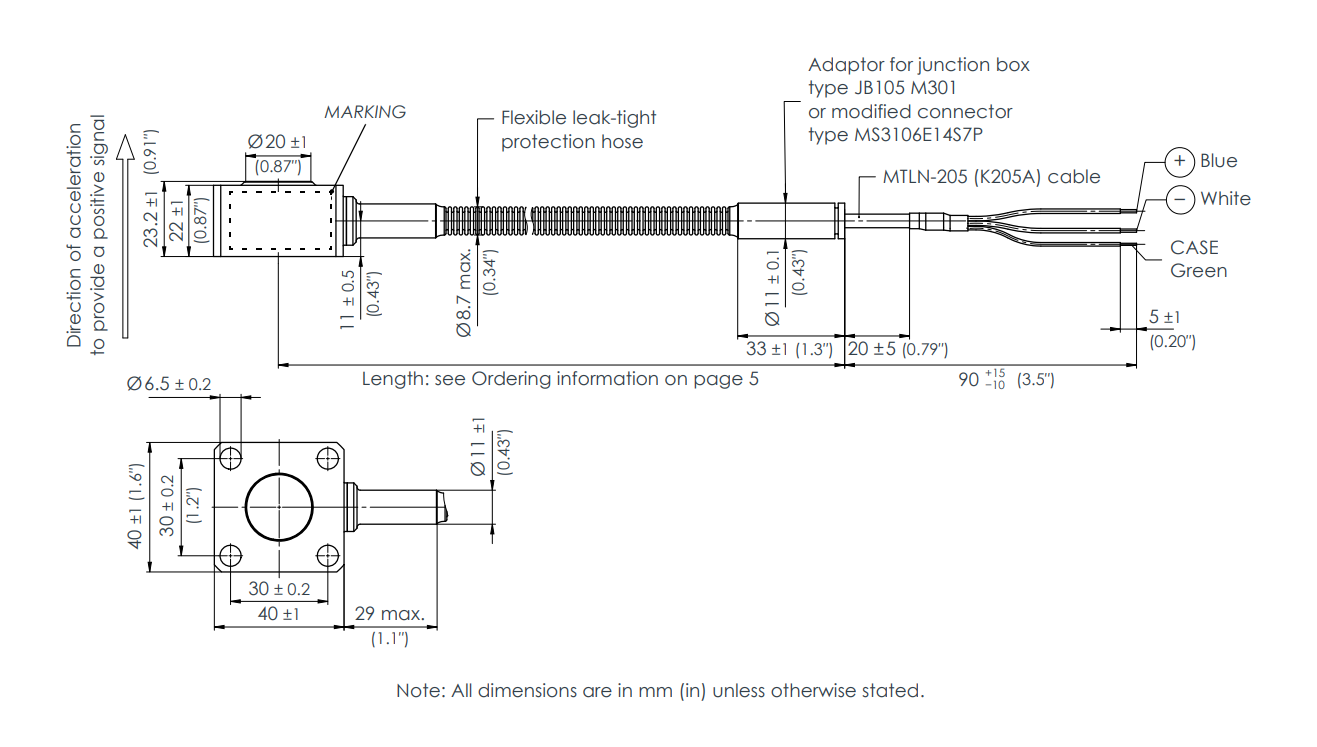
The CA202 piezoelectric accelerometer is a core industrial-grade vibration sensor from Meggitt Sensing Systems' vibro-meter product line, designed for high-precision, highly reliable vibration monitoring in harsh but non-explosive industrial environments. This report details model 144-202-000-206, the standard industrial version equipped with a 3-meter integral cable. This model lacks explosion-proof certification and is suitable for a wide range of industrial sectors where potentially explosive atmospheres are not present, such as conventional power plants, water facilities, general manufacturing, building infrastructure, and R&D test benches. It provides a proven, robust solution for equipment condition monitoring, predictive maintenance, and vibration analysis.
Inheriting the core technical DNA of the CA202 series, this sensor employs a shear-mode polycrystalline piezoelectric sensing element and full internal case isolation design, ensuring excellent signal stability and interference immunity. Its signature feature is the integration of the austenitic stainless steel sensor housing with a high-temperature resistant stainless steel protection hose via fully hermetic welding, forming a robust, leak-proof monolithic measurement unit. This design allows it to handle common industrial challenges like high humidity, water splash, oil, dust, and general chemical corrosion with ease, delivering long-term stable performance.
As a reliable sensing node in Industrial IoT vibration monitoring networks, the CA202-206 works seamlessly with vibro-meter charge amplifiers (IPC series) and upper-level monitoring systems, forming a complete chain from field sensing to data insight. Its 3-meter cable length provides ample flexibility for mounting near most industrial equipment, making it an ideal foundational component for building cost-effective, high-performance condition monitoring systems.
2. Core Advantages and Value Proposition
Exceptional Industrial-Grade Reliability & Environmental Tolerance:
Wide Operating Temperature Range: The sensing head operates from -55°C to +260°C, and the cable withstands -55°C to +200°C, enabling it to serve a broad spectrum of applications from refrigeration equipment to high-temperature fan and pump bearing housings.
Fully Welded Sealed Construction: The welded, sealed connection between sensor and cable completely eliminates failure risks at junctions caused by vibration or corrosion. Its protection level far exceeds that of connector-type sensors relying on elastomeric seals, resulting in minimal maintenance needs over its lifecycle.
Outstanding Measurement Performance & Signal Fidelity:
High Sensitivity & Wide Bandwidth: A nominal sensitivity of 100 pC/g provides a solid foundation for detecting weak vibration signals. A flat frequency response from 0.5 Hz to 6 kHz (±5%) allows it to monitor both the fundamental frequencies of low-speed rotating equipment and accurately capture high-frequency components caused by gear mesh or bearing defects.
Excellent Dynamic Characteristics: A linear measurement range up to 400g and a resonant frequency greater than 22kHz ensure the sensor's output signal remains true and accurate even under complex operating conditions with impacts or broad-spectrum vibration, with linearity error less than ±1%.
Strong Anti-Interference Capability: The symmetrical differential output design and high internal insulation resistance (≥1GΩ) effectively suppress the impact of ground loops and electromagnetic interference on the measurement signal.
Optimized Design & Cost-Effectiveness for Non-Explosive Applications:
Simplified System Integration: As a standard version, it does not require compliance with complex intrinsic safety system design rules (e.g., safety barrier calculations, entity isolation). It can connect directly to standard industrial charge amplifiers and data acquisition systems, enabling faster, lower-cost system implementation.
Easy Installation & Maintenance: The 3-meter cable length is suitable for the distance between most machine measurement points and nearby junction boxes or amplifier mounting locations, reducing the complexity and cost associated with long cable runs.
Global Versatility: Compliance with international standards like CE and RoHS eliminates the need for additional approvals or adaptations for region-specific explosion-proof certifications, simplifying procurement and deployment processes.
Plug-and-Play Convenience:
Factory Precision Calibration: Each sensor is dynamically calibrated under standard conditions (5g, 120Hz), with calibration data provided, ensuring nominal accuracy out-of-the-box and greatly simplifying on-site commissioning and calibration work.
Robust Mechanical Design: The heavy-duty stainless steel housing and armored cable withstand harsh installation environments and continuous operational vibration, reducing failure rates due to physical damage.
3. Working Principle and Technical Explanation
The CA202-206 is a high-impedance charge output piezoelectric accelerometer. Its core is a shear-mode piezoelectric sensing assembly. When subjected to axial vibration, the internal seismic mass applies a shear force to the piezoelectric crystal, causing it to deform.
Based on the direct piezoelectric effect, the charge distribution within the crystal changes, generating a charge quantity (Q) on its electrode faces that is strictly proportional to the applied mechanical stress (i.e., acceleration). This relationship is: Q = S * a, where S is the charge sensitivity (100 pC/g) and *a* is the vibration acceleration (g). This charge signal has high impedance and high output impedance characteristics.
Therefore, a dedicated charge amplifier (e.g., IPC70x) is required for signal conditioning. The charge amplifier is a circuit with extremely high input impedance. Its core functions are:
Charge-to-Voltage Conversion: Provides a near-ideal "virtual ground" for the sensor, linearly converting the weak charge signal into a voltage signal.
Voltage-to-Current Conversion/Driving: Vibro-meter® amplifiers typically further convert the voltage signal into a highly interference-resistant 2-wire 4-20 mA current loop signal. Advantages of this technology include:
Superior Noise Immunity: Current signals are insensitive to transmission line resistance and less susceptible to electromagnetic noise.
Long-Distance Transmission: Can be transmitted hundreds to thousands of meters using ordinary twisted pair cable.
Combined Power & Signal: Only two wires simultaneously provide excitation to the front-end sensor (via the amplifier) and return the signal.
The final 4-20 mA signal can be directly connected to PLC or DCS modules supporting current input, or converted to a voltage signal via a signal conditioning card before being fed into a data acquisition system or dedicated vibration monitoring system (e.g., VM600) for storage, analysis, and alarming.
The significance of choosing the standard CA202-206 is that for the vast majority of non-explosive industrial applications, it offers the same core sensing performance, mechanical robustness, and environmental tolerance as the explosion-proof versions, while avoiding the increased system complexity and additional costs associated with explosion-proof certification, achieving the best cost-performance ratio.
4. Typical Application Scenarios
Leveraging its robustness, wide temperature range, and high performance, the CA202-206 standard version is widely used in the following non-explosive industrial sectors:
Power & Energy (Non-Hazardous Areas):
Thermal Power Plants: Vibration monitoring of bearings on steam turbines, generators, feedwater pumps, fans, coal mills, and other auxiliary equipment.
Hydroelectric Power Plants: Vibration monitoring of water turbine guide bearings, thrust bearings, and governor systems.
Wind Farms: Condition monitoring of gearboxes, generators, main bearings (in non-explosive areas of the nacelle).
Nuclear Power Plant Conventional Island: Rotating equipment like pumps and fans.
General Manufacturing & Process Industries:
Paper Machinery: Bearing monitoring on dryers, calenders, winders.
Printing Machinery.
Food & Beverage Processing Equipment (suitable for clean environments).
Plastic Extruders, Injection Molding Machines.
Heavy Equipment & Transportation:
Marine Propulsion System (main engine, gearbox) monitoring.
Locomotive Traction Motors, Compressor monitoring.
Key rotating components of large construction machinery (mine trucks, excavators).
Infrastructure & Utilities:
Building HVAC Systems: Vibration monitoring of large cooling tower fans, chillers, pumps.
Water Treatment Plants: Large pumps, blowers.
Bridge and Building Structural Health Monitoring.
Research & Development Testing:
5. Installation, Wiring & Commissioning Guidelines
5.1 Installation Planning
Measurement Point Selection: Choose locations with good rigidity, preferably on bearing housings. Ensure the surface is clean and flat. The measurement direction should align with the sensor's sensitivity axis (indicated by arrow on housing).
Cable Route: Plan the route for the 3-meter cable. Avoid proximity to high-temperature heat sources (>200°C) and strong EMI sources (e.g., VFD output cables, high-current busbars). Allow adequate slack.
5.2 Mechanical Installation
Surface Preparation: The mounting surface should be smooth and flat. If necessary, machine a small flat area with a recommended roughness of Ra 3.2 μm or better.
Installation Steps:
Use the supplied or specification-compliant M6 x 35 socket head cap screws and spring lock washers.
A small amount of medium-strength thread-locking adhesive (e.g., Loctite 243) can be applied to the screw threads to prevent vibration loosening.
Using a torque wrench, tighten all four screws evenly in a crisscross pattern in two steps (e.g., first to 8 N·m, then to 15 N·m). Do not over-torque.
5.3 Cable Handling
Bend Protection: During installation, the cable's minimum bending radius must not be less than 50 millimeters. Form a smooth strain relief loop at the sensor exit.
Fixing: Use cable clamps or ties to secure the cable to cable trays or the machine body every 0.5-1 meters, avoiding dangling or flapping.
Grounding: Implement single-point grounding. Typically, ground the cable shield at the Charge Amplifier (IPC) terminal. Ensure the ground connection is reliable, with a short and thick ground wire. The sensor mounting base is grounded via the equipment body.
5.4 Electrical Connection
Connect to Amplifier: Correctly connect the CA202 cable's flying leads (typically red/white for signal, shield braid for ground) to the designated input terminals of the IPC charge amplifier. Tighten the terminal screws.
Connect to Downstream System: Connect the amplifier's output (typically 4-20mA) to the corresponding input channel of the data logger, PLC, or vibration monitoring system.
Power-Up Check: After connections are complete, verify the wiring is correct, then power up the system. Observe the amplifier status indicators.
5.5 Commissioning & Verification
Channel Test: Observe the vibration signal for this channel in the monitoring software. Gently tapping near the sensor mounting base with a hand hammer or rubber mallet should produce a clear transient pulse signal, confirming the entire signal path is functional.
Baseline Recording: During normal equipment operation, record the vibration baseline values (e.g., velocity RMS, acceleration peak) for each measurement point as a reference for future trend analysis.
6. Maintenance, Diagnostics & Support
Routine Maintenance:
Fault Diagnosis:
No Signal: Check amplifier power supply, and whether sensor wiring is open or short-circuited (measure insulation resistance and continuity).
High Signal Noise: Check if grounding is proper, if the cable is away from interference sources, and if amplifier settings are correct.
Reading Drift or Inaccuracy: Check for loose mounting, and whether the sensor has experienced overload shock. Compare data with similar equipment measurement points.
Recommended Calibration Interval: Under normal operating conditions, a recommended recalibration interval for the sensor itself is 3-5 years, or when its accuracy is suspected to have changed due to overload or other reasons. Calibration must be performed by a professional organization or returned to the manufacturer.
Technical Support: Meggitt SA and its global authorized distribution network provide comprehensive product technical support. Users can obtain the latest product documentation, application notes, and contact local support teams via the official website.