nyban1
You are here: Home » Systems » Sensing System » VM Piezoelectric Accelerometer » Vibro-Meter CA202 144-202-000-236 Piezoelectric Accelerometer
Leave Us A Message

loading

Vibro-Meter CA202 144-202-000-236 Piezoelectric Accelerometer

  • VM

  • CA202 144-202-000-236

  • $10700

  • In Stock

  • T/T

  • Xiamen

Availability:
Quantity:
facebook sharing button
twitter sharing button
line sharing button
wechat sharing button
linkedin sharing button
pinterest sharing button
whatsapp sharing button
kakao sharing button
snapchat sharing button
telegram sharing button
sharethis sharing button

The CA202 piezoelectric accelerometer is a top-tier industrial vibration sensor from Meggitt Sensing Systems' vibro-meter product line, engineered specifically for ultra-long distance, highly reliable vibration monitoring in harsh but non-explosive industrial environments. This comprehensive report introduces model 144-202-000-236, the Standard Industrial Version equipped with a 20-meter integral cable. This model does not possess explosion-proof certification and is designed to meet the requirements of large-scale industrial applications where measurement points are distant from control rooms or junction boxes, and the environment is free from explosive hazards. Typical scenarios include plant-wide auxiliary equipment monitoring in large thermal power plants, centralized monitoring of multiple units in water conservancy hubs, full-process equipment condition management in iron, steel, and metallurgical enterprises, and equipment cluster monitoring in ultra-large commercial building energy centers.


This sensor represents the flagship configuration of the CA202 series for standard industrial applications, perfectly inheriting the core technical essence of the series. It employs a shear-mode polycrystalline piezoelectric sensing element with an internal fully electrically isolated design, ensuring highly symmetrical signal output, excellent linearity, and exceptional common-mode interference rejection. Its most notable feature is the 20-meter factory-integrated low-noise cable. This cable is entirely sheathed in a flexible, high-temperature-resistant stainless steel armored hose and permanently connected to the sensor's stainless steel housing via a fully hermetic welding process. This creates a completely sealed, robust measurement unit with no intermediate connection points from the sensitive element to the cable end. This innovative design fundamentally eliminates risks of signal attenuation, noise introduction, and premature failure inherent in traditional split sensor systems due to poor field wiring, connector corrosion, or seal aging. It sets a new industry benchmark for the original fidelity of ultra-long-distance signal transmission and long-term operational reliability.


As a strategic sensing component for building modern, distributed industrial predictive maintenance systems, the CA202-236 works in deep synergy with the vibro-meter signal conditioning ecosystem (IPC series charge amplifiers, GSI isolators) and upper-level intelligent analysis platforms (e.g., VM600). This enables seamless linking from remote vibration sensing and high-quality, interference-resistant transmission to centralized intelligent diagnostics. The 20-meter cable length represents exceptional engineering freedom, allowing system designers to precisely mount the sensor at the optimal, sometimes even hard-to-access measurement point, while centrally locating the relatively delicate charge amplifiers in a safe, clean, temperature-controlled, and easily maintainable central electrical room or junction cabinet dozens of meters away. This not only significantly enhances the service life and stability of the electronic equipment but also simplifies wiring engineering and reduces long-term operational and maintenance costs. It is the core of a "turnkey" solution for systematic condition monitoring of large, complex industrial facilities.


2. Core Value & Strategic Advantages

  1. Revolutionary Value of Ultra-Long Distance Integrated Architecture:

    • Complete Elimination of Field Splicing Risks: The 20-meter factory-integrated cable means there are no field joints between the sensor and the amplifier input. This avoids issues like varying contact resistance, insulation degradation due to manual wiring process variations, environmental corrosion, or vibration, providing an unparalleled starting point for signal integrity over ultra-long distances.

    • Optimized System Capacitance Consistency: The sensor and 20-meter cable are tested and calibrated as a complete unit at the factory, ensuring consistent and known total capacitance parameters. This simplifies the range configuration of the backend charge amplifier, avoids performance deviations in multi-point monitoring systems caused by using different batches or lengths of cable, and guarantees system consistency.

    • Significant Engineering Economics: Although the individual sensor cost may be higher, it eliminates a series of material and labor costs associated with field-installing long-distance special low-noise cables, intermediate junction boxes, and sealing processes. When evaluated from the perspective of total cost of ownership (TCO) over the entire system lifecycle, it often proves more economical.

  2. Unparalleled Industrial Environmental Durability & Reliability:

    • Full-Chain Operation Under Extreme Temperatures: The sensing head withstands -55°C to +260°C, and the 20-meter integral cable can also operate continuously from -55°C to +200°C. This performance ensures system stability and reliability even across a 20-meter transmission path in hot spot areas like power plant boiler houses or steel mill high-temperature workshops, or in frigid outdoor environments in northern regions.

    • Military-Grade Fully Welded Hermetic Protection: The fully welded hermetic seal from the sensing head to the cable exit provides protection levels exceeding IP68. It does not rely on any dynamic seals, offering inherent immunity to continuous high-pressure water mist, saturated humidity, oil immersion, acid/alkaline atmospheres, and abrasive dust. It is particularly suitable for achieving "maintenance-free" long-term operation in extremely harsh industrial environments.

  3. Top-Tier Measurement Performance Laying the Foundation for Accurate Diagnosis:

    • High Sensitivity & Ultra-Wide Frequency Response: High sensitivity of 100 pC/g ensures the capture of early-stage, weak fault signatures. The flat frequency response from 0.5 Hz to 6 kHz (±5%) enables simultaneous precise analysis of fundamental vibrations in large, low-speed equipment (e.g., cooling tower fans) and complex spectra of high-speed precision components (e.g., gas turbine auxiliary gears), meeting comprehensive needs from online protection to offline precision diagnosis.

    • Exceptional Dynamic Range & Fidelity: A linear measurement range of 400g and a high resonant frequency >22kHz ensure the sensor outputs highly true, undistorted signals under vibration environments with wide amplitude and frequency ranges. A linearity error of ±1% provides a solid foundation for precise quantitative comparison of vibration trends.

    • Powerful Inherent Anti-Interference Characteristics: The differential symmetrical sensing design, extremely high insulation resistance (≥1GΩ), and integral double-layer shielding (sensor housing + cable shield) together construct multiple lines of defense against ground loops, electromagnetic interference, and cable triboelectric noise, ensuring the output of a "clean" signal in complex industrial electromagnetic environments.

  4. Optimized Design & Deployment Advantages for Large-Scale Standard Industrial Facilities:

    • Greatly Simplified System Design & Installation: As a Standard Industrial Version, the CA202-236 does not require intrinsic safety system calculations or safety barriers and can be directly connected to standard industrial I/O systems. The 20-meter cable allows the use of "star" or "hybrid" wiring topologies, directly routing signals from sensors scattered across equipment to regionally centralized junction cabinets, greatly simplifying the complexity of conduit and tray routing.

    • Outstanding Deployment Flexibility & Future Expandability: The 20-meter length provides tremendous installation flexibility for retrofitting older plants or new projects with compact layouts. Even if future equipment layout changes, sufficient cable slack facilitates sensor repositioning, protecting the investment.

    • Barrier-Free Access to Global Markets: The product carries the CE mark, complies with EU EMC and LVD directives, and meets RoHS requirements. It can be directly sold and applied in most global non-explosive industrial markets without additional regional certifications, accelerating the execution of international projects.


3. Working Principle & System Integration Framework

The core of the CA202-236 is a shear-type piezoelectric accelerometer. Its physical essence is the conversion of mechanical vibration energy into electrical energy (charge).

  1. Vibration Input: Vibration from the measured object is transmitted through the rigidly mounted base into the sensor interior.

  2. Electromechanical Conversion: The internal seismic mass applies an alternating shear force to the shear-mode arranged piezoelectric crystal. Based on the direct piezoelectric effect, the crystal generates a surface charge proportional to the applied force (i.e., acceleration).

  3. Signal Output: This high-impedance charge signal (Q) is transmitted directly via the specially designed 20-meter low-noise coaxial cable. This cable is designed to minimize parasitic "triboelectric" noise induced by bending, vibration, or temperature changes.


The key link in system integration is the Charge Amplifier (IPC):

  • Impedance Transformation & Signal Conditioning: The charge amplifier provides near-infinite input impedance, linearly converting the weak charge signal into a low-impedance voltage signal.

  • Anti-Interference Long-Distance Transmission: The IPC typically integrates a V/I converter, outputting the industry-standard 2-wire 4-20 mA current loop signal. Current signals are insensitive to transmission line resistance and have strong electromagnetic interference (EMI) immunity, making them ideal for long-distance (up to 1000+ meters) transmission in industrial settings.

  • Simplified Wiring: Just one pair of twisted wires is needed to simultaneously provide power (loop power) to the front-end sensor-amplifier loop and return the signal, greatly simplifying system wiring.

Finally, the standard 4-20 mA signal is fed into the monitoring system located in the control room, such as a PLC, DCS, or dedicated vibration condition monitoring system (e.g., VM600), for display, recording, analysis, alarming, and diagnosis.


The Deep Engineering Logic Behind Choosing the 20m Standard CA202-236: It achieves the optimal physical separation of the pure sensing head, which tolerates extreme environments, from the precision electronic equipment (amplifier), which is sensitive to the environment. The 20-meter "bridge" allows the electronic equipment to be centrally housed in a well-controlled environment in the control room, while the sensors can be deployed at the frontline, harsh measurement points. This architecture maximizes the reliability, maintainability, and optimizes the lifecycle cost of the electronic system while guaranteeing top-tier measurement performance. It is a model for system design in non-explosive, large-scale projects.


4. Typical Application Areas

With its 20-meter ultra-long cable and top-tier industrial performance, the CA202-236 is the authoritative choice for condition monitoring in the following large-scale, distributed, non-explosive industrial facilities:

  • Large Power Generation Bases (Plant-Wide Auxiliary Equipment Monitoring Networks):

    • Million-kilowatt-class Thermal Power Plants: Dozens or even hundreds of important auxiliary machines spread across the turbine hall, boiler house, dust removal, and desulfurization areas, such as various pumps (feedwater, circulating, condensate, cooling), fans (forced draft, induced draft, primary air, seal air), coal mills, air compressors, etc.

    • Large Hydroelectric Power Stations: Multiple hydro-generator units and their auxiliary systems (technical water supply, drainage, ventilation) within the powerhouse.

    • Nuclear Power Plant Conventional Islands: Clusters of large rotating equipment throughout the building.

  • Process Industries & Heavy Manufacturing (Full-Process Equipment Management):

    • Integrated Iron & Steel Plants: Key fans, pumps, compressors, and main mill drive systems throughout the entire process from sintering, coking, ironmaking, steelmaking to rolling.

    • Large Cement Production Lines: Important equipment across the entire line from raw material crushing, raw meal grinding, rotary kiln to cement grinding and packing.

    • Petrochemicals (Non-Hazardous Areas): Large pumps in circulating water fields, cooling tower fans, air separation units, and large equipment in utility stations.

  • Ultra-Large Infrastructure & Campuses:

    • District Energy Centers / Central Plants: Central chillers, chilled water pumps, cooling tower clusters, and gas boilers providing energy for urban complexes or data center clusters.

    • Large Municipal Water Systems: Intake and delivery pump house clusters in water treatment plants; influent pump houses, aeration blower houses, and sludge treatment workshops in wastewater treatment plants.

    • Transportation Hubs: Core equipment in energy centers and HVAC systems of international airports and large high-speed rail stations.

  • Marine & Offshore (Non-Hazardous Areas):

    • Main propulsion diesel engines, generator sets, and large circulating pump groups in the engine rooms of large cruise ships, cargo vessels, and engineering ships.

  • Testing & Certification Institutions:

    • Foundation measurements for large structural laboratories or shaker tables requiring long lead wires.


5. Installation, Commissioning & Lifecycle Management Guide

5.1 Preliminary Planning & Design

  1. System Topology Design: Utilize the advantage of the 20-meter cable to plan "sensor → regional field junction box" star or trunk wiring. Define the path for each cable, avoiding long parallel runs with high-voltage, high-current power cables (recommended spacing >0.5 meters).

  2. Amplifier Location Selection: Choose areas with low vibration, suitable temperature/humidity, and low electromagnetic interference to centrally install charge amplifiers (IPC). Calculate the required input capacitance range for the amplifier to ensure it covers the total capacitance of the sensor + 20m cable.

5.2 Sensor Installation (Foundation of Accuracy)

  1. Mounting Surface Preparation: This is a critical step. The surface must be clean, flat (recommended flatness <0.01mm), and dry. It is best to machine a local mounting pad or flat surface with a finish of Ra 1.6 μm. Ensure the mounting orientation (arrow) aligns with the intended vibration measurement direction.

  2. Torque-Controlled Installation:

    • Use M6 x 35 screws and spring lock washers. A medium-strength thread-locking compound like Loctite 243 can be applied to the threads.

    • Using a calibrated torque wrench, strictly follow the crisscross pattern and tighten the four screws evenly in two stages (e.g., first to 10 N·m, then to 15 N·m). Even contact pressure is an absolute prerequisite for ensuring high-frequency response and measurement consistency.

5.3 Professional Routing of the 20-Meter Long Cable

  1. Path & Bending: Design a gentle routing path. The absolute minimum static bending radius is 50mm; for dynamic or permanent bends, a radius >100mm is recommended. Sharp right-angle bends are strictly prohibited.

  2. Stress Relief & Fixing:

    • Primary Rule: Within 0.3-0.5 meters of the sensor cable exit, a natural, smooth, large-radius (>150mm) stress relief loop must be formed to absorb vibration from the equipment body and prevent its direct transmission to the vulnerable welded joint.

    • Secure Fixing Along Entire Route: Use stainless steel clamps to fix the cable every 0.5-1.0 meters on straight runs, and reinforce near all bends and connection points. Fixing should not crush the cable sheath.

    • Additional Protection: In areas prone to mechanical damage (e.g., walkways, maintenance areas), route the cable inside heavy-duty flexible metallic conduit (e.g., KS series) or cable trays.

  3. Grounding – The Core of System Noise Control:

    • Strict Single-Point Grounding: The cable shield should be grounded at only one point: the input of the Charge Amplifier (IPC). Use a short, thick wire to connect to the amplifier's ground terminal or the system ground busbar.

    • Isolation at Sensor End: The sensor is already electrically connected to the equipment body (earth) via its stainless steel housing and mounting screws. Do NOT ground the cable shield again at the sensor end or at any point along the route, as this will create a "ground loop," introducing severe power-frequency interference.

5.4 Electrical Connection & System Commissioning

  1. Connect to Amplifier: Correctly and securely connect the CA202 cable's flying leads (typically red: signal+, white: signal- / reference, exposed copper braid: shield) to the high-impedance input terminals of the IPC amplifier. Ensure terminal screws are tight.

  2. System Power-Up & Path Test:

    • After verifying all wiring is correct, power up the system.

    • Observe the signal for this channel in the monitoring software. Gently tap the sensor mounting base with a rubber mallet; a clear transient pulse waveform should immediately appear on the screen. This is the most direct method to verify the integrity of the entire path from sensor to host computer.

  3. Parameter Configuration & Baseline Establishment:

    • In the monitoring system, input the sensor's overall sensitivity (including cable influence) according to the calibration certificate.

    • After the equipment has been operating normally for at least 24 hours, record the stable vibration values (velocity RMS, acceleration peak, etc.) for each monitoring point as the original baseline for that equipment's health status, used to set alarm thresholds and for subsequent trend comparison.

5.5 Safety & Compliance Warnings

  • Non-Explosion-Proof Equipment: The CA202-236 is a standard industrial device and does not possess explosion-proof functionality. It is strictly prohibited for installation and use in any area classified as a hazardous area Zone 0, 1, or 2 (e.g., refineries, chemical plants, coal mines, natural gas processing).

  • No Modifications Allowed: Cutting, splicing, lengthening, or attempting to alter the length or structure of the original 20-meter cable is strictly prohibited. Any such operation will permanently destroy the product's sealing, electrical performance, and void all warranties and calibration.

  • Professional Operation: Installation, commissioning, and maintenance must be performed by trained professionals who understand vibration measurement principles and industrial safety regulations.


6. Maintenance, Diagnostics & Sustainable Services

  1. Preventive Maintenance Strategy:

    • Regular Inspections: Conduct a visual inspection every quarter or half-year, focusing on physical damage, severe corrosion, loose fastenings on the sensor and cable, and the condition of the stress relief loop.

    • Periodic Electrical Checks: During annual equipment overhaul shutdowns, with connections disconnected, use a megohmmeter (500V range) to measure the insulation resistance between the sensor's two signal wires (should be >1GΩ) and between each signal wire and the shield.

  2. System Fault Diagnosis Process:

    • Symptom: Channel has no signal. Troubleshoot: 1) Check monitoring system channel configuration and power supply; 2) Check IPC amplifier power and status lights; 3) Disconnect the sensor at the amplifier end, use a multimeter to check for short or open circuit between the cable's two signal wires; 4) Measure resistance between signal wires and shield (should be very high).

    • Symptom: High signal noise, baseline drift. Troubleshoot: 1) First check single-point grounding for reliability and uniqueness; 2) Check if cable routing is subject to strong EMI; 3) Confirm sensor mounting is secure and surface is clean; 4) Check amplifier settings.

    • Sensor body failure rate is extremely low. The vast majority of problems stem from installation workmanship, poor grounding, or backend electronic equipment.

  3. Calibration & Lifecycle Management:

    • Recommended Calibration Interval: Under normal operating conditions, it is recommended to have the sensor and cable recalibrated as a complete unit every 4-5 years at a Meggitt authorized service center or a nationally accredited metrology institution. If subjected to severe overload shock or if data shows systematic deviation, immediate calibration is advised.

    • Technical Service & Support: Meggitt SA provides global technical consultation, fault diagnosis, calibration, and repair services. Users can obtain the latest technical documentation via its official website and contact local offices for rapid response.


Category Parameter Technical Specification & Performance Indicator Test Conditions, Notes & Engineering Significance
Product Identification Full Model CA202 (Standard Industrial Version, 20m Integral Cable) Ordering Part Number: 144-202-000-236

Sensing Principle Shear-mode piezoelectric effect, High-impedance charge output Internal sensing element fully electrically isolated from metal housing, provides symmetrical differential charge signal, inherently resistant to common-mode interference.

Output Signal Form Charge Signal (Unit: pC/g) Raw output. Must be converted to low-impedance voltage or 4-20mA current signal by a compatible charge amplifier (e.g., vibro-meter® IPC series).
Electrical Performance Charge Sensitivity 100 pC/g ±5% Calibrated at 23°C, 120Hz, 5g peak sinusoidal vibration. The basis for system gain setting.

Linear Operating Range 0.01 g to 400 g (peak) Within this range, the output is in strict proportion to the input acceleration, with non-linearity error ≤ ±1%.

Transient Overload Capacity 500 g (peak) Capable of withstanding occasional high shocks without causing permanent performance degradation or damage.

Frequency Response (±5%) 0.5 Hz to 6000 Hz Amplitude flat zone. The actual system lower frequency limit is determined by the charge amplifier's high-pass filter.

Resonant Frequency > 22 kHz (nominal) Sensor's first-order natural frequency, far above the operating bandwidth, ensuring flat and accurate phase and amplitude response within the operating band.

Transverse Sensitivity Ratio ≤ 3% Ratio of maximum transverse axis sensitivity to main sensitivity axis sensitivity. A low value ensures low sensitivity to vibrations in non-measurement directions.

Insulation Resistance ≥ 1 x 10^9 Ω Measured between sensor pins (@ 50 V DC). High impedance is key to preventing charge signal leakage and maintaining high signal-to-noise ratio.

Distributed Capacitance Sensor Body: ~5000 pF pin-to-pin; ~10 pF pin-to-case
Integral Cable (per meter, typical): ~105 pF core-to-core; ~210 pF core-to-shield
Critical Parameter. Total capacitance for 20m cable is approx. ~7100 pF (core-to-core). This value must be provided to the charge amplifier for accurate setting of its feedback capacitance to determine the overall sensitivity (mV/g) of the entire measurement chain.
Environmental & Mechanical Characteristics Continuous Operating Temp. Sensing Head: -55°C to +260°C
Integral Cable & Sheath: -55°C to +200°C
Defines the environmental temperature limits within which the sensor can operate safely and reliably long-term. Sensing head can be mounted on high-temperature equipment surfaces.

Short-Term Survival Temp. Sensing Head: -70°C to +280°C
Integral Cable: -62°C to +250°C
Permissible short-term exposure to extreme temperatures, e.g., during equipment start-up, shutdown, or abnormal conditions, without causing permanent damage.

Sensitivity Temperature Coefficient -55°C to +23°C range: +0.25% / °C
+23°C to +260°C range: +0.10% / °C
Describes how sensitivity changes with temperature. In highly demanding measurements, software compensation can be applied based on measured temperature.

Mechanical Shock Resistance 1000 g (peak) Half-sine wave, 1ms pulse width. Indicates the sensor can withstand severe shocks during installation, transportation, or equipment anomalies.

Base Strain Sensitivity 0.15 x 10^-3 g/με Spurious signal output generated when the sensor mounting surface deforms. This value is extremely low and negligible in most applications.

Housing Material & Process Austenitic Stainless Steel (1.4441, equivalent to 316L), laser/TIG welded fully perimeter sealed. Provides excellent mechanical strength, corrosion resistance, and long-term sealing. Welding process guarantees hermeticity.

Cable Sheath Material Heat-Resistant Stainless Steel Braided Armor (1.4541) Provides high flexibility, abrasion resistance, and crush resistance, protecting the internal low-noise cable and welded to the sensor as one.

Overall Protection Fully welded hermetic encapsulation, dustproof, waterproof, oil-proof, resistant to general industrial chemical media. Suitable for the most demanding industrial environments, but explicitly not suitable for explosive atmospheres.
Physical & Mounting Characteristics Weight Sensing Head: approx. 250 g
Integral Cable: approx. 135 g/m
Total weight for 20m cable approx. 2.95 kg. Its weight impact on supporting structures must be considered during installation.

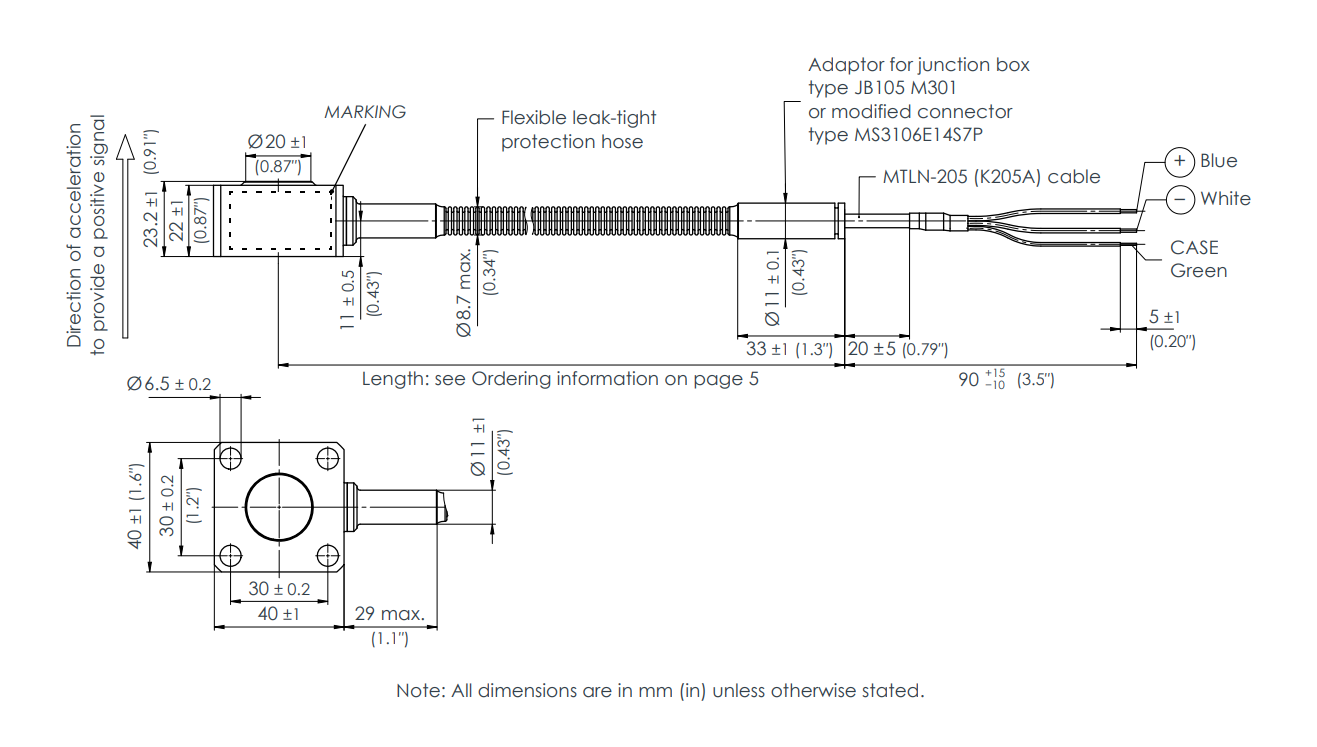
Mounting Interface Four-hole flange mount, thru-hole Ø6.6 mm, for M6 bolts. Standard mounting method providing firm mechanical coupling, ensuring high-frequency vibration transfer efficiency.

Recommended Mounting Hardware M6 x 35 Socket Head Cap Screws, M6 Spring Lock Washers, optional thread-locking compound. Spring washers prevent loosening; locking compound for high-vibration environments.

Maximum Mounting Torque 15 N·m Critical Installation Parameter. Must use a torque wrench and tighten in a crisscross pattern stepwise to ensure even force distribution on the mounting surface and avoid base deformation affecting performance.

Total Cable Length 20 meters Defined configuration for Model 236. Supplied as an inseparable unit ex-factory; field shortening or splicing is strictly prohibited.

Cable Termination Flying leads (typically red and white cores plus shield braid). For direct connection to terminal blocks or special connectors, providing flexible field wiring options.
Certifications & Compliance General Safety Certification CE Marking Complies with EU Directives 2014/30/EU (EMC) and 2014/35/EU (LVD), permitting sale in the EU market.

Electromagnetic Compatibility Complies with EN 61000-6-2:2005 (Immunity for Industrial Environments)
Complies with EN 61000-6-4:2007+A1:2011 (Emission for Industrial Environments)
Ensures normal operation in typical industrial electromagnetic environments and that its own emissions do not interfere with other equipment.

Electrical Safety Complies with EN 61010-1:2010 Meets basic safety requirements for measurement and control equipment.

Environmental Compliance Complies with EU RoHS Directive (2011/65/EU) recast. Restricts the use of hazardous substances like lead, mercury, and cadmium, complying with environmental regulations.

Factory Calibration Sensor and 20m cable dynamically calibrated as a complete unit (5g, 120Hz). Calibration certificate provided includes actual sensitivity, capacitance, etc. Calibration values already incorporate the influence of the 20m cable and can be used directly by the customer.

Explosion-Proof Certification None This is a Standard Industrial Version, not certified for any explosion-proof use. It is strictly prohibited for use in hazardous areas (Zone 0/1/2) where explosive risks exist, such as in petroleum, chemical, natural gas, or mining industries.

CA202 (4)

Previous: 
Next: 

Quick Links

PRODUCTS

OEM

Contact Us

 Telephone: +86-181-0690-6650
 WhatsApp: +8618106906650
 Email:  sales2@exstar-automation.com / lily@htechplc.com
 Address: Room 1904, Building B, Diamond Coast, No. 96 Lujiang Road, Siming District, Xiamen Fujian, China
Copyright © 2025 Exstar Automation Services Co., Ltd. All Rights Reserved.