VM
CA202 144-202-000-226
$6800
In Stock
T/T
Xiamen
| Availability: | |
|---|---|
| Quantity: | |
The CA202 piezoelectric accelerometer is a high-performance industrial vibration sensor from Meggitt Sensing Systems' vibro-meter product line, designed for medium-distance, highly reliable vibration monitoring in harsh but non-explosive industrial environments. This report focuses on model 144-202-000-226, the Standard Industrial Version equipped with an 11-meter integral cable. This model does not possess explosion-proof certification and is intended for long-term condition monitoring and predictive maintenance of critical rotating equipment in non-hazardous environments spanning power generation, water conservancy, manufacturing, buildings, and infrastructure.
The sensor continues the signature design of the CA202 family, employing a core shear-mode polycrystalline piezoelectric sensing technology and an internally fully isolated architecture. This ensures exceptional measurement accuracy, excellent signal symmetry, and robust anti-interference capability. Its most distinctive structural feature is the seamless integration of the rugged austenitic stainless steel sensor housing with a flexible, high-temperature resistant stainless steel armored protection hose via fully hermetic welding. This forms a connector-less, leak-proof monolithic measurement unit from the sensing head to the cable end. This design fundamentally eliminates failure risks associated with traditional plug-and-play sensors, such as connector corrosion, loosening, or seal failure, allowing it to withstand long-term exposure to common industrial challenges like humidity, condensation, oil, dust, and general chemical corrosion.
As a reliable "sense organ" for industrial equipment health management systems, the CA202-226 integrates seamlessly with vibro-meter signal conditioners (IPC series), data acquisition systems, and intelligent analysis software (e.g., the VM600 platform), constructing a complete solution from physical signal sensing and high-quality transmission to intelligent diagnostics. Its 11-meter cable length provides significant practical value in terms of installation flexibility: it allows the sensor to be mounted at the optimal measurement point while placing the relatively delicate charge amplifier several meters away in a safer, cleaner, and more serviceable location. This is particularly suitable for applications with dispersed equipment layouts or relatively centralized electrical cabinet locations. This makes the CA202-226 an ideal choice for pursuing top-tier performance and reliability while balancing engineering installation convenience and system economics.
Rugged Industrial-Grade Design & Exceptional Environmental Adaptability:
Ultra-Wide Operating Temperature Range: The sensing head can operate continuously and stably at extreme temperatures from -55°C to +260°C, and the integral cable can withstand environments from -55°C to +200°C. This characteristic enables its widespread application in various climates and operating conditions, from outdoor fans in cold northern regions to pumps and compressors in high-temperature workshops in the south.
Fully Welded Monolithic Sealed Structure: The permanent welded connection between the sensor and cable provides a protection level surpassing that of traditional sensors relying on elastomeric seals. It completely eliminates leakage risks at interfaces, is impervious to high-pressure water washdown, sustained high humidity, or corrosive atmospheres, significantly enhancing long-term operational reliability in harsh environments and substantially reducing maintenance needs and costs over its lifecycle.
Accurate, Stable Top-Tier Measurement Performance:
High Sensitivity & Wide Frequency Response: A standard sensitivity of 100 pC/g provides a good signal-to-noise ratio foundation for detecting early-stage, weak mechanical fault signatures. The flat frequency response range from 0.5 Hz to 6 kHz (±5%) enables precise measurement from the fundamental frequencies of large, slow-speed rotors (e.g., cement mills) to high-frequency impact components from gears or rolling element bearings, meeting comprehensive fault diagnosis needs.
Excellent Dynamic Characteristics & Linearity: A linear measurement range up to 400g ensures the sensor output remains highly true and linear (error < ±1%) even under complex operating conditions with shocks or large-amplitude vibrations. A high resonant frequency (>22kHz) guarantees outstanding phase and amplitude fidelity within its operating bandwidth.
Powerful Immunity to Environmental Interference: The built-in differential symmetrical sensing element, high insulation resistance (≥1GΩ), and fully shielded cable design together form an effective barrier against ground loop interference, electromagnetic noise, and triboelectric effects, ensuring the output of a pure, stable raw signal in complex industrial electrical environments.
Optimized Engineering & Cost-Effectiveness for Standard Industrial Applications:
Simplified System Integration & Certification Process: As a Standard Industrial Version, the CA202-226 does not require intrinsically safe barriers or complex intrinsic safety system calculations and certifications. This greatly simplifies system design, procurement, and engineering implementation processes, shortens project timelines, and reduces overall system costs.
Installation Freedom Provided by the 11-Meter Cable: The 11-meter length is a practically proven, useful distance that balances the need for remote amplifier/junction box installation with avoiding signal attenuation and cost increases associated with excessively long cables. It is particularly suitable for applications where the measurement point is about 10 meters from the nearest junction box or control cabinet, reducing the need for on-site installation of additional conduit or cable.
Global Market Access Compliance: The product carries the CE mark, complies with EU EMC and Low Voltage Directive (LVD), and meets RoHS environmental requirements. This allows this model barrier-free access to most global non-explosive industrial markets without requiring additional regional certification adaptations.
Plug-and-Play & Ultra-Long Service Life:
Factory Precision Calibration, Precision Out-of-the-Box: Each sensor undergoes a complete end-to-end dynamic calibration (5g, 120Hz) under standard laboratory conditions and is supplied with a calibration certificate. This ensures users achieve nominal performance directly upon unboxing, greatly simplifying on-site commissioning and verification work.
Near "Maintenance-Free" Reliability: Thanks to the fully welded hermetic structure and all-stainless-steel materials, the sensor requires almost no preventive maintenance after correct installation beyond periodic visual inspections, providing users with very high operational certainty and very low total cost of ownership (TCO).
The CA202-226 is a high-impedance charge output piezoelectric accelerometer. Its internal sensing core is a shear-mode designed piezoelectric assembly. When the sensor base vibrates with the measured object, the internal seismic mass applies a periodic shear force to the piezoelectric crystal.
Based on the direct piezoelectric effect, polarization charge proportional to the applied mechanical stress (i.e., acceleration) is generated inside the crystal, forming a high-impedance charge signal (Q) on its electrode surfaces. The relationship is: Q = S * a, where S is the charge sensitivity (100 pC/g) and *a* is the vibration acceleration (g). This raw charge signal is extremely weak and susceptible to interference.
Therefore, a dedicated charge amplifier (e.g., IPC70x) is essential for signal conditioning and conversion:
Charge-to-Voltage Conversion: The amplifier provides extremely high input impedance, linearly converting the charge signal into a low-impedance voltage signal.
Voltage-to-Current Conversion & Driving: Vibro-meter® amplifiers typically further convert the voltage signal into a highly interference-resistant 2-wire 4-20 mA current loop signal. The advantages of this technology are:
Superior Noise Immunity: Current signals are insensitive to transmission line resistance and less susceptible to electromagnetic induction noise.
Long-Distance Transmission Capability: Can be transmitted over hundreds to thousands of meters using ordinary twisted-pair shielded cable.
2-Wire Simplified Wiring: Uses just one pair of wires to simultaneously provide power to the front-end sensor-amplifier loop and return the signal, greatly simplifying field wiring.
Finally, the standard 4-20 mA signal can be directly connected to PLC or DCS modules supporting current input, or, after conversion via a signal conditioning card, fed into a dedicated vibration monitoring and analysis system (e.g., VM600) for real-time display, historical data logging, spectrum analysis, trend prediction, and alarming.
Engineering Considerations for Choosing the 11m Standard CA202-226: It is completely consistent with explosion-proof versions in terms of core sensing performance, environmental tolerance, and mechanical ruggedness. By omitting explosion-proof certification and associated safety barriers, it brings significant cost savings and system simplification to the entire monitoring channel. The 11-meter cable length is particularly suitable for occasions where measurement points are relatively dispersed but signals need to be concentrated into a single area control cabinet, making it the preferred solution for achieving the best balance between performance and engineering economics.
Leveraging its robustness, wide temperature range, high performance, and moderate cable length, the CA202-226 Standard Version is an ideal choice for vibration monitoring in the following non-explosive industrial sectors:
Power Generation (Non-Hazardous Areas):
Thermal Power Plants: Bearings on turbine-generator sets, boiler feedwater pumps, forced/induced draft (FD/ID) fans, coal mills, coal crushers.
Hydroelectric Power Plants: Water turbine guide and thrust bearings, governor systems, technical water supply pumps.
Nuclear Power Plant Conventional Island: Main feedwater pumps, condensate pumps, circulating water pumps, critical ventilation fans.
Biomass/Waste-to-Energy Plants: Conveying, crushing, and incinerator auxiliary equipment.
Heavy Industry & Process Manufacturing:
Cement Industry: Raw material vertical mills, rotary kilns, grate coolers, cement mills, large fans.
Steel & Metallurgy: Sintering machines, blast furnace blowers, dust collection fans, main mill drive systems.
Mining Industry: Crushers, ball mills, gyratory crushers, large mining pumps.
Paper Industry: Paper machine wire section, press section, dryer section, calenders, winders.
Large Infrastructure & Public Utilities:
Large Commercial Complexes & Hospitals: Central plant chillers, cooling tower fans, oil/gas-fired boilers.
Municipal Water Services: Intake and delivery pump houses in water treatment plants, aeration blowers in wastewater treatment plants, sludge dewatering machines.
Transportation Hubs: Large HVAC equipment in subway/airport systems, escalator drive mechanisms.
Marine & General Machinery:
Ship main propulsion diesel engines, generator diesel engines, gearboxes, large seawater pumps (in non-hazardous areas of engine rooms).
Key power components of large construction machinery (excavators, loaders).
Testing & R&D:
Durability test benches for products like engines, gearboxes, and motors.
Modal analysis and vibration testing of large structural components (e.g., wind turbine blades, bridge models).
System Design & Confirmation: Confirm that the input range setting of the charge amplifier in the measurement chain can accommodate the sum of the sensor body capacitance and the 11-meter cable capacitance. Plan the cable route from the sensor to the junction box/amplifier, avoiding long parallel runs with power cables.
Measurement Point Selection & Preparation: Select locations on rigid structures such as bearing housings as measurement points. Clean the mounting surface to ensure it is flat, free of paint and rust. If the surface is uneven, it is recommended to machine a small local flat area to a finish of Ra 3.2 μm.
Installation Steps:
Use the specified M6 x 35 Socket Head Cap Screws and Spring Lock Washers. A small amount of medium-strength thread-locking adhesive (e.g., Loctite 243) may be applied to the screw threads.
Position the sensor, install the washers and screws in sequence.
Using a calibrated torque wrench, strictly follow the crisscross pattern and tighten all four screws evenly in two stages (e.g., first to 10 N·m, then to 15 N·m). Do not exceed torque or use impact tools.
Mounting Orientation: Ensure the sensitivity axis arrow on the sensor side aligns with the primary direction of the vibration to be measured.
Routing & Bending: Plan a smooth cable path; the minimum static bending radius must not be less than 50 millimeters. Avoid passing over sharp edges, hot surfaces (>200°C), or strong vibration sources.
Stress Relief & Fixing:
Within 30-50 centimeters of the sensor cable exit, a smooth stress relief loop with a radius greater than 100 millimeters must be formed to absorb equipment vibration and protect the welded joint.
Use corrosion-resistant cable clamps to securely fix the cable to cable trays, raceways, or equipment structures every 0.8-1.5 meters. Avoid having the cable dangling or flapping.
Where conditions permit, route the cable inside flexible metallic conduit (e.g., KS series) or PVC pipe for additional mechanical protection.
Grounding Treatment (Crucial): Strictly implement the single-point grounding principle. Connect the cable shield to the amplifier's designated grounding terminal only at the input of the Charge Amplifier (IPC). Use a short, thick grounding wire to ensure a good connection. The sensor mounting base is grounded via the equipment body. Do not ground the shield again at the sensor end or any other location to avoid creating ground loops that introduce noise.
Connect to Amplifier: Correctly and securely connect the CA202 cable's flying leads (typically red/white for signal wires, exposed copper braid for shield) to the terminals on the IPC charge amplifier labeled "Sensor Input".
Connect to Downstream System: Connect the amplifier's 4-20mA output to the corresponding analog input channel of the data logger, PLC, or vibration monitoring system.
Power-Up & Functional Verification:
After verifying all wiring is correct, power up the system.
Observe the vibration signal for this channel in the monitoring software. Using a rubber mallet, gently tap near the sensor mounting base; a clear transient pulse response should immediately appear on the screen, indicating the entire signal path from sensor to host computer is functioning normally.
Baseline Data Acquisition: After the equipment has been operating normally and stably for at least 24 hours, record vibration values such as velocity RMS and acceleration peak for each monitoring point as health baselines for subsequent trend analysis and alarm threshold setting.
Non-Explosion-Proof Equipment: The CA202-226 Standard Industrial Version does not have explosion-proof functionality and is strictly prohibited from installation in hazardous areas (Zone 0, 1, 2) where explosive gases, vapors, or dust may be present, such as in petroleum, chemical, natural gas, or coal mining industries.
No Modification: Cutting, splicing, or attempting to alter the length or structure of the original 11-meter cable is strictly prohibited. Any destructive operation will cause product sealing failure, performance degradation, and void the warranty.
Professional Installation: Installation, wiring, and commissioning work must be performed by qualified electrical or instrumentation professionals.
Preventive Maintenance Recommendations:
Regular Inspections: Conduct a visual inspection every quarter or half-year as part of equipment checks, looking for physical damage, severe corrosion, or loose fastenings on the sensor and cable.
Electrical Check: During annual equipment overhauls, with connections disconnected, use a megohmmeter to measure the insulation resistance of the sensor loop (signal wires to shield), which should remain in the GΩ range.
Common Fault Diagnosis:
Problem: Monitoring system shows no signal. Troubleshooting steps: 1) Check data acquisition channel configuration and power supply; 2) Check IPC amplifier power and status indicators; 3) Disconnect the sensor at the amplifier end, use a multimeter to check for short or open circuit between the two cable signal wires, and measure insulation resistance of signal wires to shield.
Problem: High signal noise, instability, or drift. Troubleshooting steps: 1) Confirm and check single-point grounding is proper; 2) Check if cable routing is far from strong EMI sources; 3) Check if sensor mounting is secure and mounting surface is flat; 4) Check amplifier settings (gain, filter frequency) are correct.
Sensor failure itself is extremely rare due to its rugged design; most issues originate from installation, grounding, or downstream electronic equipment.
Calibration Interval & Service:
Recommended Calibration Interval: Under normal operating conditions, the recommended recalibration interval is 4-5 years. If the sensor experiences severe overload shock, or monitoring data shows unexplained, persistent deviation, consider earlier calibration.
Calibration Service: Contact a Meggitt authorized service center or a nationally accredited metrology organization. Calibration requires sending the sensor with the 11-meter cable as a complete unit. Update the relevant parameters in the monitoring system after calibration.
Technical Support & Resources: Meggitt SA provides global technical support and customer service. Users can obtain the latest product datasheets, installation guides, CAD drawings, and compliance certificates via its official website. For specific application questions or fault diagnosis, contact the local Meggitt sales representative or technical support engineer.
The CA202 piezoelectric accelerometer is a high-performance industrial vibration sensor from Meggitt Sensing Systems' vibro-meter product line, designed for medium-distance, highly reliable vibration monitoring in harsh but non-explosive industrial environments. This report focuses on model 144-202-000-226, the Standard Industrial Version equipped with an 11-meter integral cable. This model does not possess explosion-proof certification and is intended for long-term condition monitoring and predictive maintenance of critical rotating equipment in non-hazardous environments spanning power generation, water conservancy, manufacturing, buildings, and infrastructure.
The sensor continues the signature design of the CA202 family, employing a core shear-mode polycrystalline piezoelectric sensing technology and an internally fully isolated architecture. This ensures exceptional measurement accuracy, excellent signal symmetry, and robust anti-interference capability. Its most distinctive structural feature is the seamless integration of the rugged austenitic stainless steel sensor housing with a flexible, high-temperature resistant stainless steel armored protection hose via fully hermetic welding. This forms a connector-less, leak-proof monolithic measurement unit from the sensing head to the cable end. This design fundamentally eliminates failure risks associated with traditional plug-and-play sensors, such as connector corrosion, loosening, or seal failure, allowing it to withstand long-term exposure to common industrial challenges like humidity, condensation, oil, dust, and general chemical corrosion.
As a reliable "sense organ" for industrial equipment health management systems, the CA202-226 integrates seamlessly with vibro-meter signal conditioners (IPC series), data acquisition systems, and intelligent analysis software (e.g., the VM600 platform), constructing a complete solution from physical signal sensing and high-quality transmission to intelligent diagnostics. Its 11-meter cable length provides significant practical value in terms of installation flexibility: it allows the sensor to be mounted at the optimal measurement point while placing the relatively delicate charge amplifier several meters away in a safer, cleaner, and more serviceable location. This is particularly suitable for applications with dispersed equipment layouts or relatively centralized electrical cabinet locations. This makes the CA202-226 an ideal choice for pursuing top-tier performance and reliability while balancing engineering installation convenience and system economics.
Rugged Industrial-Grade Design & Exceptional Environmental Adaptability:
Ultra-Wide Operating Temperature Range: The sensing head can operate continuously and stably at extreme temperatures from -55°C to +260°C, and the integral cable can withstand environments from -55°C to +200°C. This characteristic enables its widespread application in various climates and operating conditions, from outdoor fans in cold northern regions to pumps and compressors in high-temperature workshops in the south.
Fully Welded Monolithic Sealed Structure: The permanent welded connection between the sensor and cable provides a protection level surpassing that of traditional sensors relying on elastomeric seals. It completely eliminates leakage risks at interfaces, is impervious to high-pressure water washdown, sustained high humidity, or corrosive atmospheres, significantly enhancing long-term operational reliability in harsh environments and substantially reducing maintenance needs and costs over its lifecycle.
Accurate, Stable Top-Tier Measurement Performance:
High Sensitivity & Wide Frequency Response: A standard sensitivity of 100 pC/g provides a good signal-to-noise ratio foundation for detecting early-stage, weak mechanical fault signatures. The flat frequency response range from 0.5 Hz to 6 kHz (±5%) enables precise measurement from the fundamental frequencies of large, slow-speed rotors (e.g., cement mills) to high-frequency impact components from gears or rolling element bearings, meeting comprehensive fault diagnosis needs.
Excellent Dynamic Characteristics & Linearity: A linear measurement range up to 400g ensures the sensor output remains highly true and linear (error < ±1%) even under complex operating conditions with shocks or large-amplitude vibrations. A high resonant frequency (>22kHz) guarantees outstanding phase and amplitude fidelity within its operating bandwidth.
Powerful Immunity to Environmental Interference: The built-in differential symmetrical sensing element, high insulation resistance (≥1GΩ), and fully shielded cable design together form an effective barrier against ground loop interference, electromagnetic noise, and triboelectric effects, ensuring the output of a pure, stable raw signal in complex industrial electrical environments.
Optimized Engineering & Cost-Effectiveness for Standard Industrial Applications:
Simplified System Integration & Certification Process: As a Standard Industrial Version, the CA202-226 does not require intrinsically safe barriers or complex intrinsic safety system calculations and certifications. This greatly simplifies system design, procurement, and engineering implementation processes, shortens project timelines, and reduces overall system costs.
Installation Freedom Provided by the 11-Meter Cable: The 11-meter length is a practically proven, useful distance that balances the need for remote amplifier/junction box installation with avoiding signal attenuation and cost increases associated with excessively long cables. It is particularly suitable for applications where the measurement point is about 10 meters from the nearest junction box or control cabinet, reducing the need for on-site installation of additional conduit or cable.
Global Market Access Compliance: The product carries the CE mark, complies with EU EMC and Low Voltage Directive (LVD), and meets RoHS environmental requirements. This allows this model barrier-free access to most global non-explosive industrial markets without requiring additional regional certification adaptations.
Plug-and-Play & Ultra-Long Service Life:
Factory Precision Calibration, Precision Out-of-the-Box: Each sensor undergoes a complete end-to-end dynamic calibration (5g, 120Hz) under standard laboratory conditions and is supplied with a calibration certificate. This ensures users achieve nominal performance directly upon unboxing, greatly simplifying on-site commissioning and verification work.
Near "Maintenance-Free" Reliability: Thanks to the fully welded hermetic structure and all-stainless-steel materials, the sensor requires almost no preventive maintenance after correct installation beyond periodic visual inspections, providing users with very high operational certainty and very low total cost of ownership (TCO).
The CA202-226 is a high-impedance charge output piezoelectric accelerometer. Its internal sensing core is a shear-mode designed piezoelectric assembly. When the sensor base vibrates with the measured object, the internal seismic mass applies a periodic shear force to the piezoelectric crystal.
Based on the direct piezoelectric effect, polarization charge proportional to the applied mechanical stress (i.e., acceleration) is generated inside the crystal, forming a high-impedance charge signal (Q) on its electrode surfaces. The relationship is: Q = S * a, where S is the charge sensitivity (100 pC/g) and *a* is the vibration acceleration (g). This raw charge signal is extremely weak and susceptible to interference.
Therefore, a dedicated charge amplifier (e.g., IPC70x) is essential for signal conditioning and conversion:
Charge-to-Voltage Conversion: The amplifier provides extremely high input impedance, linearly converting the charge signal into a low-impedance voltage signal.
Voltage-to-Current Conversion & Driving: Vibro-meter® amplifiers typically further convert the voltage signal into a highly interference-resistant 2-wire 4-20 mA current loop signal. The advantages of this technology are:
Superior Noise Immunity: Current signals are insensitive to transmission line resistance and less susceptible to electromagnetic induction noise.
Long-Distance Transmission Capability: Can be transmitted over hundreds to thousands of meters using ordinary twisted-pair shielded cable.
2-Wire Simplified Wiring: Uses just one pair of wires to simultaneously provide power to the front-end sensor-amplifier loop and return the signal, greatly simplifying field wiring.
Finally, the standard 4-20 mA signal can be directly connected to PLC or DCS modules supporting current input, or, after conversion via a signal conditioning card, fed into a dedicated vibration monitoring and analysis system (e.g., VM600) for real-time display, historical data logging, spectrum analysis, trend prediction, and alarming.
Engineering Considerations for Choosing the 11m Standard CA202-226: It is completely consistent with explosion-proof versions in terms of core sensing performance, environmental tolerance, and mechanical ruggedness. By omitting explosion-proof certification and associated safety barriers, it brings significant cost savings and system simplification to the entire monitoring channel. The 11-meter cable length is particularly suitable for occasions where measurement points are relatively dispersed but signals need to be concentrated into a single area control cabinet, making it the preferred solution for achieving the best balance between performance and engineering economics.
Leveraging its robustness, wide temperature range, high performance, and moderate cable length, the CA202-226 Standard Version is an ideal choice for vibration monitoring in the following non-explosive industrial sectors:
Power Generation (Non-Hazardous Areas):
Thermal Power Plants: Bearings on turbine-generator sets, boiler feedwater pumps, forced/induced draft (FD/ID) fans, coal mills, coal crushers.
Hydroelectric Power Plants: Water turbine guide and thrust bearings, governor systems, technical water supply pumps.
Nuclear Power Plant Conventional Island: Main feedwater pumps, condensate pumps, circulating water pumps, critical ventilation fans.
Biomass/Waste-to-Energy Plants: Conveying, crushing, and incinerator auxiliary equipment.
Heavy Industry & Process Manufacturing:
Cement Industry: Raw material vertical mills, rotary kilns, grate coolers, cement mills, large fans.
Steel & Metallurgy: Sintering machines, blast furnace blowers, dust collection fans, main mill drive systems.
Mining Industry: Crushers, ball mills, gyratory crushers, large mining pumps.
Paper Industry: Paper machine wire section, press section, dryer section, calenders, winders.
Large Infrastructure & Public Utilities:
Large Commercial Complexes & Hospitals: Central plant chillers, cooling tower fans, oil/gas-fired boilers.
Municipal Water Services: Intake and delivery pump houses in water treatment plants, aeration blowers in wastewater treatment plants, sludge dewatering machines.
Transportation Hubs: Large HVAC equipment in subway/airport systems, escalator drive mechanisms.
Marine & General Machinery:
Ship main propulsion diesel engines, generator diesel engines, gearboxes, large seawater pumps (in non-hazardous areas of engine rooms).
Key power components of large construction machinery (excavators, loaders).
Testing & R&D:
Durability test benches for products like engines, gearboxes, and motors.
Modal analysis and vibration testing of large structural components (e.g., wind turbine blades, bridge models).
System Design & Confirmation: Confirm that the input range setting of the charge amplifier in the measurement chain can accommodate the sum of the sensor body capacitance and the 11-meter cable capacitance. Plan the cable route from the sensor to the junction box/amplifier, avoiding long parallel runs with power cables.
Measurement Point Selection & Preparation: Select locations on rigid structures such as bearing housings as measurement points. Clean the mounting surface to ensure it is flat, free of paint and rust. If the surface is uneven, it is recommended to machine a small local flat area to a finish of Ra 3.2 μm.
Installation Steps:
Use the specified M6 x 35 Socket Head Cap Screws and Spring Lock Washers. A small amount of medium-strength thread-locking adhesive (e.g., Loctite 243) may be applied to the screw threads.
Position the sensor, install the washers and screws in sequence.
Using a calibrated torque wrench, strictly follow the crisscross pattern and tighten all four screws evenly in two stages (e.g., first to 10 N·m, then to 15 N·m). Do not exceed torque or use impact tools.
Mounting Orientation: Ensure the sensitivity axis arrow on the sensor side aligns with the primary direction of the vibration to be measured.
Routing & Bending: Plan a smooth cable path; the minimum static bending radius must not be less than 50 millimeters. Avoid passing over sharp edges, hot surfaces (>200°C), or strong vibration sources.
Stress Relief & Fixing:
Within 30-50 centimeters of the sensor cable exit, a smooth stress relief loop with a radius greater than 100 millimeters must be formed to absorb equipment vibration and protect the welded joint.
Use corrosion-resistant cable clamps to securely fix the cable to cable trays, raceways, or equipment structures every 0.8-1.5 meters. Avoid having the cable dangling or flapping.
Where conditions permit, route the cable inside flexible metallic conduit (e.g., KS series) or PVC pipe for additional mechanical protection.
Grounding Treatment (Crucial): Strictly implement the single-point grounding principle. Connect the cable shield to the amplifier's designated grounding terminal only at the input of the Charge Amplifier (IPC). Use a short, thick grounding wire to ensure a good connection. The sensor mounting base is grounded via the equipment body. Do not ground the shield again at the sensor end or any other location to avoid creating ground loops that introduce noise.
Connect to Amplifier: Correctly and securely connect the CA202 cable's flying leads (typically red/white for signal wires, exposed copper braid for shield) to the terminals on the IPC charge amplifier labeled "Sensor Input".
Connect to Downstream System: Connect the amplifier's 4-20mA output to the corresponding analog input channel of the data logger, PLC, or vibration monitoring system.
Power-Up & Functional Verification:
After verifying all wiring is correct, power up the system.
Observe the vibration signal for this channel in the monitoring software. Using a rubber mallet, gently tap near the sensor mounting base; a clear transient pulse response should immediately appear on the screen, indicating the entire signal path from sensor to host computer is functioning normally.
Baseline Data Acquisition: After the equipment has been operating normally and stably for at least 24 hours, record vibration values such as velocity RMS and acceleration peak for each monitoring point as health baselines for subsequent trend analysis and alarm threshold setting.
Non-Explosion-Proof Equipment: The CA202-226 Standard Industrial Version does not have explosion-proof functionality and is strictly prohibited from installation in hazardous areas (Zone 0, 1, 2) where explosive gases, vapors, or dust may be present, such as in petroleum, chemical, natural gas, or coal mining industries.
No Modification: Cutting, splicing, or attempting to alter the length or structure of the original 11-meter cable is strictly prohibited. Any destructive operation will cause product sealing failure, performance degradation, and void the warranty.
Professional Installation: Installation, wiring, and commissioning work must be performed by qualified electrical or instrumentation professionals.
Preventive Maintenance Recommendations:
Regular Inspections: Conduct a visual inspection every quarter or half-year as part of equipment checks, looking for physical damage, severe corrosion, or loose fastenings on the sensor and cable.
Electrical Check: During annual equipment overhauls, with connections disconnected, use a megohmmeter to measure the insulation resistance of the sensor loop (signal wires to shield), which should remain in the GΩ range.
Common Fault Diagnosis:
Problem: Monitoring system shows no signal. Troubleshooting steps: 1) Check data acquisition channel configuration and power supply; 2) Check IPC amplifier power and status indicators; 3) Disconnect the sensor at the amplifier end, use a multimeter to check for short or open circuit between the two cable signal wires, and measure insulation resistance of signal wires to shield.
Problem: High signal noise, instability, or drift. Troubleshooting steps: 1) Confirm and check single-point grounding is proper; 2) Check if cable routing is far from strong EMI sources; 3) Check if sensor mounting is secure and mounting surface is flat; 4) Check amplifier settings (gain, filter frequency) are correct.
Sensor failure itself is extremely rare due to its rugged design; most issues originate from installation, grounding, or downstream electronic equipment.
Calibration Interval & Service:
Recommended Calibration Interval: Under normal operating conditions, the recommended recalibration interval is 4-5 years. If the sensor experiences severe overload shock, or monitoring data shows unexplained, persistent deviation, consider earlier calibration.
Calibration Service: Contact a Meggitt authorized service center or a nationally accredited metrology organization. Calibration requires sending the sensor with the 11-meter cable as a complete unit. Update the relevant parameters in the monitoring system after calibration.
Technical Support & Resources: Meggitt SA provides global technical support and customer service. Users can obtain the latest product datasheets, installation guides, CAD drawings, and compliance certificates via its official website. For specific application questions or fault diagnosis, contact the local Meggitt sales representative or technical support engineer.
| Category | Parameter | Technical Specification & Performance Indicator | Conditions, Remarks & Supplementary Information |
|---|---|---|---|
| Product Identification & Principle | Full Model | CA202 (Standard Industrial Version, 11m Integral Cable) | Ordering Part Number: 144-202-000-226 |
| Operating Principle | Shear-mode piezoelectric effect, High-impedance charge output | Sensing element electrically isolated from housing, symmetrical differential output, strong common-mode rejection. | |
| Output Signal Type | Charge Signal (Unit: pC/g) | Requires an external charge amplifier (e.g., vibro-meter® IPC70x series) for conversion to standard voltage or current signal. | |
| Electrical Performance | Charge Sensitivity | 100 pC/g ±5% | Reference condition: 120 Hz, 5 g (peak) sinusoidal excitation, 23°C ambient temperature. |
| Linear Operating Range | 0.01 g to 400 g (peak) | Non-linearity error ≤ ±1% within this range. | |
| Transient Overload Capacity | 500 g (peak) | Maximum non-destructive single shock withstand limit. | |
| Frequency Response (±5%) | 0.5 Hz to 6000 Hz | Amplitude flat zone. Actual lower frequency limit is determined by the subsequent charge amplifier's high-pass filter setting. | |
| Resonant Frequency | > 22 kHz (nominal) | Sensor's first-order mechanical natural frequency, determining its usable upper frequency limit. | |
| Transverse Sensitivity Ratio | ≤ 3% | Ratio of maximum transverse axis sensitivity to main sensitivity axis sensitivity. | |
| Insulation Resistance | ≥ 1 x 10^9 Ω | Measured between sensor pins (@ 50 V DC). | |
| Distributed Capacitance | Sensor Body: ~5000 pF pin-to-pin; ~10 pF pin-to-case Integral Cable (per meter, typical): ~105 pF core-to-core; ~210 pF core-to-shield | The total capacitance of the 11m cable must be estimated based on this value. Total capacitance is a key parameter for amplifier range setting and system frequency response calculation. | |
| Environmental & Mechanical Characteristics | Continuous Operating Temp. | Sensing Head: -55°C to +260°C Integral Cable & Sheath: -55°C to +200°C | The sensor can operate continuously within this temperature range long-term while maintaining performance. |
| Short-Term Survival Temp. | Sensing Head: -70°C to +280°C Integral Cable: -62°C to +250°C | Permissible short-term extreme temperature exposure without causing permanent performance degradation or structural damage. | |
| Sensitivity Temperature Coefficient | -55°C to +23°C range: +0.25% / °C +23°C to +260°C range: +0.10% / °C | Sensitivity change rate relative to the 23°C reference point; temperature compensation can be applied in highly demanding applications. | |
| Mechanical Shock Resistance | 1000 g (peak) | Half-sine wave, pulse duration 1 ms. | |
| Base Strain Sensitivity | 0.15 x 10^-3 g/με | Equivalent acceleration output generated when the sensor base is subjected to 250 με peak-to-peak strain; usually negligible. | |
| Housing Material & Process | Austenitic Stainless Steel (Grade 1.4441, similar to 316L), fully perimeter sealed via TIG welding. | Provides high strength, good toughness, and excellent resistance to general chemical corrosion. | |
| Cable Sheath Material | Heat-Resistant Stainless Steel Braided Armor (Grade 1.4541) | Provides flexible mechanical protection, abrasion and crush resistant, welded to the sensor housing. | |
| Overall Protection | Hermetically sealed structure, dustproof, waterproof, oil-proof, resistant to general industrial corrosive media. | Suitable for demanding industrial environments (exceeding IP68 rating), but not suitable for any explosive atmosphere. | |
| Physical & Mounting Characteristics | Weight | Sensing Head: approx. 250 g Integral Cable: approx. 135 g/m | Total weight for 11m cable approx. 1.74 kg (including sensor). |
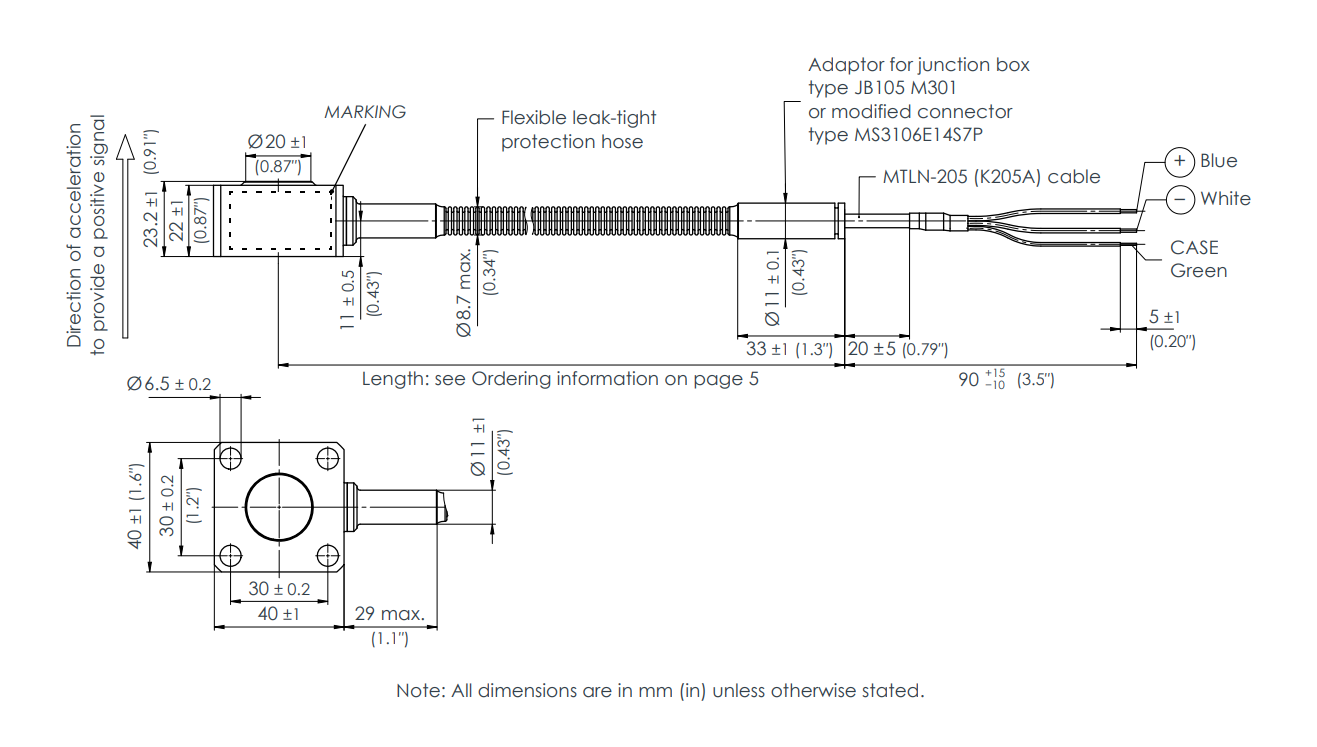
| Mounting Interface | Four-hole flange mount, thru-hole diameter Ø6.6 mm, for M6 bolts. | Mounting holes in rectangular symmetric pattern. | |
| Recommended Mounting Hardware | M6 x 35 Socket Head Cap Screws, with M6 Spring Lock Washers. | Spring washers prevent screw loosening due to vibration. | |
| Maximum Mounting Torque | 15 N·m | A torque wrench must be used. Tighten evenly in a crisscross pattern stepwise to ensure even force distribution on the mounting surface. | |
| Total Cable Length | 11 meters | Defined length for Model 226, supplied as an inseparable unit ex-factory. | |
| Cable Termination | Flying leads, includes two color-coded insulated signal wires and an exposed copper braid shield. | For easy direct field connection to terminal blocks or connectors. | |
| Certifications & Compliance | General Safety Certification | CE Marking: Complies with EU Electromagnetic Compatibility Directive (2014/30/EU) & Low Voltage Directive (2014/35/EU). | Indicates the product meets the essential health, safety, and environmental protection requirements for the European Economic Area. |
| Electromagnetic Compatibility | Complies with EN 61000-6-2:2005 (Immunity for Industrial Environments) Complies with EN 61000-6-4:2007+A1:2011 (Emission for Industrial Environments) | Ensures stable operation in typical industrial electromagnetic environments and does not interfere with other equipment. | |
| Electrical Safety | Complies with EN 61010-1:2010 | General safety requirements for electrical equipment for measurement, control, and laboratory use. | |
| Environmental Compliance | Complies with the requirements of the EU RoHS Directive (2011/65/EU) recast. | Restricts the use of hazardous substances such as lead, mercury, and cadmium in electrical and electronic equipment. | |
| Factory Calibration | Complete dynamic calibration chain test (sensor + 11m cable, 5g, 120Hz) under standard conditions. | Calibration certificate provided with sensitivity, reference frequency response data, ensuring end-to-end measurement accuracy. | |
| Explosion-Proof Certification | None | This is a Standard Industrial Version, not certified for any explosion-proof use. It is strictly prohibited for use in hazardous areas (Zone 0/1/2) where explosive gases, vapors, or dust may be present. |
| Category | Parameter | Technical Specification & Performance Indicator | Conditions, Remarks & Supplementary Information |
|---|---|---|---|
| Product Identification & Principle | Full Model | CA202 (Standard Industrial Version, 11m Integral Cable) | Ordering Part Number: 144-202-000-226 |
| Operating Principle | Shear-mode piezoelectric effect, High-impedance charge output | Sensing element electrically isolated from housing, symmetrical differential output, strong common-mode rejection. | |
| Output Signal Type | Charge Signal (Unit: pC/g) | Requires an external charge amplifier (e.g., vibro-meter® IPC70x series) for conversion to standard voltage or current signal. | |
| Electrical Performance | Charge Sensitivity | 100 pC/g ±5% | Reference condition: 120 Hz, 5 g (peak) sinusoidal excitation, 23°C ambient temperature. |
| Linear Operating Range | 0.01 g to 400 g (peak) | Non-linearity error ≤ ±1% within this range. | |
| Transient Overload Capacity | 500 g (peak) | Maximum non-destructive single shock withstand limit. | |
| Frequency Response (±5%) | 0.5 Hz to 6000 Hz | Amplitude flat zone. Actual lower frequency limit is determined by the subsequent charge amplifier's high-pass filter setting. | |
| Resonant Frequency | > 22 kHz (nominal) | Sensor's first-order mechanical natural frequency, determining its usable upper frequency limit. | |
| Transverse Sensitivity Ratio | ≤ 3% | Ratio of maximum transverse axis sensitivity to main sensitivity axis sensitivity. | |
| Insulation Resistance | ≥ 1 x 10^9 Ω | Measured between sensor pins (@ 50 V DC). | |
| Distributed Capacitance | Sensor Body: ~5000 pF pin-to-pin; ~10 pF pin-to-case Integral Cable (per meter, typical): ~105 pF core-to-core; ~210 pF core-to-shield | The total capacitance of the 11m cable must be estimated based on this value. Total capacitance is a key parameter for amplifier range setting and system frequency response calculation. | |
| Environmental & Mechanical Characteristics | Continuous Operating Temp. | Sensing Head: -55°C to +260°C Integral Cable & Sheath: -55°C to +200°C | The sensor can operate continuously within this temperature range long-term while maintaining performance. |
| Short-Term Survival Temp. | Sensing Head: -70°C to +280°C Integral Cable: -62°C to +250°C | Permissible short-term extreme temperature exposure without causing permanent performance degradation or structural damage. | |
| Sensitivity Temperature Coefficient | -55°C to +23°C range: +0.25% / °C +23°C to +260°C range: +0.10% / °C | Sensitivity change rate relative to the 23°C reference point; temperature compensation can be applied in highly demanding applications. | |
| Mechanical Shock Resistance | 1000 g (peak) | Half-sine wave, pulse duration 1 ms. | |
| Base Strain Sensitivity | 0.15 x 10^-3 g/με | Equivalent acceleration output generated when the sensor base is subjected to 250 με peak-to-peak strain; usually negligible. | |
| Housing Material & Process | Austenitic Stainless Steel (Grade 1.4441, similar to 316L), fully perimeter sealed via TIG welding. | Provides high strength, good toughness, and excellent resistance to general chemical corrosion. | |
| Cable Sheath Material | Heat-Resistant Stainless Steel Braided Armor (Grade 1.4541) | Provides flexible mechanical protection, abrasion and crush resistant, welded to the sensor housing. | |
| Overall Protection | Hermetically sealed structure, dustproof, waterproof, oil-proof, resistant to general industrial corrosive media. | Suitable for demanding industrial environments (exceeding IP68 rating), but not suitable for any explosive atmosphere. | |
| Physical & Mounting Characteristics | Weight | Sensing Head: approx. 250 g Integral Cable: approx. 135 g/m | Total weight for 11m cable approx. 1.74 kg (including sensor). |
| Mounting Interface | Four-hole flange mount, thru-hole diameter Ø6.6 mm, for M6 bolts. | Mounting holes in rectangular symmetric pattern. | |
| Recommended Mounting Hardware | M6 x 35 Socket Head Cap Screws, with M6 Spring Lock Washers. | Spring washers prevent screw loosening due to vibration. | |
| Maximum Mounting Torque | 15 N·m | A torque wrench must be used. Tighten evenly in a crisscross pattern stepwise to ensure even force distribution on the mounting surface. | |
| Total Cable Length | 11 meters | Defined length for Model 226, supplied as an inseparable unit ex-factory. | |
| Cable Termination | Flying leads, includes two color-coded insulated signal wires and an exposed copper braid shield. | For easy direct field connection to terminal blocks or connectors. | |
| Certifications & Compliance | General Safety Certification | CE Marking: Complies with EU Electromagnetic Compatibility Directive (2014/30/EU) & Low Voltage Directive (2014/35/EU). | Indicates the product meets the essential health, safety, and environmental protection requirements for the European Economic Area. |
| Electromagnetic Compatibility | Complies with EN 61000-6-2:2005 (Immunity for Industrial Environments) Complies with EN 61000-6-4:2007+A1:2011 (Emission for Industrial Environments) | Ensures stable operation in typical industrial electromagnetic environments and does not interfere with other equipment. | |
| Electrical Safety | Complies with EN 61010-1:2010 | General safety requirements for electrical equipment for measurement, control, and laboratory use. | |
| Environmental Compliance | Complies with the requirements of the EU RoHS Directive (2011/65/EU) recast. | Restricts the use of hazardous substances such as lead, mercury, and cadmium in electrical and electronic equipment. | |
| Factory Calibration | Complete dynamic calibration chain test (sensor + 11m cable, 5g, 120Hz) under standard conditions. | Calibration certificate provided with sensitivity, reference frequency response data, ensuring end-to-end measurement accuracy. | |
| Explosion-Proof Certification | None | This is a Standard Industrial Version, not certified for any explosion-proof use. It is strictly prohibited for use in hazardous areas (Zone 0/1/2) where explosive gases, vapors, or dust may be present. |