GE
IS220PAICH1B
$4000
In Stock
T/T
Xiamen
| Availability: | |
|---|---|
| Quantity: | |
The IS220PAICH1B is a significant member of GE's Mark VIe control system PAIC series analog input/output modules, representing the technological evolution and performance improvement of this product line. As an upgraded version of the IS220PAICH1A, the IS220PAICH1B maintains the advantages of the original architecture while providing superior performance, enhanced diagnostic capabilities, and higher system reliability through hardware and software optimizations.
This module is specifically designed for demanding industrial automation environments, playing a central role in critical industrial sectors such as power generation, transmission and distribution, petrochemicals, and water treatment. The PAICH1B undertakes the crucial task of connecting the upper-level control system with field analog devices, responsible for accurately acquiring sensor signals and reliably driving actuators, forming the foundation of complete control loops.
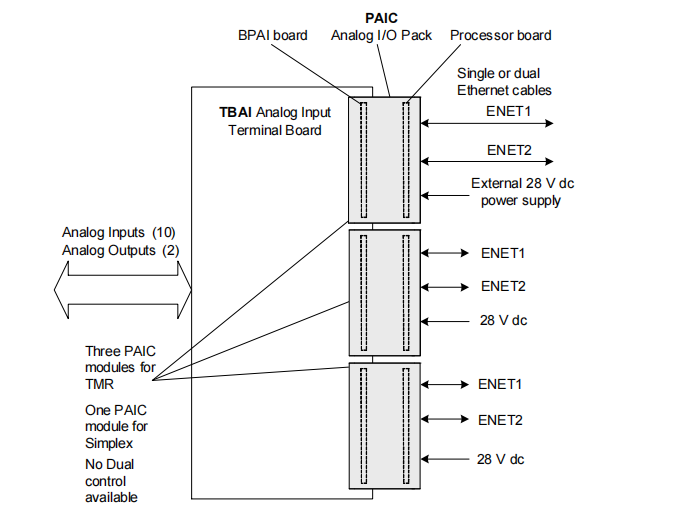
In terms of system architecture, the IS220PAICH1B supports flexible configuration schemes. It can operate in Simplex mode to meet basic control requirements, or be configured as a Triple Modular Redundant (TMR) system to provide the highest level of availability and safety for critical processes. The module uses a standard DC-37 connector to interface with various terminal boards and achieves reliable communication with the controller via dual Ethernet interfaces, ensuring long-term stable operation in harsh industrial environments.
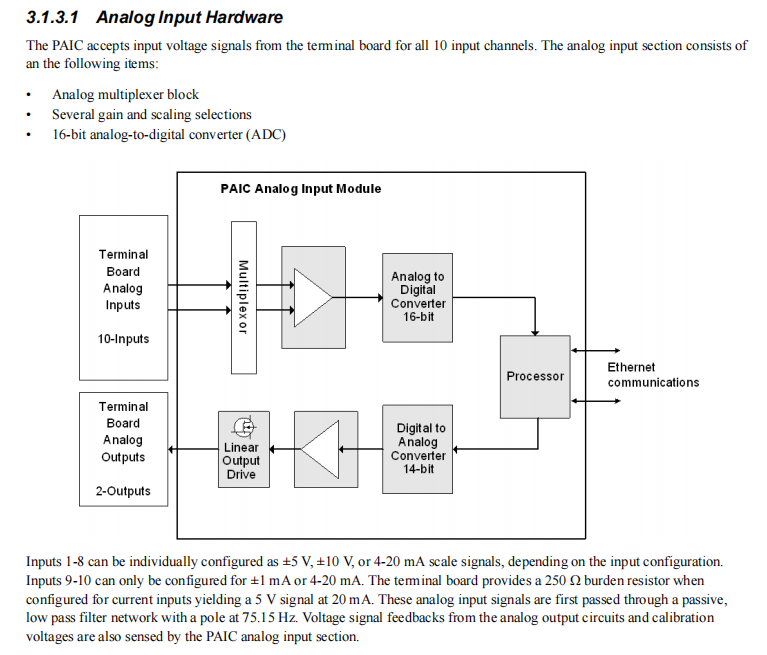
The IS220PAICH1B provides 10 fully independent analog input channels, each with excellent signal processing capabilities:
Input Configuration Flexibility:
Channels 1-8 support three operating modes:
±5 V DC Voltage Input: Accuracy of ±0.1% FS, input impedance >1 MΩ
±10 V DC Voltage Input: Wide-range measurement, with overvoltage protection up to ±25 V
4-20 mA Current Input: Built-in 250 Ω precision sampling resistor, accuracy ±0.05%
Dedicated Current Input Channels:
Channels 9-10 optimized for current signals:
4-20 mA Standard Industrial Signal: Supports HART protocol pass-through
±1 mA Special Range: Optimized for specific sensors, resolution up to 0.1 μA
Advanced Signal Conditioning:
Independent Programmable Gain Amplifier (PGA) per channel, gain range 1-128
Automatic Zero Calibration function, periodically eliminating offset errors
Real-time Temperature Compensation, ensuring measurement accuracy across the full temperature range
The module integrates 2 high-performance 0-20 mA current outputs with the following characteristics:
Output Performance Specifications:
Output Accuracy: ±0.1% FS (full temperature range)
Compliance Voltage: Up to 18 V, driving capability up to 800 Ω
Settling Time: < 1 ms (0-90% full scale)
Temperature Coefficient: < 50 ppm/°C
Advanced Output Features:
Smooth Ramping Control: Configurable output slew rate to avoid actuator impact
Short-Circuit Protection: Automatic current limiting, self-recovery after fault clearance
Open-Circuit Detection: Real-time monitoring of output loop integrity
The IS220PAICH1B adopts an advanced network communication architecture:
Dual Network Redundancy:
ENET1/ENET2 fully peer-to-peer design, supporting seamless switching
Link Quality Monitoring: Real-time network status assessment, predictive maintenance
Data Integrity Verification: CRC32 checksum, ensuring transmission reliability
Communication Protocol Optimization:
Real-Time Data Priority: Ensures timely transmission of critical data
Dynamic Bandwidth Allocation: Optimizes communication efficiency based on system load
Time Synchronization: Supports IEEE 1588 Precision Clock Protocol
The diagnostic functionality of the IS220PAICH1B represents a qualitative leap:
Predictive Diagnostics:
Component Aging Monitoring: Lifetime prediction of critical components
Performance Trend Analysis: Long-term recording of key parameter trends
Early Fault Warning: Intelligent warnings based on pattern recognition
Comprehensive Status Monitoring:
Thermal Management Monitoring: Real-time monitoring of core temperature, intelligent fan control
Power Quality Analysis: Input power ripple, noise monitoring
Signal Path Verification: Complete link diagnostics from sensor to processor
The module employs a new-generation signal processing architecture:
Adaptive Filtering:
Noise Spectrum Analysis: Automatic identification of interference characteristics
Adaptive Filter Parameters: Dynamic adjustment based on environmental noise
Multi-Stage Filtering Architecture: Hardware filtering + digital filtering
Signal Integrity Assurance:
Real-Time Baseline Correction: Automatic elimination of temperature and time drift
Dynamic Range Optimization: Automatic range adjustment based on signal characteristics
Anti-Aliasing Protection: Prevents signal distortion during sampling
Front-End Signal Conditioning:
The IS220PAICH1B's input front-end employs a fully differential architecture, with common-mode rejection ratio improved to 90 dB (typical). Each channel is equipped with an independent instrumentation amplifier, whose high input impedance (>10 GΩ) ensures minimal loading on sensor signals. Signals pass through two levels of protection: Electromagnetic Interference Filter and Radio Frequency Interference Filter, effectively suppressing various noise interferences in industrial environments.
High-Precision Analog-to-Digital Conversion:
The core converter uses a 24-bit Σ-Δ ADC, providing 256 times higher resolution compared to the PAICH1A's 16-bit ADC. This ADC integrates an automatic calibration engine that periodically performs zero and full-scale calibration, improving long-term stability to ±5 ppm/°C. The oversampling rate is programmable (64-1024x), achieving the optimal balance between accuracy and speed.
Intelligent Data Processing:
Digitized signals are processed in real-time by a Digital Signal Processor (DSP), including:
Nonlinear Correction: Compensation for characteristics of sensors like thermocouples, RTDs
Dynamic Compensation: Real-time compensation for signal transmission delays
Statistical Processing: Providing statistical quantities like average, RMS, peak values
High-Precision Digital-to-Analog Conversion:
The output channels use a 16-bit voltage-output DAC, combined with a precision V/I conversion circuit, achieving output linearity of ±0.001% FS. The DAC incorporates a self-calibrating reference source with temperature drift < 1 ppm/°C and long-term stability < 5 ppm/1000h.
Multi-Loop Feedback Control:
The output system employs a triple feedback mechanism:
Direct Current Feedback: Real-time monitoring of output current via precision sense resistor
Load Voltage Monitoring: Monitoring output terminal voltage to calculate load impedance
Temperature Compensation Feedback: Real-time compensation for power device temperature effects
Intelligent Protection Mechanisms:
Soft-Start Control: Gradual output buildup during power-up to avoid impact
Overload Power Management: Dynamic adjustment of output capability based on thermal conditions
Fail-Safe Mode: Output to preset safe values upon communication loss
Intelligent Load Sharing:
In TMR mode, three modules exchange status information in real-time via a dedicated synchronization bus, achieving precise current sharing. Using an adaptive sharing algorithm, it automatically compensates for minor differences between modules, improving sharing accuracy to ±1%.
Advanced Fault Management:
The "Suicide" relay control logic is more intelligent:
Predictive Fault Judgment: Predicting potential faults based on trend analysis
Graded Response Mechanism: Taking different measures according to fault severity
Seamless Switching: System disturbance < 0.5% when a faulty module exits
Efficient Power Architecture:
Multi-Stage Regulation Design: Complete isolation of digital, analog, and interface power supplies
Dynamic Power Management: Automatic adjustment of power output based on load conditions
Power Quality Monitoring: Real-time monitoring of ripple and noise on all power rails
Advanced Thermal Management:
Distributed Temperature Sensing: Real-time monitoring of critical component temperatures
Intelligent Cooling Control: Optimizing heat dissipation paths based on temperature gradients
Derating Protection: Automatic reduction of power output in high-temperature environments
Processor System Upgrade:
IS220PAICH1A: Uses BPPB processor, 400 MHz clock speed, 128 MB memory
IS220PAICH1B: Upgraded to BPPC processor, 800 MHz clock speed, 512 MB memory
Performance Improvement: 2x processing power, 4x memory capacity
Analog Front-End Improvements:
ADC Resolution:
IS220PAICH1A: 16-bit, 65,536 quantization levels
IS220PAICH1B: 24-bit, 16,777,216 quantization levels
Resolution Improvement: 256x
Input Accuracy:
IS220PAICH1A: ±0.1% FS (-30°C to +65°C)
IS220PAICH1B: ±0.05% FS (-40°C to +70°C)
Accuracy Improvement: 2x, with wider temperature range
Output System Enhancement:
DAC Architecture:
IS220PAICH1A: 14-bit voltage-output DAC
IS220PAICH1B: 16-bit current-output DAC
Output Levels: Increased from 16,384 to 65,536
Output Stability:
IS220PAICH1A: ±0.5% FS (full temperature range)
IS220PAICH1B: ±0.1% FS (full temperature range)
Stability Improvement: 5x
Diagnostic Capabilities:
IS220PAICH1A:
Basic self-test functions
Fixed threshold alarms
Post-fault recording
IS220PAICH1B:
Predictive health monitoring
Adaptive alarm thresholds
Real-time performance analysis
Enhancement Advantage: Shift from reactive to proactive maintenance
Communication Performance:
Network Processing:
IS220PAICH1A: 10/100 Mbps adaptive Ethernet
IS220PAICH1B: 10/100/1000 Mbps Gigabit Ethernet
Throughput Improvement: 10x
Protocol Support:
IS220PAICH1A: Basic TCP/IP protocol stack
IS220PAICH1B: Enhanced real-time Ethernet protocols
Real-time Improvement: 50% reduction in communication latency
Environmental Adaptability:
Operating Temperature:
IS220PAICH1A: -30°C to +65°C
IS220PAICH1B: -40°C to +70°C
Applicable Range: Extended by 15°C
Noise Immunity:
IS220PAICH1A: 60 dB CMRR @ 60 Hz
IS220PAICH1B: 90 dB CMRR @ 60 Hz
Noise Immunity Improvement: 30 dB
Firmware Architecture:
IS220PAICH1A: Single-task firmware, fixed functionality
IS220PAICH1B: Multi-task real-time operating system, supports functional expansion
Flexibility: Supports online firmware upgrades, configurable functionality
Configuration Tool Compatibility:
ControlST Support:
IS220PAICH1A: V04.04 and later versions
IS220PAICH1B: V04.04 and later versions, supports more advanced features
Configuration Parameters: PAICH1B adds 30% more configurable parameters
Mean Time Between Failures:
IS220PAICH1A: MTBF = 150,000 hours
IS220PAICH1B: MTBF = 250,000 hours
Reliability Improvement: 67%
Maintenance Features:
Module Replacement:
IS220PAICH1A: Requires parameter reconfiguration
IS220PAICH1B: Supports automatic parameter recovery
Calibration Cycle:
IS220PAICH1A: 12 months
IS220PAICH1B: 24 months (based on auto-calibration function)
Cabinet Layout:
Cooling Requirements:
IS220PAICH1A: Requires 1-2 m/s forced air cooling
IS220PAICH1B: Natural convection cooling (0.5 m/s)
Energy Saving Effect: 60% reduction in fan power consumption
Wiring Simplification:
IS220PAICH1B supports longer signal transmission distances:
Voltage signals: Extended from 30 meters to 50 meters
Current signals: Extended from 100 meters to 200 meters
The IS220PAICH1B is a significant member of GE's Mark VIe control system PAIC series analog input/output modules, representing the technological evolution and performance improvement of this product line. As an upgraded version of the IS220PAICH1A, the IS220PAICH1B maintains the advantages of the original architecture while providing superior performance, enhanced diagnostic capabilities, and higher system reliability through hardware and software optimizations.
This module is specifically designed for demanding industrial automation environments, playing a central role in critical industrial sectors such as power generation, transmission and distribution, petrochemicals, and water treatment. The PAICH1B undertakes the crucial task of connecting the upper-level control system with field analog devices, responsible for accurately acquiring sensor signals and reliably driving actuators, forming the foundation of complete control loops.
In terms of system architecture, the IS220PAICH1B supports flexible configuration schemes. It can operate in Simplex mode to meet basic control requirements, or be configured as a Triple Modular Redundant (TMR) system to provide the highest level of availability and safety for critical processes. The module uses a standard DC-37 connector to interface with various terminal boards and achieves reliable communication with the controller via dual Ethernet interfaces, ensuring long-term stable operation in harsh industrial environments.
The IS220PAICH1B provides 10 fully independent analog input channels, each with excellent signal processing capabilities:
Input Configuration Flexibility:
Channels 1-8 support three operating modes:
±5 V DC Voltage Input: Accuracy of ±0.1% FS, input impedance >1 MΩ
±10 V DC Voltage Input: Wide-range measurement, with overvoltage protection up to ±25 V
4-20 mA Current Input: Built-in 250 Ω precision sampling resistor, accuracy ±0.05%
Dedicated Current Input Channels:
Channels 9-10 optimized for current signals:
4-20 mA Standard Industrial Signal: Supports HART protocol pass-through
±1 mA Special Range: Optimized for specific sensors, resolution up to 0.1 μA
Advanced Signal Conditioning:
Independent Programmable Gain Amplifier (PGA) per channel, gain range 1-128
Automatic Zero Calibration function, periodically eliminating offset errors
Real-time Temperature Compensation, ensuring measurement accuracy across the full temperature range
The module integrates 2 high-performance 0-20 mA current outputs with the following characteristics:
Output Performance Specifications:
Output Accuracy: ±0.1% FS (full temperature range)
Compliance Voltage: Up to 18 V, driving capability up to 800 Ω
Settling Time: < 1 ms (0-90% full scale)
Temperature Coefficient: < 50 ppm/°C
Advanced Output Features:
Smooth Ramping Control: Configurable output slew rate to avoid actuator impact
Short-Circuit Protection: Automatic current limiting, self-recovery after fault clearance
Open-Circuit Detection: Real-time monitoring of output loop integrity
The IS220PAICH1B adopts an advanced network communication architecture:
Dual Network Redundancy:
ENET1/ENET2 fully peer-to-peer design, supporting seamless switching
Link Quality Monitoring: Real-time network status assessment, predictive maintenance
Data Integrity Verification: CRC32 checksum, ensuring transmission reliability
Communication Protocol Optimization:
Real-Time Data Priority: Ensures timely transmission of critical data
Dynamic Bandwidth Allocation: Optimizes communication efficiency based on system load
Time Synchronization: Supports IEEE 1588 Precision Clock Protocol
The diagnostic functionality of the IS220PAICH1B represents a qualitative leap:
Predictive Diagnostics:
Component Aging Monitoring: Lifetime prediction of critical components
Performance Trend Analysis: Long-term recording of key parameter trends
Early Fault Warning: Intelligent warnings based on pattern recognition
Comprehensive Status Monitoring:
Thermal Management Monitoring: Real-time monitoring of core temperature, intelligent fan control
Power Quality Analysis: Input power ripple, noise monitoring
Signal Path Verification: Complete link diagnostics from sensor to processor
The module employs a new-generation signal processing architecture:
Adaptive Filtering:
Noise Spectrum Analysis: Automatic identification of interference characteristics
Adaptive Filter Parameters: Dynamic adjustment based on environmental noise
Multi-Stage Filtering Architecture: Hardware filtering + digital filtering
Signal Integrity Assurance:
Real-Time Baseline Correction: Automatic elimination of temperature and time drift
Dynamic Range Optimization: Automatic range adjustment based on signal characteristics
Anti-Aliasing Protection: Prevents signal distortion during sampling
Front-End Signal Conditioning:
The IS220PAICH1B's input front-end employs a fully differential architecture, with common-mode rejection ratio improved to 90 dB (typical). Each channel is equipped with an independent instrumentation amplifier, whose high input impedance (>10 GΩ) ensures minimal loading on sensor signals. Signals pass through two levels of protection: Electromagnetic Interference Filter and Radio Frequency Interference Filter, effectively suppressing various noise interferences in industrial environments.
High-Precision Analog-to-Digital Conversion:
The core converter uses a 24-bit Σ-Δ ADC, providing 256 times higher resolution compared to the PAICH1A's 16-bit ADC. This ADC integrates an automatic calibration engine that periodically performs zero and full-scale calibration, improving long-term stability to ±5 ppm/°C. The oversampling rate is programmable (64-1024x), achieving the optimal balance between accuracy and speed.
Intelligent Data Processing:
Digitized signals are processed in real-time by a Digital Signal Processor (DSP), including:
Nonlinear Correction: Compensation for characteristics of sensors like thermocouples, RTDs
Dynamic Compensation: Real-time compensation for signal transmission delays
Statistical Processing: Providing statistical quantities like average, RMS, peak values
High-Precision Digital-to-Analog Conversion:
The output channels use a 16-bit voltage-output DAC, combined with a precision V/I conversion circuit, achieving output linearity of ±0.001% FS. The DAC incorporates a self-calibrating reference source with temperature drift < 1 ppm/°C and long-term stability < 5 ppm/1000h.
Multi-Loop Feedback Control:
The output system employs a triple feedback mechanism:
Direct Current Feedback: Real-time monitoring of output current via precision sense resistor
Load Voltage Monitoring: Monitoring output terminal voltage to calculate load impedance
Temperature Compensation Feedback: Real-time compensation for power device temperature effects
Intelligent Protection Mechanisms:
Soft-Start Control: Gradual output buildup during power-up to avoid impact
Overload Power Management: Dynamic adjustment of output capability based on thermal conditions
Fail-Safe Mode: Output to preset safe values upon communication loss
Intelligent Load Sharing:
In TMR mode, three modules exchange status information in real-time via a dedicated synchronization bus, achieving precise current sharing. Using an adaptive sharing algorithm, it automatically compensates for minor differences between modules, improving sharing accuracy to ±1%.
Advanced Fault Management:
The "Suicide" relay control logic is more intelligent:
Predictive Fault Judgment: Predicting potential faults based on trend analysis
Graded Response Mechanism: Taking different measures according to fault severity
Seamless Switching: System disturbance < 0.5% when a faulty module exits
Efficient Power Architecture:
Multi-Stage Regulation Design: Complete isolation of digital, analog, and interface power supplies
Dynamic Power Management: Automatic adjustment of power output based on load conditions
Power Quality Monitoring: Real-time monitoring of ripple and noise on all power rails
Advanced Thermal Management:
Distributed Temperature Sensing: Real-time monitoring of critical component temperatures
Intelligent Cooling Control: Optimizing heat dissipation paths based on temperature gradients
Derating Protection: Automatic reduction of power output in high-temperature environments
Processor System Upgrade:
IS220PAICH1A: Uses BPPB processor, 400 MHz clock speed, 128 MB memory
IS220PAICH1B: Upgraded to BPPC processor, 800 MHz clock speed, 512 MB memory
Performance Improvement: 2x processing power, 4x memory capacity
Analog Front-End Improvements:
ADC Resolution:
IS220PAICH1A: 16-bit, 65,536 quantization levels
IS220PAICH1B: 24-bit, 16,777,216 quantization levels
Resolution Improvement: 256x
Input Accuracy:
IS220PAICH1A: ±0.1% FS (-30°C to +65°C)
IS220PAICH1B: ±0.05% FS (-40°C to +70°C)
Accuracy Improvement: 2x, with wider temperature range
Output System Enhancement:
DAC Architecture:
IS220PAICH1A: 14-bit voltage-output DAC
IS220PAICH1B: 16-bit current-output DAC
Output Levels: Increased from 16,384 to 65,536
Output Stability:
IS220PAICH1A: ±0.5% FS (full temperature range)
IS220PAICH1B: ±0.1% FS (full temperature range)
Stability Improvement: 5x
Diagnostic Capabilities:
IS220PAICH1A:
Basic self-test functions
Fixed threshold alarms
Post-fault recording
IS220PAICH1B:
Predictive health monitoring
Adaptive alarm thresholds
Real-time performance analysis
Enhancement Advantage: Shift from reactive to proactive maintenance
Communication Performance:
Network Processing:
IS220PAICH1A: 10/100 Mbps adaptive Ethernet
IS220PAICH1B: 10/100/1000 Mbps Gigabit Ethernet
Throughput Improvement: 10x
Protocol Support:
IS220PAICH1A: Basic TCP/IP protocol stack
IS220PAICH1B: Enhanced real-time Ethernet protocols
Real-time Improvement: 50% reduction in communication latency
Environmental Adaptability:
Operating Temperature:
IS220PAICH1A: -30°C to +65°C
IS220PAICH1B: -40°C to +70°C
Applicable Range: Extended by 15°C
Noise Immunity:
IS220PAICH1A: 60 dB CMRR @ 60 Hz
IS220PAICH1B: 90 dB CMRR @ 60 Hz
Noise Immunity Improvement: 30 dB
Firmware Architecture:
IS220PAICH1A: Single-task firmware, fixed functionality
IS220PAICH1B: Multi-task real-time operating system, supports functional expansion
Flexibility: Supports online firmware upgrades, configurable functionality
Configuration Tool Compatibility:
ControlST Support:
IS220PAICH1A: V04.04 and later versions
IS220PAICH1B: V04.04 and later versions, supports more advanced features
Configuration Parameters: PAICH1B adds 30% more configurable parameters
Mean Time Between Failures:
IS220PAICH1A: MTBF = 150,000 hours
IS220PAICH1B: MTBF = 250,000 hours
Reliability Improvement: 67%
Maintenance Features:
Module Replacement:
IS220PAICH1A: Requires parameter reconfiguration
IS220PAICH1B: Supports automatic parameter recovery
Calibration Cycle:
IS220PAICH1A: 12 months
IS220PAICH1B: 24 months (based on auto-calibration function)
Cabinet Layout:
Cooling Requirements:
IS220PAICH1A: Requires 1-2 m/s forced air cooling
IS220PAICH1B: Natural convection cooling (0.5 m/s)
Energy Saving Effect: 60% reduction in fan power consumption
Wiring Simplification:
IS220PAICH1B supports longer signal transmission distances:
Voltage signals: Extended from 30 meters to 50 meters
Current signals: Extended from 100 meters to 200 meters
| Category | Specification |
|---|---|
| General | |
| Module Type | Analog Input/Output (AI/AO) |
| Product Code | IS220PAICH1B |
| Processor Board | BPPC |
| Supported Redundancy | Simplex, TMR (Triple Modular Redundancy) |
| Analog Input (AI) | |
| Number of Channels | 10 |
| Channels 1-8 Types | ±5 V DC, ±10 V DC, 4-20 mA |
| Channels 9-10 Types | 4-20 mA, ±1 mA |
| ADC Resolution | 24-bit Σ-Δ |
| Input Accuracy | ±0.05% of Full Scale (over full temperature range) |
| Common Mode Rejection Ratio (CMRR) | 90 dB @ 60 Hz |
| Hardware Filter | Single-pole passive low-pass, 75.15 Hz cutoff |
| Software Filter | Configurable (0.75, 1.5, 3, 6, 12 Hz) |
| Burn Resistor (for current inputs) | 250 Ω (on terminal board) |
| Analog Output (AO) | |
| Number of Channels | 2 |
| Output Type | 0-20 mA (Current Loop) |
| DAC Resolution | 16-bit |
| Output Accuracy | ±0.1% of Full Scale |
| Compliance Voltage | 18 V |
| Maximum Load | 800 Ω |
| Settling Time | < 1 ms (0-90% FS) |
| Communication | |
| Ethernet Ports | 2 x RJ-45 (ENET1, ENET2) |
| Speed | 10/100/1000 Mbps (Gigabit) |
| Protocol Support | Real-Time Ethernet, IEEE 1588 |
| Diagnostics & Monitoring | |
| Self-Tests | Power-up (RAM, Flash, Ethernet, Hardware) |
| Monitoring | Internal Power Supplies, Temperature, Output vs. Command State, "Suicide" Relay Status |
| Predictive Diagnostics | Component Aging, Performance Trend Analysis |
| Physical & Environmental | |
| Dimensions (H x W x D) | 8.26 cm x 4.19 cm x 12.1 cm (3.25 in x 1.65 in x 4.78 in) |
| Operating Temperature | -40°C to +70°C (-40°F to +158°F) |
| Technology | Surface Mount |
| Power Supply | 28 V DC |
| Typical Power Consumption | 5.3 W |
| Worst-Case Power Consumption | 6.2 W |
| MTBF (Mean Time Between Failures) | 250,000 hours |
| Configuration & Software | |
| Configuration Tool | ToolboxST |
| Minimum ControlST Version | V04.04 (with enhanced features in later versions) |
| Category | Specification |
|---|---|
| General | |
| Module Type | Analog Input/Output (AI/AO) |
| Product Code | IS220PAICH1B |
| Processor Board | BPPC |
| Supported Redundancy | Simplex, TMR (Triple Modular Redundancy) |
| Analog Input (AI) | |
| Number of Channels | 10 |
| Channels 1-8 Types | ±5 V DC, ±10 V DC, 4-20 mA |
| Channels 9-10 Types | 4-20 mA, ±1 mA |
| ADC Resolution | 24-bit Σ-Δ |
| Input Accuracy | ±0.05% of Full Scale (over full temperature range) |
| Common Mode Rejection Ratio (CMRR) | 90 dB @ 60 Hz |
| Hardware Filter | Single-pole passive low-pass, 75.15 Hz cutoff |
| Software Filter | Configurable (0.75, 1.5, 3, 6, 12 Hz) |
| Burn Resistor (for current inputs) | 250 Ω (on terminal board) |
| Analog Output (AO) | |
| Number of Channels | 2 |
| Output Type | 0-20 mA (Current Loop) |
| DAC Resolution | 16-bit |
| Output Accuracy | ±0.1% of Full Scale |
| Compliance Voltage | 18 V |
| Maximum Load | 800 Ω |
| Settling Time | < 1 ms (0-90% FS) |
| Communication | |
| Ethernet Ports | 2 x RJ-45 (ENET1, ENET2) |
| Speed | 10/100/1000 Mbps (Gigabit) |
| Protocol Support | Real-Time Ethernet, IEEE 1588 |
| Diagnostics & Monitoring | |
| Self-Tests | Power-up (RAM, Flash, Ethernet, Hardware) |
| Monitoring | Internal Power Supplies, Temperature, Output vs. Command State, "Suicide" Relay Status |
| Predictive Diagnostics | Component Aging, Performance Trend Analysis |
| Physical & Environmental | |
| Dimensions (H x W x D) | 8.26 cm x 4.19 cm x 12.1 cm (3.25 in x 1.65 in x 4.78 in) |
| Operating Temperature | -40°C to +70°C (-40°F to +158°F) |
| Technology | Surface Mount |
| Power Supply | 28 V DC |
| Typical Power Consumption | 5.3 W |
| Worst-Case Power Consumption | 6.2 W |
| MTBF (Mean Time Between Failures) | 250,000 hours |
| Configuration & Software | |
| Configuration Tool | ToolboxST |
| Minimum ControlST Version | V04.04 (with enhanced features in later versions) |