GE
IS420UCSBH4A
$11000
In Stock
T/T
Xiamen
| Availability: | |
|---|---|
| Quantity: | |
The IS420UCSBH4A is a high-performance controller within General Electric's (GE) Mark VIe series, part of the UCSB product line. It is designed for industrial automation and process control, with widespread applications in critical control scenarios such as gas turbines, steam turbines, wind power generation, hydroelectric power generation, and nuclear power plants. Its design balances high reliability, real-time performance, and flexibility, supports various redundancy configurations and communication protocols, and is suitable for demanding industrial environments.
Processor: Utilizes an Intel EP80579 processor running at 1066 MHz.
Memory: Equipped with sufficient Flash memory and Dynamic Random-Access Memory (DRAM) to support the execution of complex control algorithms and storage of large data volumes.
Thermal Design: Certain UCSB models incorporate fan cooling systems to ensure stable operation in high-temperature environments.
Ethernet Ports:
Two 10/100Base-TX ports for the Unit Data Highway (UDH) and Control Data Highway (CDH).
Three 10/100Base-TX ports for the I/O Network (IONet), supporting triple-network redundant configurations.
Supported Protocols: Ethernet Global Data (EGD), Modbus TCP/IP, OPC UA, PROFIBUS, FOUNDATION Fieldbus, among others.
Power Input: Features a built-in power supply module supporting a wide range of DC or AC inputs.
Mounting: Can be mounted independently within a control cabinet, supporting rail or board-style installation.
Environmental Ruggedness: Operating temperature range of -30°C to 65°C, compliant with industrial protection standards (IP20).
Supports Simplex, Dual-redundant, and Triple Modular Redundant (TMR) configurations.
In redundant modes, controllers synchronize state and exchange data via the IONet, ensuring continuous system operation even in the event of a single point of failure.
Features online replacement capability, supporting hot-swapping for maintenance without requiring system shutdown.
Control frame rates can reach 100 Hz (10 ms cycle), suitable for high-speed control loops such as servo control and speed regulation.
Supports the IEEE 1588 Precision Time Protocol (PTP) to ensure time synchronization accuracy within ±100 microseconds among all controllers and I/O modules.
Capable of executing control logic including Relay Ladder Diagrams (RLD) and Function Block Diagrams.
Supports analog and digital input acquisition and output, featuring signal conditioning, filtering, and alarm functions.
Includes built-in diagnostics to detect abnormalities such as I/O module health issues, communication loss, and overtemperature conditions.
Integrates with higher-level systems such as HMIs and historians via the UDH and Plant Data Highway (PDH) networks.
Supports data exchange with third-party DCS systems using protocols like Modbus, OPC, and GE Standard Messaging (GSM).
Can function as an OPC UA server, providing real-time data directly to client applications.
The operation of the IS420UCSBH4A controller is based on a distributed control architecture and real-time network communication. Its core operational workflow is as follows:
I/O modules convert field sensor signals (e.g., temperature, pressure, speed) into digital values and transmit them to the controller via the IONet.
The controller performs preprocessing on the input data, such as filtering, calibration, and range checking, before storing it in its internal database.
The controller executes user-programmed control logic (e.g., function blocks, ladder logic) to calculate control outputs based on input signals and setpoints.
Supports various control strategies, including PID regulation, sequential control, and protective interlocking.
The controller sends the computed results via the IONet to output modules, which drive actuators such as valves, relays, and servo drives.
In redundant systems, output signals are generated by multiple controllers, and reliability is ensured through hardware or software voting mechanisms.
In Dual or TMR systems, controllers exchange state variables (e.g., timers, counters, intermediate variables) over the IONet to maintain consistency across all controllers.
Real-time data, alarms, and event records are transmitted to the HMI or data center via the UDH network.
The controller continuously monitors its own health and the status of I/O modules for issues like communication timeouts, hardware faults, and temperature excursions.
Upon fault detection, the system automatically switches to a backup controller or output channel and generates alarm notifications.
The IS420UCSBH4A controller is suitable for the following industrial applications:
Power Generation: Control and protection of gas turbines, steam turbines, and wind turbine generator sets.
Process Industries: Automation control in oil & gas, petrochemical, water treatment, and pharmaceutical processes.
Rail Transportation: Traction control, signaling systems, and energy management.
Marine and Shipping: Propulsion control, power management, and safety systems.
Infrastructure: Building automation, power grid monitoring, and data center backup power control.
The IS420UCSBH4A is a high-performance controller within General Electric's (GE) Mark VIe series, part of the UCSB product line. It is designed for industrial automation and process control, with widespread applications in critical control scenarios such as gas turbines, steam turbines, wind power generation, hydroelectric power generation, and nuclear power plants. Its design balances high reliability, real-time performance, and flexibility, supports various redundancy configurations and communication protocols, and is suitable for demanding industrial environments.
Processor: Utilizes an Intel EP80579 processor running at 1066 MHz.
Memory: Equipped with sufficient Flash memory and Dynamic Random-Access Memory (DRAM) to support the execution of complex control algorithms and storage of large data volumes.
Thermal Design: Certain UCSB models incorporate fan cooling systems to ensure stable operation in high-temperature environments.
Ethernet Ports:
Two 10/100Base-TX ports for the Unit Data Highway (UDH) and Control Data Highway (CDH).
Three 10/100Base-TX ports for the I/O Network (IONet), supporting triple-network redundant configurations.
Supported Protocols: Ethernet Global Data (EGD), Modbus TCP/IP, OPC UA, PROFIBUS, FOUNDATION Fieldbus, among others.
Power Input: Features a built-in power supply module supporting a wide range of DC or AC inputs.
Mounting: Can be mounted independently within a control cabinet, supporting rail or board-style installation.
Environmental Ruggedness: Operating temperature range of -30°C to 65°C, compliant with industrial protection standards (IP20).
Supports Simplex, Dual-redundant, and Triple Modular Redundant (TMR) configurations.
In redundant modes, controllers synchronize state and exchange data via the IONet, ensuring continuous system operation even in the event of a single point of failure.
Features online replacement capability, supporting hot-swapping for maintenance without requiring system shutdown.
Control frame rates can reach 100 Hz (10 ms cycle), suitable for high-speed control loops such as servo control and speed regulation.
Supports the IEEE 1588 Precision Time Protocol (PTP) to ensure time synchronization accuracy within ±100 microseconds among all controllers and I/O modules.
Capable of executing control logic including Relay Ladder Diagrams (RLD) and Function Block Diagrams.
Supports analog and digital input acquisition and output, featuring signal conditioning, filtering, and alarm functions.
Includes built-in diagnostics to detect abnormalities such as I/O module health issues, communication loss, and overtemperature conditions.
Integrates with higher-level systems such as HMIs and historians via the UDH and Plant Data Highway (PDH) networks.
Supports data exchange with third-party DCS systems using protocols like Modbus, OPC, and GE Standard Messaging (GSM).
Can function as an OPC UA server, providing real-time data directly to client applications.
The operation of the IS420UCSBH4A controller is based on a distributed control architecture and real-time network communication. Its core operational workflow is as follows:
I/O modules convert field sensor signals (e.g., temperature, pressure, speed) into digital values and transmit them to the controller via the IONet.
The controller performs preprocessing on the input data, such as filtering, calibration, and range checking, before storing it in its internal database.
The controller executes user-programmed control logic (e.g., function blocks, ladder logic) to calculate control outputs based on input signals and setpoints.
Supports various control strategies, including PID regulation, sequential control, and protective interlocking.
The controller sends the computed results via the IONet to output modules, which drive actuators such as valves, relays, and servo drives.
In redundant systems, output signals are generated by multiple controllers, and reliability is ensured through hardware or software voting mechanisms.
In Dual or TMR systems, controllers exchange state variables (e.g., timers, counters, intermediate variables) over the IONet to maintain consistency across all controllers.
Real-time data, alarms, and event records are transmitted to the HMI or data center via the UDH network.
The controller continuously monitors its own health and the status of I/O modules for issues like communication timeouts, hardware faults, and temperature excursions.
Upon fault detection, the system automatically switches to a backup controller or output channel and generates alarm notifications.
The IS420UCSBH4A controller is suitable for the following industrial applications:
Power Generation: Control and protection of gas turbines, steam turbines, and wind turbine generator sets.
Process Industries: Automation control in oil & gas, petrochemical, water treatment, and pharmaceutical processes.
Rail Transportation: Traction control, signaling systems, and energy management.
Marine and Shipping: Propulsion control, power management, and safety systems.
Infrastructure: Building automation, power grid monitoring, and data center backup power control.
| Category | Specification Details |
|---|---|
| Microprocessor | Intel EP80579, 1066 MHz |
| Memory | 256 MB DDR2 SDRAM with Error-Correcting Code (ECC) |
| Flash Memory | 2 GB NAND Flash |
| Non-Volatile Memory | 8 KB Flash-backed SRAM (allocated as NVRAM for controller functions) |
| Operating System | QNX Neutrino (real-time multitasking OS) |
| Programming Support | Control block language (analog and discrete blocks); relay ladder diagram logic |
| Data Types | Boolean, 16/32-bit signed/unsigned integers, 32/64-bit floating point |
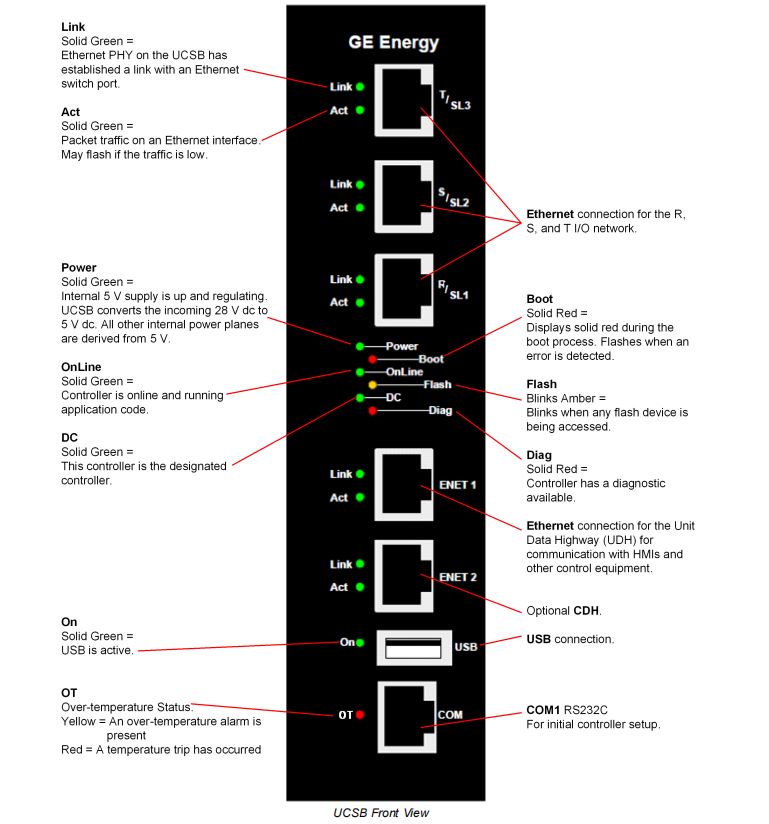
| Ethernet Interfaces | 2 × RJ-45 ports (10/100Base-TX) for UDH and optional CDH |
| IONet Interfaces | 3 × RJ-45 ports (10/100Base-TX) for I/O module communication |
| Serial Port | 1 × RS-232C (via RJ-45 connector), used for initial setup |
| USB Port | 1 × front USB 2.0 port for system backup and restore |
| Input Voltage | 28 V DC (range: 18–36 V DC) |
| Typical Power | 15.6 W |
| Peak Power | 26.7 W |
| Operating Temp. | -30°C to 65°C (-22°F to 149°F) |
| Storage Temp. | -40°C to 85°C (-40°F to 185°F) |
| Humidity | 5% to 95% non-condensing |
| Cooling | Fanless, convection cooling |
| Dimensions | Standard module form factor (exact dimensions not specified in document) |
| Weight | 2.4 lbs (1.09 kg) |
| Mounting | Panel mount or DIN-rail mount |
| LED Indicators | Link, Act, Power, Online, Flash, Diag, Boot |
| USB Recovery | Supports backup/restore via FAT32 USB drive (min. 4 GB) |
| Recovery Button | Located on rear of controller |
| Network Protocol | TCP/IP, Ethernet Global Data (EGD), Modbus TCP |
| Time Sync | IEEE 1588 Precision Time Protocol (PTP) for I/O pack synchronization |
| Redundancy Support | Simplex, Dual, or TMR architectures |
| Certifications | Complies with industrial standards for vibration, shock, and EMC (see Chapter 28) |
| Category | Specification Details |
|---|---|
| Microprocessor | Intel EP80579, 1066 MHz |
| Memory | 256 MB DDR2 SDRAM with Error-Correcting Code (ECC) |
| Flash Memory | 2 GB NAND Flash |
| Non-Volatile Memory | 8 KB Flash-backed SRAM (allocated as NVRAM for controller functions) |
| Operating System | QNX Neutrino (real-time multitasking OS) |
| Programming Support | Control block language (analog and discrete blocks); relay ladder diagram logic |
| Data Types | Boolean, 16/32-bit signed/unsigned integers, 32/64-bit floating point |
| Ethernet Interfaces | 2 × RJ-45 ports (10/100Base-TX) for UDH and optional CDH |
| IONet Interfaces | 3 × RJ-45 ports (10/100Base-TX) for I/O module communication |
| Serial Port | 1 × RS-232C (via RJ-45 connector), used for initial setup |
| USB Port | 1 × front USB 2.0 port for system backup and restore |
| Input Voltage | 28 V DC (range: 18–36 V DC) |
| Typical Power | 15.6 W |
| Peak Power | 26.7 W |
| Operating Temp. | -30°C to 65°C (-22°F to 149°F) |
| Storage Temp. | -40°C to 85°C (-40°F to 185°F) |
| Humidity | 5% to 95% non-condensing |
| Cooling | Fanless, convection cooling |
| Dimensions | Standard module form factor (exact dimensions not specified in document) |
| Weight | 2.4 lbs (1.09 kg) |
| Mounting | Panel mount or DIN-rail mount |
| LED Indicators | Link, Act, Power, Online, Flash, Diag, Boot |
| USB Recovery | Supports backup/restore via FAT32 USB drive (min. 4 GB) |
| Recovery Button | Located on rear of controller |
| Network Protocol | TCP/IP, Ethernet Global Data (EGD), Modbus TCP |
| Time Sync | IEEE 1588 Precision Time Protocol (PTP) for I/O pack synchronization |
| Redundancy Support | Simplex, Dual, or TMR architectures |
| Certifications | Complies with industrial standards for vibration, shock, and EMC (see Chapter 28) |