GE
IS420UCSBH3A
$8000
In Stock
T/T
Xiamen
| Availability: | |
|---|---|
| Quantity: | |
The IS420UCSBH3A is a standalone controller module within GE's Mark VIe Control System, belonging to the UCSx controller family. Designed for industrial automation and critical control applications such as gas turbines, steam turbines, wind power, hydroelectric power, and balance of plant (BOP) systems, this controller features a high-performance Intel processor and runs the QNX Neutrino real-time operating system (RTOS). It offers high reliability, substantial processing power, and flexible communication interfaces suitable for various industrial environments.
The IS420UCSBH3A is a standalone single-board computer that integrates the processor, memory, communication interfaces, and power supply into a compact enclosure. Its main hardware components include:
Processor: Utilizes an Intel EP80579 series processor with a clock speed of 1200 MHz, delivering robust computational performance.
Memory: Equipped with 256 MB of DDR2 SDRAM featuring Error-Correcting Code (ECC) for enhanced data integrity. It also includes 2 GB of NAND Flash for storing application code and system images.
Communication Interfaces:
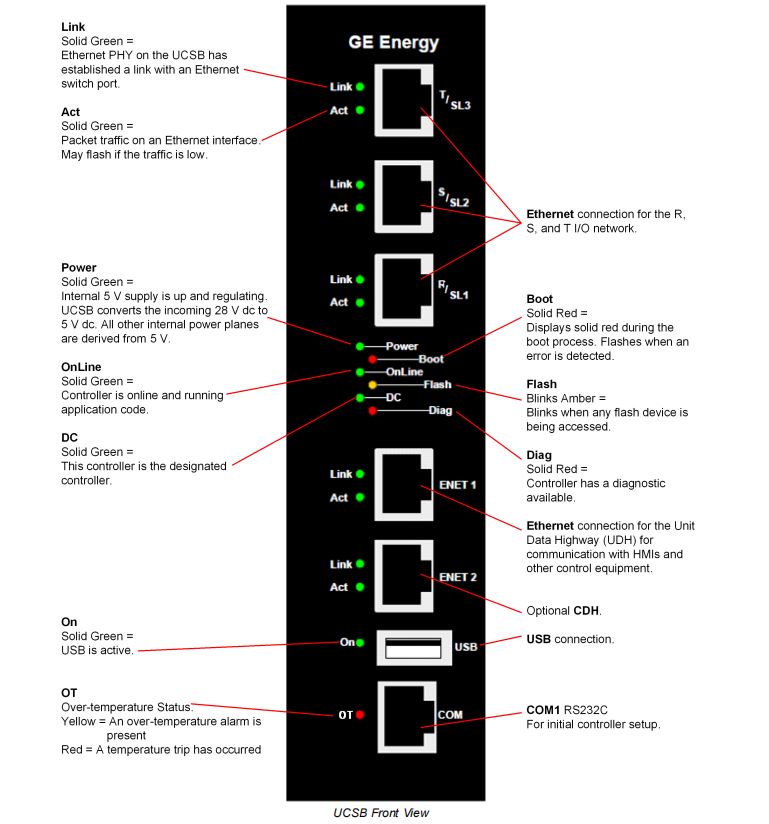
Two 10/100Base-TX Ethernet ports for connection to the Unit Data Highway (UDH) and an optional Control Data Highway (CDH).
Three additional 10/100Base-TX Ethernet ports for connection to the R, S, and T I/O Networks (IONet), enabling communication with distributed I/O packs.
One RS-232C serial port (COM1) for initial setup and configuration.
One USB port for software recovery and backup procedures.
Power Input: Accepts a wide-range 28 V DC input, with built-in power conversion circuitry.
Cooling System: Incorporates a dual-redundant fan assembly to ensure reliable operation in elevated ambient temperatures.
The controller runs the QNX Neutrino real-time operating system, designed for high-reliability, high-speed industrial applications. The system supports the following programming paradigms:
Control Block Language: For analog and discrete control blocks.
Relay Ladder Diagram (RLD): For representing Boolean logic.
Supported Data Types: Include Boolean, 16-bit and 32-bit signed/unsigned integers, and 32-bit and 64-bit floating-point numbers.
The controller uses the IEEE 1588 Precision Time Protocol (PTP) over the R, S, and T IONets to synchronize the clocks of I/O packs and other controllers to within ±100 microseconds. It supports the following communication protocols:
TCP/IP: For communication with the ToolboxST engineering tool and Human-Machine Interfaces (HMIs).
Ethernet Global Data (EGD): For exchanging application variables with CIMPLICITY HMI and Series 90-70 PLCs.
Ethernet Modbus (Modbus TCP): Supported for communication with third-party Distributed Control Systems (DCS).
Dual-Network Redundancy: Supports two independent IONet connections; both paths are active simultaneously, ensuring communication continues uninterrupted if one network fails.
Auto-Reconfiguration: Facilitates hot-swapping and automatic module recognition.
Watchdog Timer: Monitors system operation to prevent lock-ups.
| Feature | IS420UCSBH3A | IS420UCSBH1A |
|---|---|---|
| Processor Speed | 1200 MHz | 600 MHz |
| Memory Type | DDR2 SDRAM with ECC | Details on ECC support not explicitly stated |
| Flash Memory | 2 GB NAND Flash | Not explicitly specified |
| Cooling Method | Dual Redundant Fans (Active) | Fanless (Passive) |
| Operating Temperature | 0°C to 65°C (32°F to 149°F) | -30°C to 65°C (-22°F to 149°F) |
| Peak Power Consumption | 28.7 W | 26.7 W |
| Nominal Power Consumption | 17.3 W | 15.6 W |
| Weight | 2.9 lbs (1.3 kg) | 2.4 lbs (1.1 kg) |
Processing Power: The IS420UCSBH3A's processor is twice as fast as the H1A's, making it suitable for applications requiring higher computational density, such as complex control algorithms, high-speed data acquisition, and real-time signal processing.
Memory and Reliability: The H3A's ECC memory can detect and correct single-bit errors, enhancing system stability in harsh industrial environments.
Thermal Design: The H3A's active cooling with dual fans makes it suitable for high-temperature or enclosed panel environments. The H1A's fanless design is advantageous in dusty environments or where silence is required.
Temperature Tolerance: The H1A supports a lower starting temperature (-30°C), making it better suited for installations in cold climates. The H3A's operating range is typical for standard industrial environments.
Power and Weight: Due to its higher-performance processor and fan system, the H3A has slightly higher power consumption and weight compared to the H1A.
Gas Turbine Control (Frame 6, 7, 9)
Steam Turbine Control
Wind Turbine Generator Control
Hydroelectric Turbine Control
Balance of Plant (BOP) Systems
Process Automation and Monitoring
The IS420UCSBH3A is a standalone controller module within GE's Mark VIe Control System, belonging to the UCSx controller family. Designed for industrial automation and critical control applications such as gas turbines, steam turbines, wind power, hydroelectric power, and balance of plant (BOP) systems, this controller features a high-performance Intel processor and runs the QNX Neutrino real-time operating system (RTOS). It offers high reliability, substantial processing power, and flexible communication interfaces suitable for various industrial environments.
The IS420UCSBH3A is a standalone single-board computer that integrates the processor, memory, communication interfaces, and power supply into a compact enclosure. Its main hardware components include:
Processor: Utilizes an Intel EP80579 series processor with a clock speed of 1200 MHz, delivering robust computational performance.
Memory: Equipped with 256 MB of DDR2 SDRAM featuring Error-Correcting Code (ECC) for enhanced data integrity. It also includes 2 GB of NAND Flash for storing application code and system images.
Communication Interfaces:
Two 10/100Base-TX Ethernet ports for connection to the Unit Data Highway (UDH) and an optional Control Data Highway (CDH).
Three additional 10/100Base-TX Ethernet ports for connection to the R, S, and T I/O Networks (IONet), enabling communication with distributed I/O packs.
One RS-232C serial port (COM1) for initial setup and configuration.
One USB port for software recovery and backup procedures.
Power Input: Accepts a wide-range 28 V DC input, with built-in power conversion circuitry.
Cooling System: Incorporates a dual-redundant fan assembly to ensure reliable operation in elevated ambient temperatures.
The controller runs the QNX Neutrino real-time operating system, designed for high-reliability, high-speed industrial applications. The system supports the following programming paradigms:
Control Block Language: For analog and discrete control blocks.
Relay Ladder Diagram (RLD): For representing Boolean logic.
Supported Data Types: Include Boolean, 16-bit and 32-bit signed/unsigned integers, and 32-bit and 64-bit floating-point numbers.
The controller uses the IEEE 1588 Precision Time Protocol (PTP) over the R, S, and T IONets to synchronize the clocks of I/O packs and other controllers to within ±100 microseconds. It supports the following communication protocols:
TCP/IP: For communication with the ToolboxST engineering tool and Human-Machine Interfaces (HMIs).
Ethernet Global Data (EGD): For exchanging application variables with CIMPLICITY HMI and Series 90-70 PLCs.
Ethernet Modbus (Modbus TCP): Supported for communication with third-party Distributed Control Systems (DCS).
Dual-Network Redundancy: Supports two independent IONet connections; both paths are active simultaneously, ensuring communication continues uninterrupted if one network fails.
Auto-Reconfiguration: Facilitates hot-swapping and automatic module recognition.
Watchdog Timer: Monitors system operation to prevent lock-ups.
| Feature | IS420UCSBH3A | IS420UCSBH1A |
|---|---|---|
| Processor Speed | 1200 MHz | 600 MHz |
| Memory Type | DDR2 SDRAM with ECC | Details on ECC support not explicitly stated |
| Flash Memory | 2 GB NAND Flash | Not explicitly specified |
| Cooling Method | Dual Redundant Fans (Active) | Fanless (Passive) |
| Operating Temperature | 0°C to 65°C (32°F to 149°F) | -30°C to 65°C (-22°F to 149°F) |
| Peak Power Consumption | 28.7 W | 26.7 W |
| Nominal Power Consumption | 17.3 W | 15.6 W |
| Weight | 2.9 lbs (1.3 kg) | 2.4 lbs (1.1 kg) |
Processing Power: The IS420UCSBH3A's processor is twice as fast as the H1A's, making it suitable for applications requiring higher computational density, such as complex control algorithms, high-speed data acquisition, and real-time signal processing.
Memory and Reliability: The H3A's ECC memory can detect and correct single-bit errors, enhancing system stability in harsh industrial environments.
Thermal Design: The H3A's active cooling with dual fans makes it suitable for high-temperature or enclosed panel environments. The H1A's fanless design is advantageous in dusty environments or where silence is required.
Temperature Tolerance: The H1A supports a lower starting temperature (-30°C), making it better suited for installations in cold climates. The H3A's operating range is typical for standard industrial environments.
Power and Weight: Due to its higher-performance processor and fan system, the H3A has slightly higher power consumption and weight compared to the H1A.
Gas Turbine Control (Frame 6, 7, 9)
Steam Turbine Control
Wind Turbine Generator Control
Hydroelectric Turbine Control
Balance of Plant (BOP) Systems
Process Automation and Monitoring
| Category | Specification Details |
|---|---|
| Microprocessor | Intel EP80579, 1200 MHz |
| Memory | 256 MB DDR2 SDRAM with Error-Correcting Code (ECC) |
| Flash Memory | 2 GB NAND Flash |
| Non-Volatile Memory | 8 KB Flash-backed SRAM (allocated as NVRAM for controller functions) |
| Operating System | QNX Neutrino (real-time multitasking OS) |
| Programming Support | Control block language (analog and discrete blocks); relay ladder diagram logic |
| Data Types | Boolean, 16/32-bit signed/unsigned integers, 32/64-bit floating point |
| Ethernet Interfaces | 2 × RJ-45 ports (10/100Base-TX) for UDH and optional CDH |
| IONet Interfaces | 3 × RJ-45 ports (10/100Base-TX) for I/O module communication |
| Serial Port | 1 × RS-232C (via RJ-45 connector), used for initial setup |
| USB Port | 1 × front USB 2.0 port for system backup and restore |
| Input Voltage | 28 V DC (range: 18–36 V DC) |
| Typical Power | 15.6 W |
| Peak Power | 26.7 W |
| Operating Temp. | -30°C to 65°C (-22°F to 149°F) |
| Storage Temp. | -40°C to 85°C (-40°F to 185°F) |
| Humidity | 5% to 95% non-condensing |
| Cooling | Fanless, convection cooling |
| Dimensions | Standard module form factor (exact dimensions not specified in document) |
| Weight | 2.4 lbs (1.09 kg) |
| Mounting | Panel mount or DIN-rail mount |
| LED Indicators | Link, Act, Power, Online, Flash, Diag, Boot |
| USB Recovery | Supports backup/restore via FAT32 USB drive (min. 4 GB) |
| Recovery Button | Located on rear of controller |
| Network Protocol | TCP/IP, Ethernet Global Data (EGD), Modbus TCP |
| Time Sync | IEEE 1588 Precision Time Protocol (PTP) for I/O pack synchronization |
| Redundancy Support | Simplex, Dual, or TMR architectures |
| Certifications | Complies with industrial standards for vibration, shock, and EMC (see Chapter 28) |
| Category | Specification Details |
|---|---|
| Microprocessor | Intel EP80579, 1200 MHz |
| Memory | 256 MB DDR2 SDRAM with Error-Correcting Code (ECC) |
| Flash Memory | 2 GB NAND Flash |
| Non-Volatile Memory | 8 KB Flash-backed SRAM (allocated as NVRAM for controller functions) |
| Operating System | QNX Neutrino (real-time multitasking OS) |
| Programming Support | Control block language (analog and discrete blocks); relay ladder diagram logic |
| Data Types | Boolean, 16/32-bit signed/unsigned integers, 32/64-bit floating point |
| Ethernet Interfaces | 2 × RJ-45 ports (10/100Base-TX) for UDH and optional CDH |
| IONet Interfaces | 3 × RJ-45 ports (10/100Base-TX) for I/O module communication |
| Serial Port | 1 × RS-232C (via RJ-45 connector), used for initial setup |
| USB Port | 1 × front USB 2.0 port for system backup and restore |
| Input Voltage | 28 V DC (range: 18–36 V DC) |
| Typical Power | 15.6 W |
| Peak Power | 26.7 W |
| Operating Temp. | -30°C to 65°C (-22°F to 149°F) |
| Storage Temp. | -40°C to 85°C (-40°F to 185°F) |
| Humidity | 5% to 95% non-condensing |
| Cooling | Fanless, convection cooling |
| Dimensions | Standard module form factor (exact dimensions not specified in document) |
| Weight | 2.4 lbs (1.09 kg) |
| Mounting | Panel mount or DIN-rail mount |
| LED Indicators | Link, Act, Power, Online, Flash, Diag, Boot |
| USB Recovery | Supports backup/restore via FAT32 USB drive (min. 4 GB) |
| Recovery Button | Located on rear of controller |
| Network Protocol | TCP/IP, Ethernet Global Data (EGD), Modbus TCP |
| Time Sync | IEEE 1588 Precision Time Protocol (PTP) for I/O pack synchronization |
| Redundancy Support | Simplex, Dual, or TMR architectures |
| Certifications | Complies with industrial standards for vibration, shock, and EMC (see Chapter 28) |