GE
IS420ESWAH3A
$2700
In Stock
T/T
Xiamen
| Availability: | |
|---|---|
| Quantity: | |
The IS420ESWAH3A is a core product within GE's ESWA series of industrial unmanaged Ethernet switches. It is specifically designed to meet the demands of real-time control and communication in harsh industrial environments, offering high reliability, stability, and environmental adaptability. This model provides 8 10/100BASE-TX copper ports and does not include fiber uplinks, making it a pure, compact copper access switch ideally suited for providing local network connectivity and aggregation for a moderate number of field devices (such as PLCs, I/O modules, drives, HMIs) within a control cabinet. As an unmanaged switch, it embodies a "plug-and-play" design philosophy, starting operation automatically upon power-up without any software configuration, greatly simplifying installation and maintenance procedures and reducing the total cost of ownership for users.
Industrial Standard Compliance: Fully supports IEEE 802.3 (10BASE-T Ethernet), IEEE 802.3u (100BASE-TX Fast Ethernet), and IEEE 802.3x (Flow Control) standards, ensuring seamless interoperability with mainstream industrial devices.
Intelligent Port Negotiation: All 8 RJ-45 ports support auto-negotiation for 10/100 Mbps speed, full/half-duplex mode, and feature HP-MDIX (Auto Cable Polarity Detection), eliminating the need to distinguish between straight-through and crossover cables and simplifying wiring tasks.
Reliable Switching Architecture: Employs Store-and-Forward mechanism, which checks data integrity before forwarding, effectively enhancing network data reliability.
Efficient Flow Control: Supports IEEE 802.3x Pause frame-based flow control, allowing it to pause data transmission during network congestion to prevent packet loss and ensure the real-time performance of critical control commands.
Industrial-Grade Construction: Compact metal housing supporting DIN-rail or panel mounting, capable of withstanding vibration, shock, and electromagnetic interference common in industrial settings.
Wide Voltage Power Input: Supports a broad 18-36 V DC input range and features two redundant power inputs, providing power supply redundancy and enhancing system availability.
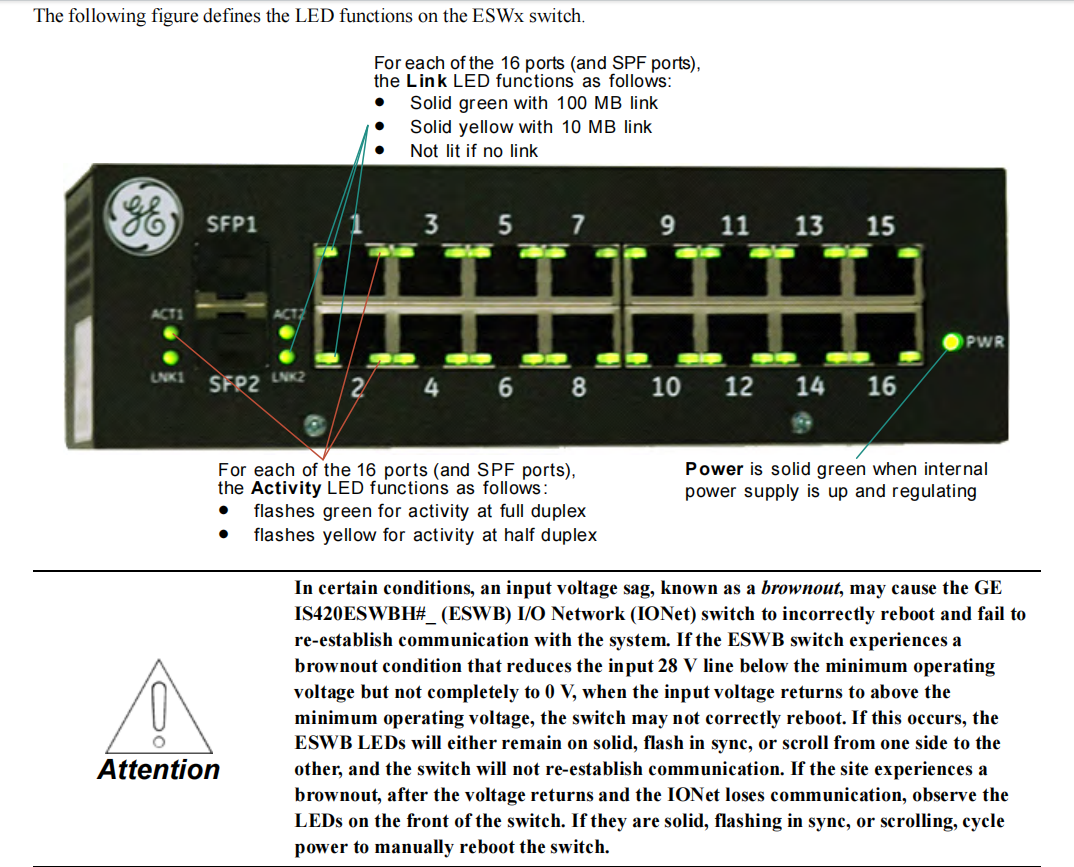
Intuitive Status Diagnostics: The front panel provides comprehensive LED indicators, including per-port Link/Speed (Green=100Mbps/Yellow=10Mbps), Activity (Green flash=Full duplex/Yellow flash=Half duplex), and a global Power indicator, facilitating quick network status diagnosis.
Robust Environmental Tolerance: Wide operating temperature range of -40°C to +70°C, compliant with IEC 60721-3-3 Class 3C2 specifications, and features corrosion protection, making it suitable for various harsh industrial sites.
Although categorized as an unmanaged device, the internal operation of the IS420ESWAH3A involves sophisticated network communication principles and designs optimized for industrial applications, forming the foundation of its high reliability and stability.
1. Core Switching Principle: Store-and-Forward Mechanism
The IS420ESWAH3A utilizes the classic "Store-and-Forward" switching architecture. This mechanism is central to its stable operation in industrial networks. When a data frame enters the switch via a port, the switch's ASIC (Application-Specific Integrated Circuit) does not forward it immediately. Instead, it receives the entire frame completely and temporarily stores it in its internal high-speed data buffer. During this buffering period, the switch performs several critical operations:
Integrity Check (CRC Verification): The switch calculates and verifies the frame's Cyclic Redundancy Check code. If any errors are detected (e.g., data corruption due to noise interference), the switch discards the erroneous frame outright, preventing it from propagating further through the network. This process acts like a quality inspection station, ensuring that only "qualified" frames are forwarded, significantly enhancing the data integrity and reliability of the entire network.
Destination Address Learning and Lookup: After confirming frame integrity, the switch examines the destination MAC address in the Ethernet header. It maintains an internal MAC address table with a capacity of up to 4K entries, which dynamically records the association between each MAC address and the corresponding switch port. By querying this table, the switch accurately determines from which port (or ports, in the case of multicast/broadcast) the data frame should be forwarded.
Decision and Forwarding: Only after completing all the above steps does the switch transmit the data frame from the determined egress port(s).
This "receive-first, check-then-forward" model, while introducing a minimal, often negligible delay in industrial Ethernet contexts, offers unparalleled data reliability advantages. It is ideally suited for industrial environments where data errors cannot be tolerated, as they could lead to control logic failures or production downtime.
2. Data Flow Management and Buffering Mechanism
Industrial control networks often experience bursty data traffic, such as multiple sensors reporting data simultaneously or controllers issuing broadcast/multicast commands. To handle scenarios where multiple data streams arrive concurrently, the IS420ESWAH3A is equipped with a shared data packet buffer of no less than 256 KB.
This buffer functions like an intelligent traffic hub. When multiple ports have data needing egress through the same port simultaneously, the switch can only process one packet at a time. The buffer temporarily stores the packets "waiting to pass," sending them sequentially according to queue management rules. This effectively prevents data packet collisions and loss during traffic peaks. Particularly in systems utilizing the IEEE 1588 Precision Time Protocol (PTP), the timely and lossless transmission of time-sensitive packets is crucial. The ample buffer ensures that even under high network load, these critical timing messages are handled properly and not dropped, thereby safeguarding the synchronization accuracy of the entire control system.
3. Flow Control and Network Congestion Avoidance
Network conditions can involve port speed mismatches or instantaneous traffic surges. For instance, a 100 Mbps port sending data to a 10 Mbps device that is processing heavy traffic might overwhelm the receiver. The IEEE 802.3x flow control capability of the IS420ESWAH3A is designed precisely to address this issue.
When the receive buffer of a switch port is nearing capacity, it proactively sends a special "Pause" frame to the data sender (which could be another switch or an end device). This frame acts like a traffic police officer's "stop" signal, requesting the sender to halt transmissions for a specified period. Once sufficient space becomes available in the receiver's buffer, communication automatically resumes. This backpressure flow control mechanism is an effective network congestion prevention measure. It smoothens network traffic flow and prevents packet loss due to buffer overflow. This function is indispensable for real-time industrial control applications that require deterministic latency and high reliability.
4. Auto-Negotiation and Physical Link Stability
Each RJ-45 port on the switch incorporates intelligent auto-negotiation protocols. When a device is connected to a port, the two parties automatically "negotiate" the best communication mode – including the highest common speed (100 Mbps or 10 Mbps) and the optimal duplex mode (full or half duplex). Full duplex mode allows for simultaneous data transmission and reception, eliminating the collision domain and significantly improving channel utilization. This automated process eliminates the hassle of manual configuration and prevents network performance degradation or link failures caused by speed/duplex mismatches.
Furthermore, the RJ-45 connectors are ruggedized, rated for a minimum of 200 mating cycles, and structurally designed to account for static stresses (like cable weight) and dynamic stresses (such as vibration during transport and operation) common in industrial environments, ensuring long-term physical connection stability.
5. Industrial Environmental Adaptation Design Principles
The reliability of the IS420ESWAH3A stems from its industrial-grade design from the ground up. Its wide voltage input range (18-36 V DC) can handle common voltage fluctuations and instability in industrial settings. The dual redundant power input design allows connection to two independent power sources; if the primary source fails, the system seamlessly switches to the backup, achieving high availability.
Its soft-start circuit effectively limits inrush current during power-on (to less than 200% of normal operating current), preventing surges on the power supply system. For thermal management, the device uses a fanless natural convection cooling design, ensuring stable operation across the wide -40°C to +70°C temperature range through a carefully designed heatsink casing. Its high MTBF (Mean Time Between Failures) exceeding 4 million hours (at 35°C) fully demonstrates its exceptional reliability for long-term continuous operation.
Mounting Options: Supports standard DIN-rail mounting (using dedicated clips 259B2451BVP1 or BVP2) or panel mounting, offering flexible installation to suit different cabinet layouts.
Power Connection: Uses Phoenix MC 1.5/ST-3.81 terminals, accepting wire sizes from 28 to 16 AWG (0.14 to 1.5 mm²), with a recommended screw torque of 0.22-0.25 Nm.
Network Connection: Use standard Cat 5e or higher grade shielded/unshielded twisted pair cables for connectivity.
Network access for small-scale PLC control systems or remote I/O stations
Device-level networks in factory automation production lines
Networking of intelligent devices in power distribution systems
Network device connectivity within traffic signal control cabinets
Network aggregation for various sensors in environmental monitoring systems
The IS420ESWAH3A and IS420ESWBH3A belong to the same family of GE industrial unmanaged switches, sharing high consistency in design philosophy, core functionality, and reliability standards. However, they differ significantly in several key parameters, aiming to meet the needs of different scales and requirements of industrial applications. Below is a detailed comparison:
Product Series & Port Count (Core Difference)
IS420ESWAH3A: Part of the ESWA series, which is the foundational 8-port switch family. The H3A model provides 8 10/100BASE-TX copper ports.
IS420ESWBH3A: Part of the ESWB series, which is the 16-port switch family. The H3A model provides 16 10/100BASE-TX copper ports.
Comparison Summary: The ESWBH3A offers twice the network access capacity of the ESWAH3A, suitable for scenarios requiring connection to more end devices.
Physical Dimensions & Space Occupancy
IS420ESWAH3A: Dimensions are 138 mm (W) x 86 mm (D) x 56 mm (H), making it more compact.
IS420ESWBH3A: Dimensions are 188 mm (W) x 86 mm (D) x 56 mm (H). Its width is significantly larger due to the doubled port count.
Comparison Summary: The ESWAH3A occupies less space inside control cabinets, making it more suitable for space-constrained, compact installations.
Power Consumption & Heat Dissipation
IS420ESWAH3A: Maximum operating current < 0.5 A, indicating lower power consumption.
IS420ESWBH3A: Maximum operating current < 1.0 A, approximately double the consumption of the ESWAH3A.
Comparison Summary: The ESWAH3A is more energy-efficient, places less demand on the power system, and generates relatively less heat.
Operating Temperature Range
IS420ESWAH3A: Operating temperature range is -40°C to +70°C.
IS420ESWBH3A: Operating temperature range is -30°C to +65°C.
Comparison Summary: The ESWAH3A offers superior adaptability to extreme temperatures, making it particularly suitable for harsher environments with lower or higher temperatures.
Applicable DIN-Rail Clips
IS420ESWAH3A requires clip 259B2451BVP2.
IS420ESWBH3A requires clip 259B2451BVP4.
Although both support DIN-rail mounting, they require different clip models due to their differing sizes. For example, when mounting with the long edge of the switch body perpendicular to the rail:
Selection Guidance:
If you need to connect 8 or fewer devices, have limited space, and have higher requirements for low power consumption and extreme temperature tolerance, the IS420ESWAH3A is the more economical and suitable choice.
If you need to connect between 9 and 16 devices and have sufficient cabinet space, the IS420ESWBH3A provides greater port density, meeting requirements with a single unit and avoiding the complexity and cost associated with using multiple smaller switches.
The IS420ESWAH3A is a core product within GE's ESWA series of industrial unmanaged Ethernet switches. It is specifically designed to meet the demands of real-time control and communication in harsh industrial environments, offering high reliability, stability, and environmental adaptability. This model provides 8 10/100BASE-TX copper ports and does not include fiber uplinks, making it a pure, compact copper access switch ideally suited for providing local network connectivity and aggregation for a moderate number of field devices (such as PLCs, I/O modules, drives, HMIs) within a control cabinet. As an unmanaged switch, it embodies a "plug-and-play" design philosophy, starting operation automatically upon power-up without any software configuration, greatly simplifying installation and maintenance procedures and reducing the total cost of ownership for users.
Industrial Standard Compliance: Fully supports IEEE 802.3 (10BASE-T Ethernet), IEEE 802.3u (100BASE-TX Fast Ethernet), and IEEE 802.3x (Flow Control) standards, ensuring seamless interoperability with mainstream industrial devices.
Intelligent Port Negotiation: All 8 RJ-45 ports support auto-negotiation for 10/100 Mbps speed, full/half-duplex mode, and feature HP-MDIX (Auto Cable Polarity Detection), eliminating the need to distinguish between straight-through and crossover cables and simplifying wiring tasks.
Reliable Switching Architecture: Employs Store-and-Forward mechanism, which checks data integrity before forwarding, effectively enhancing network data reliability.
Efficient Flow Control: Supports IEEE 802.3x Pause frame-based flow control, allowing it to pause data transmission during network congestion to prevent packet loss and ensure the real-time performance of critical control commands.
Industrial-Grade Construction: Compact metal housing supporting DIN-rail or panel mounting, capable of withstanding vibration, shock, and electromagnetic interference common in industrial settings.
Wide Voltage Power Input: Supports a broad 18-36 V DC input range and features two redundant power inputs, providing power supply redundancy and enhancing system availability.
Intuitive Status Diagnostics: The front panel provides comprehensive LED indicators, including per-port Link/Speed (Green=100Mbps/Yellow=10Mbps), Activity (Green flash=Full duplex/Yellow flash=Half duplex), and a global Power indicator, facilitating quick network status diagnosis.
Robust Environmental Tolerance: Wide operating temperature range of -40°C to +70°C, compliant with IEC 60721-3-3 Class 3C2 specifications, and features corrosion protection, making it suitable for various harsh industrial sites.
Although categorized as an unmanaged device, the internal operation of the IS420ESWAH3A involves sophisticated network communication principles and designs optimized for industrial applications, forming the foundation of its high reliability and stability.
1. Core Switching Principle: Store-and-Forward Mechanism
The IS420ESWAH3A utilizes the classic "Store-and-Forward" switching architecture. This mechanism is central to its stable operation in industrial networks. When a data frame enters the switch via a port, the switch's ASIC (Application-Specific Integrated Circuit) does not forward it immediately. Instead, it receives the entire frame completely and temporarily stores it in its internal high-speed data buffer. During this buffering period, the switch performs several critical operations:
Integrity Check (CRC Verification): The switch calculates and verifies the frame's Cyclic Redundancy Check code. If any errors are detected (e.g., data corruption due to noise interference), the switch discards the erroneous frame outright, preventing it from propagating further through the network. This process acts like a quality inspection station, ensuring that only "qualified" frames are forwarded, significantly enhancing the data integrity and reliability of the entire network.
Destination Address Learning and Lookup: After confirming frame integrity, the switch examines the destination MAC address in the Ethernet header. It maintains an internal MAC address table with a capacity of up to 4K entries, which dynamically records the association between each MAC address and the corresponding switch port. By querying this table, the switch accurately determines from which port (or ports, in the case of multicast/broadcast) the data frame should be forwarded.
Decision and Forwarding: Only after completing all the above steps does the switch transmit the data frame from the determined egress port(s).
This "receive-first, check-then-forward" model, while introducing a minimal, often negligible delay in industrial Ethernet contexts, offers unparalleled data reliability advantages. It is ideally suited for industrial environments where data errors cannot be tolerated, as they could lead to control logic failures or production downtime.
2. Data Flow Management and Buffering Mechanism
Industrial control networks often experience bursty data traffic, such as multiple sensors reporting data simultaneously or controllers issuing broadcast/multicast commands. To handle scenarios where multiple data streams arrive concurrently, the IS420ESWAH3A is equipped with a shared data packet buffer of no less than 256 KB.
This buffer functions like an intelligent traffic hub. When multiple ports have data needing egress through the same port simultaneously, the switch can only process one packet at a time. The buffer temporarily stores the packets "waiting to pass," sending them sequentially according to queue management rules. This effectively prevents data packet collisions and loss during traffic peaks. Particularly in systems utilizing the IEEE 1588 Precision Time Protocol (PTP), the timely and lossless transmission of time-sensitive packets is crucial. The ample buffer ensures that even under high network load, these critical timing messages are handled properly and not dropped, thereby safeguarding the synchronization accuracy of the entire control system.
3. Flow Control and Network Congestion Avoidance
Network conditions can involve port speed mismatches or instantaneous traffic surges. For instance, a 100 Mbps port sending data to a 10 Mbps device that is processing heavy traffic might overwhelm the receiver. The IEEE 802.3x flow control capability of the IS420ESWAH3A is designed precisely to address this issue.
When the receive buffer of a switch port is nearing capacity, it proactively sends a special "Pause" frame to the data sender (which could be another switch or an end device). This frame acts like a traffic police officer's "stop" signal, requesting the sender to halt transmissions for a specified period. Once sufficient space becomes available in the receiver's buffer, communication automatically resumes. This backpressure flow control mechanism is an effective network congestion prevention measure. It smoothens network traffic flow and prevents packet loss due to buffer overflow. This function is indispensable for real-time industrial control applications that require deterministic latency and high reliability.
4. Auto-Negotiation and Physical Link Stability
Each RJ-45 port on the switch incorporates intelligent auto-negotiation protocols. When a device is connected to a port, the two parties automatically "negotiate" the best communication mode – including the highest common speed (100 Mbps or 10 Mbps) and the optimal duplex mode (full or half duplex). Full duplex mode allows for simultaneous data transmission and reception, eliminating the collision domain and significantly improving channel utilization. This automated process eliminates the hassle of manual configuration and prevents network performance degradation or link failures caused by speed/duplex mismatches.
Furthermore, the RJ-45 connectors are ruggedized, rated for a minimum of 200 mating cycles, and structurally designed to account for static stresses (like cable weight) and dynamic stresses (such as vibration during transport and operation) common in industrial environments, ensuring long-term physical connection stability.
5. Industrial Environmental Adaptation Design Principles
The reliability of the IS420ESWAH3A stems from its industrial-grade design from the ground up. Its wide voltage input range (18-36 V DC) can handle common voltage fluctuations and instability in industrial settings. The dual redundant power input design allows connection to two independent power sources; if the primary source fails, the system seamlessly switches to the backup, achieving high availability.
Its soft-start circuit effectively limits inrush current during power-on (to less than 200% of normal operating current), preventing surges on the power supply system. For thermal management, the device uses a fanless natural convection cooling design, ensuring stable operation across the wide -40°C to +70°C temperature range through a carefully designed heatsink casing. Its high MTBF (Mean Time Between Failures) exceeding 4 million hours (at 35°C) fully demonstrates its exceptional reliability for long-term continuous operation.
Mounting Options: Supports standard DIN-rail mounting (using dedicated clips 259B2451BVP1 or BVP2) or panel mounting, offering flexible installation to suit different cabinet layouts.
Power Connection: Uses Phoenix MC 1.5/ST-3.81 terminals, accepting wire sizes from 28 to 16 AWG (0.14 to 1.5 mm²), with a recommended screw torque of 0.22-0.25 Nm.
Network Connection: Use standard Cat 5e or higher grade shielded/unshielded twisted pair cables for connectivity.
Network access for small-scale PLC control systems or remote I/O stations
Device-level networks in factory automation production lines
Networking of intelligent devices in power distribution systems
Network device connectivity within traffic signal control cabinets
Network aggregation for various sensors in environmental monitoring systems
The IS420ESWAH3A and IS420ESWBH3A belong to the same family of GE industrial unmanaged switches, sharing high consistency in design philosophy, core functionality, and reliability standards. However, they differ significantly in several key parameters, aiming to meet the needs of different scales and requirements of industrial applications. Below is a detailed comparison:
Product Series & Port Count (Core Difference)
IS420ESWAH3A: Part of the ESWA series, which is the foundational 8-port switch family. The H3A model provides 8 10/100BASE-TX copper ports.
IS420ESWBH3A: Part of the ESWB series, which is the 16-port switch family. The H3A model provides 16 10/100BASE-TX copper ports.
Comparison Summary: The ESWBH3A offers twice the network access capacity of the ESWAH3A, suitable for scenarios requiring connection to more end devices.
Physical Dimensions & Space Occupancy
IS420ESWAH3A: Dimensions are 138 mm (W) x 86 mm (D) x 56 mm (H), making it more compact.
IS420ESWBH3A: Dimensions are 188 mm (W) x 86 mm (D) x 56 mm (H). Its width is significantly larger due to the doubled port count.
Comparison Summary: The ESWAH3A occupies less space inside control cabinets, making it more suitable for space-constrained, compact installations.
Power Consumption & Heat Dissipation
IS420ESWAH3A: Maximum operating current < 0.5 A, indicating lower power consumption.
IS420ESWBH3A: Maximum operating current < 1.0 A, approximately double the consumption of the ESWAH3A.
Comparison Summary: The ESWAH3A is more energy-efficient, places less demand on the power system, and generates relatively less heat.
Operating Temperature Range
IS420ESWAH3A: Operating temperature range is -40°C to +70°C.
IS420ESWBH3A: Operating temperature range is -30°C to +65°C.
Comparison Summary: The ESWAH3A offers superior adaptability to extreme temperatures, making it particularly suitable for harsher environments with lower or higher temperatures.
Applicable DIN-Rail Clips
IS420ESWAH3A requires clip 259B2451BVP2.
IS420ESWBH3A requires clip 259B2451BVP4.
Although both support DIN-rail mounting, they require different clip models due to their differing sizes. For example, when mounting with the long edge of the switch body perpendicular to the rail:
Selection Guidance:
If you need to connect 8 or fewer devices, have limited space, and have higher requirements for low power consumption and extreme temperature tolerance, the IS420ESWAH3A is the more economical and suitable choice.
If you need to connect between 9 and 16 devices and have sufficient cabinet space, the IS420ESWBH3A provides greater port density, meeting requirements with a single unit and avoiding the complexity and cost associated with using multiple smaller switches.
| Item | Specification |
|---|---|
| Product Model | IS420ESWAH3A |
| Port Configuration | 8 x 10/100BASE-TX (RJ-45) |
| Network Standards | IEEE 802.3, 802.3u, 802.3x |
| Switching Architecture | Store-and-Forward |
| MAC Address Table | 4K entries |
| Packet Buffer | 256 KB |
| Flow Control | IEEE 802.3x Pause Frame |
| Power Input | 18-36 V DC, Redundant Inputs |
| Max. Power Consumption | < 0.5 A |
| Operating Temperature | -40°C to +70°C |
| Dimensions (W x D x H) | 138 x 86 x 56 mm |
| Mounting | DIN-rail or Panel Mount |
| LED Indicators | Per Port: Link/Speed, Activity; Global: Power |
| Item | Specification |
|---|---|
| Product Model | IS420ESWAH3A |
| Port Configuration | 8 x 10/100BASE-TX (RJ-45) |
| Network Standards | IEEE 802.3, 802.3u, 802.3x |
| Switching Architecture | Store-and-Forward |
| MAC Address Table | 4K entries |
| Packet Buffer | 256 KB |
| Flow Control | IEEE 802.3x Pause Frame |
| Power Input | 18-36 V DC, Redundant Inputs |
| Max. Power Consumption | < 0.5 A |
| Operating Temperature | -40°C to +70°C |
| Dimensions (W x D x H) | 138 x 86 x 56 mm |
| Mounting | DIN-rail or Panel Mount |
| LED Indicators | Per Port: Link/Speed, Activity; Global: Power |