GE
IS220PSCAH1A
$7000
In Stock
T/T
Xiamen
| Availability: | |
|---|---|
| Quantity: | |
The IS220PSCAH1A is a crucial interface component designed by General Electric (GE) for the Mark VIe and Mark VIeS distributed control systems, known as the PSCA Serial Communication I/O pack. This module plays a vital role in industrial automation and control systems, serving as a protocol conversion hub and electrical interface bridge between the upper-layer Ethernet control network and various lower-layer serial communication devices.
By integrating traditional, widely-used serial communication protocols (such as RS-232, RS-422, RS-485) into the modern Ethernet-based Mark VIe IONet, the PSCA module effectively resolves compatibility issues between old and new equipment, protects user investments, and enables unified data acquisition and management for numerous serial devices. It is particularly suited for industrial applications requiring communication with smart transmitters, variable frequency drives, drive systems, and other devices supporting Modbus or proprietary serial protocols.
The model number IS220PSCAH1A specifically indicates that it incorporates a BPPB model processor board, which acts as the module's "brain," responsible for executing communication protocols, managing data, and performing self-diagnostics.
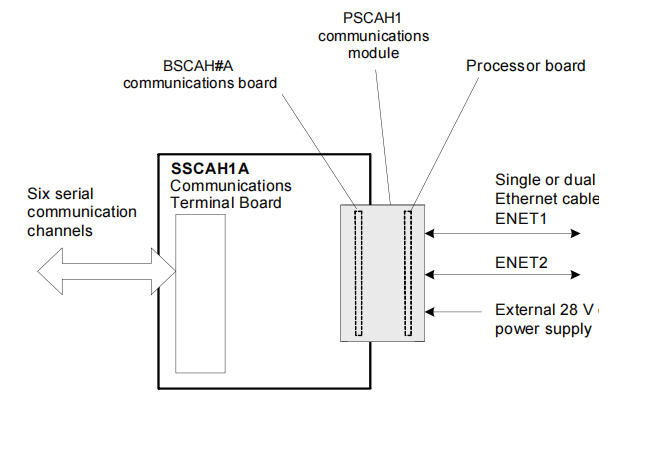
The hardware design of the PSCA module reflects a highly integrated and modular approach, consisting primarily of two parts:
Common Processor Board (BPPx): This is the common foundation for all Mark VIe distributed I/O packs. In the IS220PSCAH1A, it is specifically the BPPB processor board. It executes control logic, handles network communication, manages module power, and runs embedded diagnostic firmware. This processor board is the core for data exchange between the module and the Mark VIe controller.
Dedicated Serial Communication Board: This is the unique part of the PSCA module. This board integrates six independent serial communication channel transceivers, each configurable individually via software to adapt to different communication standards.
The module's physical interface design is compact and practical, primarily including:
Input Interfaces:
Dual RJ-45 Ethernet Ports (ENET1 & ENET2): These ports provide redundant or single network connections for the module. They connect to the Mark VIe IONet, forming the backbone for data exchange with the controller. The module can operate using either port alone. If both are connected, standard practice is to associate ENET1 with the primary (R) controller network, though the module itself is not sensitive to port selection and will auto-negotiate proper operation.
3-pin Power Input Connector: Supplies operating power. A key feature is the module's inherent soft-start capability, which controls inrush current during power-up, allowing for hot swapping, greatly facilitating maintenance.
Output Interface:
DC-62 pin High-density Connector: Located on the underside of the pack, it plugs directly into the corresponding SSCA Serial Communication Terminal Board. This connector carries signals for all six serial channels, power output, and identification signals between the pack and the terminal board.
Mechanical Fixing and Diagnostics:
Threaded inserts adjacent to the Ethernet ports allow mechanical securing using a mounting bracket specific to the terminal board type, ensuring a stable connection and preventing right-angle force on the DC-62 pin connector.
The module faceplate features multi-function indicator LEDs for real-time display of power status, network activity, processor status, and individual channel communication status, providing intuitive visual diagnostics for field engineers.
The functionality of the PSCA module goes beyond simple signal conversion; it implements complex, configurable communication services. Its working principles can be understood in depth from three aspects: data flow, protocol support, and specific services.
This is the core function of the PSCA module. Its six serial channels are independent communication entities, each flexibly configurable:
Supported Standards:
RS-232: A common point-to-point, full-duplex standard for short distances (max 15 m), with a maximum rate of 115.2 kbps. Suitable for connecting to PCs, local display units, etc.
RS-422: A differential signaling standard supporting point-to-multipoint communication, with strong noise immunity, a transmission distance up to 305 m, and a high maximum rate of 375 kbps. Ideal for applications requiring longer distances and higher speeds.
RS-485 (Half-Duplex only): A widely used multipoint communication standard also using differential transmission, offering excellent noise immunity, a distance of 305 m, and a rate of 115.2 kbps. Each RS-485 channel can support up to 8 drop devices, with a maximum of 18 devices per PSCA board. Ideal for building small device networks.
Configuration Flexibility: The physical layer characteristics of each channel can be independently configured via the ToolboxST engineering software, including:
Baud Rate (300 to 115200 bps)
Data Bits (7 or 8)
Stop Bits (1 or 2)
Parity (None, Odd, Even)
Station Addresses (for multi-drop identification)
Implementation Mechanism: The actual electrical characteristics and termination are set not on the PSCA pack itself, but on its matching SSCA Terminal Board. Jumpers on the terminal board configure the termination resistors and line configuration required for the selected communication mode (RS-232/422/485). The PSCA pack sends signals to the terminal board via the DC-62 pin connector, which then connects to the field serial devices.
Data flow from the PSCA to the controller is handled in two distinct types, reflecting its hierarchical processing capability:
Fixed I/O:
Honeywell Pressure Transducers: Use RS-422, dedicated to ports 1 and 2. Each port supports up to 6 transducers. The protocol includes robust fault tolerance, like communication miss counters. After 4 consecutive misses, the module forces the input pressure to a safe value (1.0 psi) and raises a diagnostic alarm; after 4 consecutive successful communications, it removes the forcing and clears the alarm.
Kollmorgen Electric Drive: Can use any three ports (but no more than three), employs RS-422 point-to-point communication at 19200 baud.
Each signal is mapped into the controller's signal space and can be used directly by control logic.
Each signal has an individual health bit reflecting its quality in real-time.
Supports offset and gain scaling to convert raw data into engineering units.
Many of these signals are configured for system limit checking, capable of triggering alarms or interlock protection.
Definition: This data is associated with specific, high-performance devices, explicitly mentioned in the document as Honeywell Smart Pressure Transducers and Kollmorgen Electric Drive data.
Processing Mechanism: Fixed I/O receives the highest priority processing. Data is completely processed every frame, identical to conventional I/O. This means:
Communication Characteristics:
Modbus I/O (Second Class I/O):
Data Coherency: Coherency is guaranteed only at the signal level, not at the device or board level. This means signals from the same device might not be sampled simultaneously in a single transfer.
Health Monitoring: Health bits are assigned to individual points. Three consecutive time-outs are required before a signal is declared unhealthy. The input value is cleared after a fourth consecutive time-out occurs for that signal.
No System Limit Checking: Due to batch processing and non-real-time nature, system limit checking is not performed on these signals.
Definition: This data comes from various slave devices connected via the Modbus protocol. Due to the potentially large data volume, it cannot be fully processed every frame.
Processing Mechanism: Modbus data is classified as "Second Class I/O." The module packages multiple signals and transfers them in bulk to the Mark VIe controller via a special service on the IONet at a lower update rate (configurable: 0.5, 1, 2, or 4 Hz).
The PSCA module supports operating as a Modbus Master on all six serial ports. This means it can actively poll Modbus slave devices on the serial network to request (read) or send (write) data.
Configurable Parameters (Port Level): In addition to basic serial parameters (baud rate, etc.), this includes:
Station Address List.
Time-out (milliseconds) per device.
32-bit Data Word Ordering (e.g., LSW or MSW first), crucial for handling floats or long integers.
Device Response Delay Time.
Configurable Parameters (Signal Level): In ToolboxST, for each Modbus data point:
Signal Type (e.g., Coil, Input Register, Holding Register).
Register Number.
Read/Write Access.
Transfer Rate (0.5, 1, 2, 4 Hz).
Scaling: Raw min/max, Engineering min/max.
Supported Function Codes: Covers common Modbus operations like Read Coils (01), Read Input Registers (04), Write Single Register (06), Write Multiple Registers (16), etc.
Fault Tolerance: The module periodically (every 10 sec) attempts to re-establish communications with a non-responding slave.
Besides serial Modbus, the PSCA module can use one of its two Ethernet ports specifically for Ethernet Modbus TCP/IP Master service. This function is restricted to use on a Simplex network topology.
Network Configuration: The Modbus TCP IP address must be outside the IONet subnet range. All Ethernet Modbus stations are configured via "Port 7" in ToolboxST.
Scale and Performance: A single PSCA module can support up to 18 Ethernet Modbus stations. CPU load per station varies based on the number of registers requested and the update rate. Data throughput must be validated during system test when multiple stations and/or large data volumes are involved.
Communication Mechanism: Follows the Open Modbus/TCP specification. The module employs a retry mechanism: if a response times out (default 1s), it retries reception up to 6 times, resulting in a total effective timeout of 6 times the single timeout setting. After three consecutive "No Response" events, the module closes the connection and periodically attempts to re-establish it.
For both Fixed I/O and Modbus I/O, the PSCA module and ToolboxST application support type casting and scaling of all I/O signals to/from engineering units. This allows raw device data to be seamlessly converted into meaningful engineering values readily usable by control logic.
The PSCA module features comprehensive self-diagnostics to ensure system reliability:
Power-up Self-test: Includes checks of RAM, flash memory, Ethernet ports, and most processor board hardware.
Continuous Monitoring: Monitors internal power supplies for correct operation.
Hardware/Software Validation: Checks electronic ID from terminal board, acquisition board, and processor board for hardware set match, and verifies application code compatibility.
Advanced Diagnostics: Analog inputs support configurable system limit checking. All diagnostic signals can be individually latched and reset via the RESET_DIA signal when healthy. Detailed diagnostics are available in ToolboxST for rapid troubleshooting.
The IS220PSCAH1A is a crucial interface component designed by General Electric (GE) for the Mark VIe and Mark VIeS distributed control systems, known as the PSCA Serial Communication I/O pack. This module plays a vital role in industrial automation and control systems, serving as a protocol conversion hub and electrical interface bridge between the upper-layer Ethernet control network and various lower-layer serial communication devices.
By integrating traditional, widely-used serial communication protocols (such as RS-232, RS-422, RS-485) into the modern Ethernet-based Mark VIe IONet, the PSCA module effectively resolves compatibility issues between old and new equipment, protects user investments, and enables unified data acquisition and management for numerous serial devices. It is particularly suited for industrial applications requiring communication with smart transmitters, variable frequency drives, drive systems, and other devices supporting Modbus or proprietary serial protocols.
The model number IS220PSCAH1A specifically indicates that it incorporates a BPPB model processor board, which acts as the module's "brain," responsible for executing communication protocols, managing data, and performing self-diagnostics.
The hardware design of the PSCA module reflects a highly integrated and modular approach, consisting primarily of two parts:
Common Processor Board (BPPx): This is the common foundation for all Mark VIe distributed I/O packs. In the IS220PSCAH1A, it is specifically the BPPB processor board. It executes control logic, handles network communication, manages module power, and runs embedded diagnostic firmware. This processor board is the core for data exchange between the module and the Mark VIe controller.
Dedicated Serial Communication Board: This is the unique part of the PSCA module. This board integrates six independent serial communication channel transceivers, each configurable individually via software to adapt to different communication standards.
The module's physical interface design is compact and practical, primarily including:
Input Interfaces:
Dual RJ-45 Ethernet Ports (ENET1 & ENET2): These ports provide redundant or single network connections for the module. They connect to the Mark VIe IONet, forming the backbone for data exchange with the controller. The module can operate using either port alone. If both are connected, standard practice is to associate ENET1 with the primary (R) controller network, though the module itself is not sensitive to port selection and will auto-negotiate proper operation.
3-pin Power Input Connector: Supplies operating power. A key feature is the module's inherent soft-start capability, which controls inrush current during power-up, allowing for hot swapping, greatly facilitating maintenance.
Output Interface:
DC-62 pin High-density Connector: Located on the underside of the pack, it plugs directly into the corresponding SSCA Serial Communication Terminal Board. This connector carries signals for all six serial channels, power output, and identification signals between the pack and the terminal board.
Mechanical Fixing and Diagnostics:
Threaded inserts adjacent to the Ethernet ports allow mechanical securing using a mounting bracket specific to the terminal board type, ensuring a stable connection and preventing right-angle force on the DC-62 pin connector.
The module faceplate features multi-function indicator LEDs for real-time display of power status, network activity, processor status, and individual channel communication status, providing intuitive visual diagnostics for field engineers.
The functionality of the PSCA module goes beyond simple signal conversion; it implements complex, configurable communication services. Its working principles can be understood in depth from three aspects: data flow, protocol support, and specific services.
This is the core function of the PSCA module. Its six serial channels are independent communication entities, each flexibly configurable:
Supported Standards:
RS-232: A common point-to-point, full-duplex standard for short distances (max 15 m), with a maximum rate of 115.2 kbps. Suitable for connecting to PCs, local display units, etc.
RS-422: A differential signaling standard supporting point-to-multipoint communication, with strong noise immunity, a transmission distance up to 305 m, and a high maximum rate of 375 kbps. Ideal for applications requiring longer distances and higher speeds.
RS-485 (Half-Duplex only): A widely used multipoint communication standard also using differential transmission, offering excellent noise immunity, a distance of 305 m, and a rate of 115.2 kbps. Each RS-485 channel can support up to 8 drop devices, with a maximum of 18 devices per PSCA board. Ideal for building small device networks.
Configuration Flexibility: The physical layer characteristics of each channel can be independently configured via the ToolboxST engineering software, including:
Baud Rate (300 to 115200 bps)
Data Bits (7 or 8)
Stop Bits (1 or 2)
Parity (None, Odd, Even)
Station Addresses (for multi-drop identification)
Implementation Mechanism: The actual electrical characteristics and termination are set not on the PSCA pack itself, but on its matching SSCA Terminal Board. Jumpers on the terminal board configure the termination resistors and line configuration required for the selected communication mode (RS-232/422/485). The PSCA pack sends signals to the terminal board via the DC-62 pin connector, which then connects to the field serial devices.
Data flow from the PSCA to the controller is handled in two distinct types, reflecting its hierarchical processing capability:
Fixed I/O:
Honeywell Pressure Transducers: Use RS-422, dedicated to ports 1 and 2. Each port supports up to 6 transducers. The protocol includes robust fault tolerance, like communication miss counters. After 4 consecutive misses, the module forces the input pressure to a safe value (1.0 psi) and raises a diagnostic alarm; after 4 consecutive successful communications, it removes the forcing and clears the alarm.
Kollmorgen Electric Drive: Can use any three ports (but no more than three), employs RS-422 point-to-point communication at 19200 baud.
Each signal is mapped into the controller's signal space and can be used directly by control logic.
Each signal has an individual health bit reflecting its quality in real-time.
Supports offset and gain scaling to convert raw data into engineering units.
Many of these signals are configured for system limit checking, capable of triggering alarms or interlock protection.
Definition: This data is associated with specific, high-performance devices, explicitly mentioned in the document as Honeywell Smart Pressure Transducers and Kollmorgen Electric Drive data.
Processing Mechanism: Fixed I/O receives the highest priority processing. Data is completely processed every frame, identical to conventional I/O. This means:
Communication Characteristics:
Modbus I/O (Second Class I/O):
Data Coherency: Coherency is guaranteed only at the signal level, not at the device or board level. This means signals from the same device might not be sampled simultaneously in a single transfer.
Health Monitoring: Health bits are assigned to individual points. Three consecutive time-outs are required before a signal is declared unhealthy. The input value is cleared after a fourth consecutive time-out occurs for that signal.
No System Limit Checking: Due to batch processing and non-real-time nature, system limit checking is not performed on these signals.
Definition: This data comes from various slave devices connected via the Modbus protocol. Due to the potentially large data volume, it cannot be fully processed every frame.
Processing Mechanism: Modbus data is classified as "Second Class I/O." The module packages multiple signals and transfers them in bulk to the Mark VIe controller via a special service on the IONet at a lower update rate (configurable: 0.5, 1, 2, or 4 Hz).
The PSCA module supports operating as a Modbus Master on all six serial ports. This means it can actively poll Modbus slave devices on the serial network to request (read) or send (write) data.
Configurable Parameters (Port Level): In addition to basic serial parameters (baud rate, etc.), this includes:
Station Address List.
Time-out (milliseconds) per device.
32-bit Data Word Ordering (e.g., LSW or MSW first), crucial for handling floats or long integers.
Device Response Delay Time.
Configurable Parameters (Signal Level): In ToolboxST, for each Modbus data point:
Signal Type (e.g., Coil, Input Register, Holding Register).
Register Number.
Read/Write Access.
Transfer Rate (0.5, 1, 2, 4 Hz).
Scaling: Raw min/max, Engineering min/max.
Supported Function Codes: Covers common Modbus operations like Read Coils (01), Read Input Registers (04), Write Single Register (06), Write Multiple Registers (16), etc.
Fault Tolerance: The module periodically (every 10 sec) attempts to re-establish communications with a non-responding slave.
Besides serial Modbus, the PSCA module can use one of its two Ethernet ports specifically for Ethernet Modbus TCP/IP Master service. This function is restricted to use on a Simplex network topology.
Network Configuration: The Modbus TCP IP address must be outside the IONet subnet range. All Ethernet Modbus stations are configured via "Port 7" in ToolboxST.
Scale and Performance: A single PSCA module can support up to 18 Ethernet Modbus stations. CPU load per station varies based on the number of registers requested and the update rate. Data throughput must be validated during system test when multiple stations and/or large data volumes are involved.
Communication Mechanism: Follows the Open Modbus/TCP specification. The module employs a retry mechanism: if a response times out (default 1s), it retries reception up to 6 times, resulting in a total effective timeout of 6 times the single timeout setting. After three consecutive "No Response" events, the module closes the connection and periodically attempts to re-establish it.
For both Fixed I/O and Modbus I/O, the PSCA module and ToolboxST application support type casting and scaling of all I/O signals to/from engineering units. This allows raw device data to be seamlessly converted into meaningful engineering values readily usable by control logic.
The PSCA module features comprehensive self-diagnostics to ensure system reliability:
Power-up Self-test: Includes checks of RAM, flash memory, Ethernet ports, and most processor board hardware.
Continuous Monitoring: Monitors internal power supplies for correct operation.
Hardware/Software Validation: Checks electronic ID from terminal board, acquisition board, and processor board for hardware set match, and verifies application code compatibility.
Advanced Diagnostics: Analog inputs support configurable system limit checking. All diagnostic signals can be individually latched and reset via the RESET_DIA signal when healthy. Detailed diagnostics are available in ToolboxST for rapid troubleshooting.
| Category | Specification Details |
|---|---|
| General | |
| Channels | 6 independently configurable serial channels. 1 Ethernet Modbus channel (restricted to Simplex network). |
| Communication Standards | RS-232, RS-422, RS-485 (Half-Duplex only), Ethernet Modbus TCP/IP. |
| Physical Dimensions | 8.26 cm (H) x 4.19 cm (W) x 12.1 cm (D) / 3.25 in (H) x 1.65 in (W) x 4.78 in (D). |
| Technology | Surface-mount technology. |
| Ambient Temperature Rating (IS220PSCAH1A) | -30°C to +65°C (-22°F to +149°F). |
| Serial Channel Specifications | |
| RS-232 Mode | Max Cable Distance: 15 m (50 ft). Max Communication Rate: 115.2 kbps. Topology: Point-to-Point. |
| RS-422 Mode | Max Cable Distance: 305 m (1000 ft). Max Communication Rate: 375 kbps. Topology: Point-to-Point or Multi-drop. |
| RS-485 Mode (Half-Duplex) | Max Cable Distance: 305 m (1000 ft). Max Communication Rate: 115.2 kbps. Max Devices per Port: 8 drops. Max Devices per Module: 18. |
| Input / Output Interfaces | |
| Network Input | 2 x RJ-45 ports for redundant/simplex IONet Ethernet connection. |
| Control Output | 1 x DC-62 pin connector for direct plug to SSCA Terminal Board. |
| Power Input | 1 x 3-pin power connector (supports hot swapping due to soft-start). |
| Supported Services | |
| Fixed I/O (Ports 1, 2) | Honeywell Smart Pressure Transducer protocol (RS-422, 375 kbaud). |
| Fixed I/O (Any 3 ports) | Kollmorgen Electric Drive protocol (RS-422, 19200 baud, point-to-point). |
| Serial Modbus Master | All 6 ports, configurable per port and per signal. Supports RTU mode, function codes 1-7, 15, 16. |
| Ethernet Modbus Master | 1 port (Simplex only), up to 18 stations. Follows Open Modbus/TCP spec (Port 502). |
| Category | Specification Details |
|---|---|
| General | |
| Channels | 6 independently configurable serial channels. 1 Ethernet Modbus channel (restricted to Simplex network). |
| Communication Standards | RS-232, RS-422, RS-485 (Half-Duplex only), Ethernet Modbus TCP/IP. |
| Physical Dimensions | 8.26 cm (H) x 4.19 cm (W) x 12.1 cm (D) / 3.25 in (H) x 1.65 in (W) x 4.78 in (D). |
| Technology | Surface-mount technology. |
| Ambient Temperature Rating (IS220PSCAH1A) | -30°C to +65°C (-22°F to +149°F). |
| Serial Channel Specifications | |
| RS-232 Mode | Max Cable Distance: 15 m (50 ft). Max Communication Rate: 115.2 kbps. Topology: Point-to-Point. |
| RS-422 Mode | Max Cable Distance: 305 m (1000 ft). Max Communication Rate: 375 kbps. Topology: Point-to-Point or Multi-drop. |
| RS-485 Mode (Half-Duplex) | Max Cable Distance: 305 m (1000 ft). Max Communication Rate: 115.2 kbps. Max Devices per Port: 8 drops. Max Devices per Module: 18. |
| Input / Output Interfaces | |
| Network Input | 2 x RJ-45 ports for redundant/simplex IONet Ethernet connection. |
| Control Output | 1 x DC-62 pin connector for direct plug to SSCA Terminal Board. |
| Power Input | 1 x 3-pin power connector (supports hot swapping due to soft-start). |
| Supported Services | |
| Fixed I/O (Ports 1, 2) | Honeywell Smart Pressure Transducer protocol (RS-422, 375 kbaud). |
| Fixed I/O (Any 3 ports) | Kollmorgen Electric Drive protocol (RS-422, 19200 baud, point-to-point). |
| Serial Modbus Master | All 6 ports, configurable per port and per signal. Supports RTU mode, function codes 1-7, 15, 16. |
| Ethernet Modbus Master | 1 port (Simplex only), up to 18 stations. Follows Open Modbus/TCP spec (Port 502). |