GE
IS200ESELH2A(IS200ESELH2AAA)
$4000
In Stock
T/T
Xiamen
| Availability: | |
|---|---|
| Quantity: | |
The IS200ESELH2A is a high-capacity Exciter Selector Board within the GE EX2100 static excitation system. Functioning as the central pulse-routing hub for multi-bridge power converter configurations, the H2 model is engineered to synchronize and manage the gate trigger commands for up to three parallel Power Conversion Modules (PCMs). Its primary role is to ensure unified and coordinated control across multiple power bridges, whether in simplex or complex redundant control architectures, thereby enabling the EX2100 system to meet high field current demands without compromising system integrity or fault tolerance. The "H2" designation specifically denotes its capability to drive three independent PCMs from a single control source.
1. Multi-Bridge Gate Pulse Distribution and Fan-Out
The defining feature of the IS200ESELH2A is its ability to receive one set of gate pulse commands and distribute them to multiple power bridges.
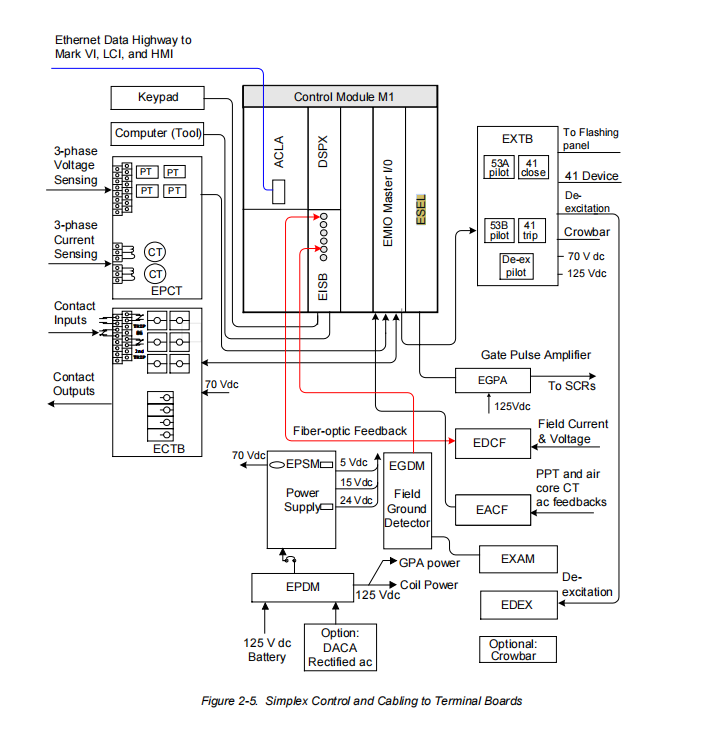
Centralized Command Reception: The board receives the standard six logic-level gate pulse signals from its associated EMIO board, representing the firing commands for a single, conceptual three-phase bridge.
Intelligent Signal Fan-Out: Unlike single-bridge selectors, the H2 replicates and routes this single set of six pulses to output channels for up to three separate PCMs. This ensures that all parallel bridges operate with identical firing angles, which is critical for current sharing and preventing circulating currents between the bridges.
2. Redundant Control Arbitration for Multi-Bridge Systems
In a Triple Modular Redundant (TMR) system, the IS200ESELH2A performs the critical arbitration function not just for one bridge, but for the entire set of bridges under its control.
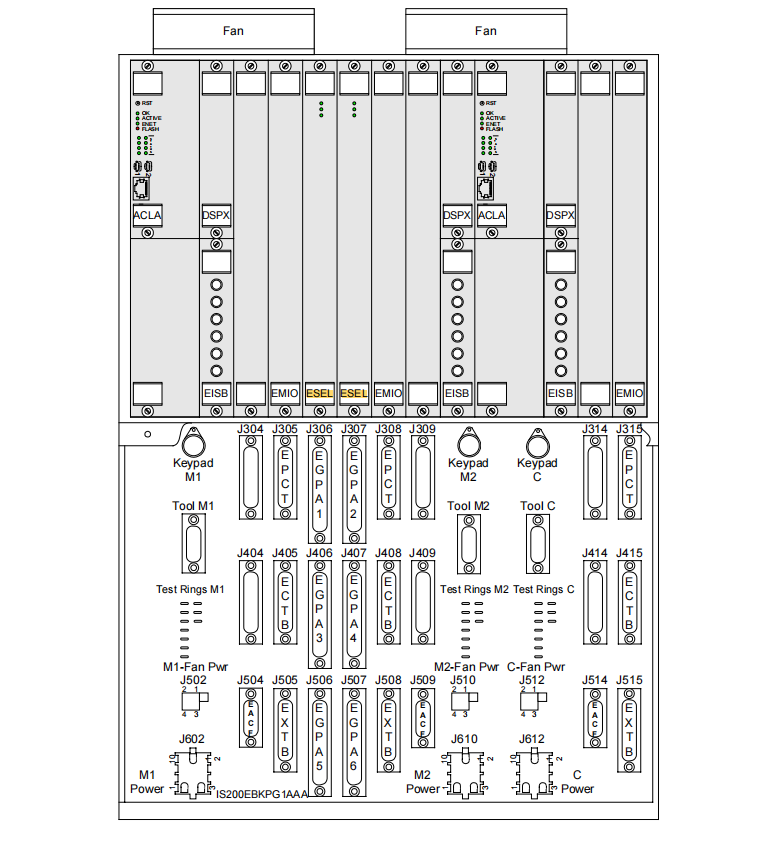
System-Wide Arbitration: Two IS200ESELH2A boards (for M1 and M2 controllers) operate in parallel. The Coordinator controller (C) determines the active master.
Coordinated Channel Gating: The arbitration command from controller C enables or disables the entire output suite of each H2 board. When the active H2 board is enabled, it simultaneously gates pulse trains to all three of its assigned PCMs. The standby H2 board has all its outputs blocked, ensuring that only one controller commands the entire multi-bridge array at any given time.
3. Facilitation of Scalability and System Growth
The H2 model is a cornerstone for scalable excitation system design. It allows for a single control rack (M1, M2, C) to manage a significant portion of the total excitation power output. By consolidating the control interface for three bridges onto a single selector board, it reduces system complexity, minimizes inter-board wiring within the control rack, and provides a modular approach to increasing the exciter's current output capability.
The operational principle of the IS200ESELH2A centers on synchronized parallel control and high-integrity signal management.
1. Signal Flow in a Multi-Bridge Configuration
Step 1: Unified Pulse Generation: The DSPX in the active controller (e.g., M1) executes its control algorithms based on generator feedback. It outputs a single set of six gate pulses, calculated to regulate the total field current, which is the sum of the outputs of all parallel bridges.
Step 2: Internal Replication and Buffering: The M1-EMIO board sends these pulses to the M1-ESELH2 board. The H2 board does not recalculate the pulses; instead, it contains the necessary driver circuitry to buffer and replicate the single input stream into three identical, isolated output streams.
Step 3: Simultaneous Output: The activated IS200ESELH2A board sends these three identical sets of six pulses, via separate cable harnesses, to three individual EGPA boards. Each EGPA board, in turn, drives its specific Power Conversion Module.
Step 4: Synchronized Power Output: All three PCMs receive the exact same firing commands at the same time, causing their thyristors to switch in unison. This synchronization is vital for the combined dc output and for the thermal balance of the parallel bridges.
2. Redundancy and Failover Dynamics
The failover process for a multi-bridge system managed by H2 selectors is a coordinated, system-level event.
Failure Detection: Controller C identifies a fault in the active master controller.
System-Level Switch: The "disable" command is sent to the active H2 board (e.g., M1), instantly cutting off pulse trains to all three of its PCMs. Simultaneously, the "enable" command is sent to the standby H2 board (M2).
Seamless Multi-Bridge Takeover: The M2-ESELH2, which has been receiving and internally replicating the tracking pulses from its own DSPX, immediately begins outputting its three sets of pulses. All three power bridges seamlessly transition from being driven by the M1 controller to being driven by the M2 controller, maintaining uninterrupted excitation to the generator field.
The choice between the IS200ESELH2A and IS200ESELH1A is fundamentally dictated by the scale and power requirements of the excitation system.
| Parameter | IS200ESELH2A | IS200ESELH1A |
|---|---|---|
| Primary Application | Multi-bridge, high-current excitation systems. | Single-bridge, standard or base redundant excitation systems. |
| Number of Bridges Driven | Three (3). This is its defining capability. | One (1). This is its core, limited function. |
| System Role | Central Pulse Router / Multi-Bridge Coordinator. It acts as a force multiplier for the control signal. | Dedicated Pulse Gate / Single-Bridge Interface. It acts as a controlled switch for a single signal path. |
| Core Functionality | Signal Replication and Synchronized Distribution. Its key task is to fan out one input to three synchronized outputs. | Signal Gating and Redundant Path Selection. Its key task is to choose one of two input paths for a single output. |
| Impact on System Design | Enables system scalability and higher power output using a single control rack. Simplifies control architecture for multi-bridge setups. | Defines a self-contained, single-bridge control unit. Adding bridges requires adding more H1 boards and associated control hardware. |
| Complexity of Operation | Manages a more complex synchronization requirement to ensure parallel bridges operate as one. The failover process switches control of multiple power devices simultaneously. | Manages a simpler, single-path switching operation. The failover process is localized to a single power bridge. |
| Model Differentiation | The "H2" suffix explicitly indicates the 3-bridge capacity. | The "H1" suffix explicitly indicates the 1-bridge capacity. |
The IS200ESELH2A is a high-capacity Exciter Selector Board within the GE EX2100 static excitation system. Functioning as the central pulse-routing hub for multi-bridge power converter configurations, the H2 model is engineered to synchronize and manage the gate trigger commands for up to three parallel Power Conversion Modules (PCMs). Its primary role is to ensure unified and coordinated control across multiple power bridges, whether in simplex or complex redundant control architectures, thereby enabling the EX2100 system to meet high field current demands without compromising system integrity or fault tolerance. The "H2" designation specifically denotes its capability to drive three independent PCMs from a single control source.
1. Multi-Bridge Gate Pulse Distribution and Fan-Out
The defining feature of the IS200ESELH2A is its ability to receive one set of gate pulse commands and distribute them to multiple power bridges.
Centralized Command Reception: The board receives the standard six logic-level gate pulse signals from its associated EMIO board, representing the firing commands for a single, conceptual three-phase bridge.
Intelligent Signal Fan-Out: Unlike single-bridge selectors, the H2 replicates and routes this single set of six pulses to output channels for up to three separate PCMs. This ensures that all parallel bridges operate with identical firing angles, which is critical for current sharing and preventing circulating currents between the bridges.
2. Redundant Control Arbitration for Multi-Bridge Systems
In a Triple Modular Redundant (TMR) system, the IS200ESELH2A performs the critical arbitration function not just for one bridge, but for the entire set of bridges under its control.
System-Wide Arbitration: Two IS200ESELH2A boards (for M1 and M2 controllers) operate in parallel. The Coordinator controller (C) determines the active master.
Coordinated Channel Gating: The arbitration command from controller C enables or disables the entire output suite of each H2 board. When the active H2 board is enabled, it simultaneously gates pulse trains to all three of its assigned PCMs. The standby H2 board has all its outputs blocked, ensuring that only one controller commands the entire multi-bridge array at any given time.
3. Facilitation of Scalability and System Growth
The H2 model is a cornerstone for scalable excitation system design. It allows for a single control rack (M1, M2, C) to manage a significant portion of the total excitation power output. By consolidating the control interface for three bridges onto a single selector board, it reduces system complexity, minimizes inter-board wiring within the control rack, and provides a modular approach to increasing the exciter's current output capability.
The operational principle of the IS200ESELH2A centers on synchronized parallel control and high-integrity signal management.
1. Signal Flow in a Multi-Bridge Configuration
Step 1: Unified Pulse Generation: The DSPX in the active controller (e.g., M1) executes its control algorithms based on generator feedback. It outputs a single set of six gate pulses, calculated to regulate the total field current, which is the sum of the outputs of all parallel bridges.
Step 2: Internal Replication and Buffering: The M1-EMIO board sends these pulses to the M1-ESELH2 board. The H2 board does not recalculate the pulses; instead, it contains the necessary driver circuitry to buffer and replicate the single input stream into three identical, isolated output streams.
Step 3: Simultaneous Output: The activated IS200ESELH2A board sends these three identical sets of six pulses, via separate cable harnesses, to three individual EGPA boards. Each EGPA board, in turn, drives its specific Power Conversion Module.
Step 4: Synchronized Power Output: All three PCMs receive the exact same firing commands at the same time, causing their thyristors to switch in unison. This synchronization is vital for the combined dc output and for the thermal balance of the parallel bridges.
2. Redundancy and Failover Dynamics
The failover process for a multi-bridge system managed by H2 selectors is a coordinated, system-level event.
Failure Detection: Controller C identifies a fault in the active master controller.
System-Level Switch: The "disable" command is sent to the active H2 board (e.g., M1), instantly cutting off pulse trains to all three of its PCMs. Simultaneously, the "enable" command is sent to the standby H2 board (M2).
Seamless Multi-Bridge Takeover: The M2-ESELH2, which has been receiving and internally replicating the tracking pulses from its own DSPX, immediately begins outputting its three sets of pulses. All three power bridges seamlessly transition from being driven by the M1 controller to being driven by the M2 controller, maintaining uninterrupted excitation to the generator field.
The choice between the IS200ESELH2A and IS200ESELH1A is fundamentally dictated by the scale and power requirements of the excitation system.
| Parameter | IS200ESELH2A | IS200ESELH1A |
|---|---|---|
| Primary Application | Multi-bridge, high-current excitation systems. | Single-bridge, standard or base redundant excitation systems. |
| Number of Bridges Driven | Three (3). This is its defining capability. | One (1). This is its core, limited function. |
| System Role | Central Pulse Router / Multi-Bridge Coordinator. It acts as a force multiplier for the control signal. | Dedicated Pulse Gate / Single-Bridge Interface. It acts as a controlled switch for a single signal path. |
| Core Functionality | Signal Replication and Synchronized Distribution. Its key task is to fan out one input to three synchronized outputs. | Signal Gating and Redundant Path Selection. Its key task is to choose one of two input paths for a single output. |
| Impact on System Design | Enables system scalability and higher power output using a single control rack. Simplifies control architecture for multi-bridge setups. | Defines a self-contained, single-bridge control unit. Adding bridges requires adding more H1 boards and associated control hardware. |
| Complexity of Operation | Manages a more complex synchronization requirement to ensure parallel bridges operate as one. The failover process switches control of multiple power devices simultaneously. | Manages a simpler, single-path switching operation. The failover process is localized to a single power bridge. |
| Model Differentiation | The "H2" suffix explicitly indicates the 3-bridge capacity. | The "H1" suffix explicitly indicates the 1-bridge capacity. |
| Feature Category | Specification Parameters |
|---|---|
| Product Model | IS200ESELH2A |
| Board Description | Exciter Selector Board, Three-Bridge Drive Model |
| Mechanical Specification | VME Standard, 3U Height |
| Core Function | Receive, Replicate, and Distribute Gate Pulses to Multiple PCMs |
| Redundancy Support | Yes (Works with another ESELH2 in TMR systems for coordinated control) |
| Number of Supported Power Bridges | 3 |
| Input Signal | 6 channels of logic-level gate pulses, from the EMIO board of the same division |
| Input Connection | Via Control Backplane (EBKP) |
| Output Signal | 3 independent sets of 6 logic-level gate pulses (18 total outputs) |
| Output Connection | Multiple front-panel D-SUB connectors for cabled connection to three EGPA boards |
| Control Interface | Receives system-wide arbitration/enable commands from Controller C (via backplane) |
| Power Requirement | +5 V DC, supplied via the control backplane |
| Key Feature | Enables synchronized, coordinated control and bumpless transfer for multi-bridge systems. |
| Feature Category | Specification Parameters |
|---|---|
| Product Model | IS200ESELH2A |
| Board Description | Exciter Selector Board, Three-Bridge Drive Model |
| Mechanical Specification | VME Standard, 3U Height |
| Core Function | Receive, Replicate, and Distribute Gate Pulses to Multiple PCMs |
| Redundancy Support | Yes (Works with another ESELH2 in TMR systems for coordinated control) |
| Number of Supported Power Bridges | 3 |
| Input Signal | 6 channels of logic-level gate pulses, from the EMIO board of the same division |
| Input Connection | Via Control Backplane (EBKP) |
| Output Signal | 3 independent sets of 6 logic-level gate pulses (18 total outputs) |
| Output Connection | Multiple front-panel D-SUB connectors for cabled connection to three EGPA boards |
| Control Interface | Receives system-wide arbitration/enable commands from Controller C (via backplane) |
| Power Requirement | +5 V DC, supplied via the control backplane |
| Key Feature | Enables synchronized, coordinated control and bumpless transfer for multi-bridge systems. |