Bently Nevada
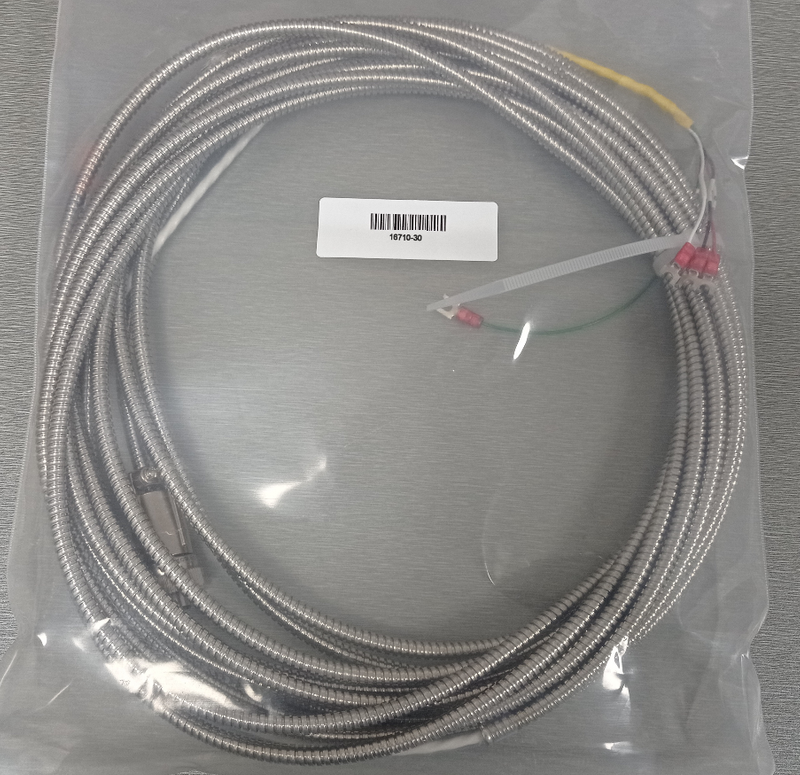
16710-30
$430
In Stock
T/T
Xiamen
| Availability: | |
|---|---|
| Quantity: | |
The 16710 Series Armored Interconnect Cable is a high-reliability signal connection solution specifically designed by Bently Nevada, a Baker Hughes business, for its 177230 Seismic Transmitter and other compatible industrial vibration monitoring sensors. As an indispensable component of machinery condition monitoring systems, this cable is tasked with the critical mission of stably, losslessly, and safely transmitting the high-precision vibration signals collected by the sensor to control systems (such as PLCs and DCS) in harsh industrial environments.
The "armored" design endows this cable with excellent physical protection performance, effectively resisting common field hazards such as mechanical crushing, cutting, abrasion, oil contamination, chemical corrosion, and rodent biting. The seamless integration of the 16710 cable with the 177230 Seismic Transmitter together forms a complete link from signal sensing to reliable transmission, ensuring the integrity and authenticity of condition monitoring data. It serves as the indispensable "nerves and blood vessels" guaranteeing the effective operation of predictive maintenance systems.
This product is primarily used in industrial sectors such as power generation, petrochemicals, metallurgy, water treatment, pulp & paper, and maritime applications. It is suitable for signal connections from various rotating machinery monitoring points within a plant to junction boxes or control cabinets, demonstrating irreplaceable value, especially in complex environments with stringent requirements for cable protection.
Metal Armor Layer: The cable is encased in a robust layer of metal armor (typically stainless steel or galvanized steel tape), providing strong mechanical protection for the internal electrical conductors. This armor effectively prevents damage during installation from pulling or trampling, as well as accidental impacts, heavy object crushing, or tool damage during operation.
High Abrasion Resistance: The combination of special outer jacket material and armored structure allows it to withstand long-term friction against metal surfaces, concrete, or other cables, significantly extending its service life in cable trays, conduit, or direct burial applications.
Resistance to Environmental Hazards: The armor layer and overall design prevent the ingress of oil, grease, most industrial chemicals, and moisture, protecting the internal insulation. The sturdy construction also deters gnawing by rodents and other small animals, avoiding signal interruption or equipment short circuits caused by such damage.
Precise Conductor Design: Strictly adhering to Bently Nevada cable specifications, it employs 3 independent conductors (typically 18 to 22 AWG), ensuring a low-resistance, low-loss transmission path for the 177230 transmitter's 4-20 mA loop (Pin A, Pin B) and dynamic acceleration signal (Pin C).
Effective Shielding Structure: The cable integrates a shield with a minimum of 80% coverage (e.g., braided copper mesh). This shield is crucial for industrial environments, as it greatly attenuates electromagnetic interference (EMI) and radio frequency interference (RFI) from sources such as motors, variable frequency drives, and high-power cables. This ensures that the vibration analog signals (especially the millivolt-level acceleration signal on Pin C) remain uncontaminated during transmission, maintaining a high signal-to-noise ratio.
High Insulation Rating: Both conductor insulation and outer jacket utilize high-standard materials with an insulation withstand voltage rating of no less than 600V, meeting industrial site electrical safety requirements and providing reliable phase-to-phase and ground insulation.
Length Customization: Offers continuous length customization service from 3 feet (approx. 0.91 m) to 99 feet (approx. 30.2 m) in 1-foot increments. Additionally, multiple common standard lengths (e.g., 8, 10, 12, 15, 17, 20, 30, 99 feet) are available as stock or quick-ship options, perfectly adapting to connection needs over various distances from sensor to interface equipment, eliminating issues of cable redundancy or insufficient length.
Standard Interface Compatibility: One end of the cable is pre-fitted or designed to mate with the standard 3-pin MIL-C-5015 (e.g., MS3106 series) stainless steel connector on the 177230 transmitter. The other end can be customized (e.g., flying leads, termination for terminal blocks, or specific connectors) according to customer control system interface requirements, simplifying field installation.
Broad Applicability: Although optimized for the 177230, its electrical and mechanical characteristics also make it suitable for other Bently Nevada vibration transmitters or sensors using similar interfaces, improving spare part commonality.
Increased System Robustness: In hazardous areas (where certified), using armored cable provides an additional safety barrier, preventing risks such as sparks or high temperatures caused by cable damage, complying with strict plant safety protocols.
Reduced Fault Downtime: The high-reliability cable significantly lowers the probability of signal loss or distortion due to transmission line issues, thereby avoiding false alarms or unnecessary shutdown inspections triggered by erroneous data, and improving the overall Mean Time Between Failures (MTBF) of the monitoring system.
Ease of Routing and Fixing: The armored structure gives the cable better stiffness and shape retention, making it neater to install in cable trays, easier to bundle and secure, and less prone to excessive sagging under its own weight, presenting a more professional installation appearance.
Critical Machinery Monitoring: Used for critical high-speed rotating equipment such as steam turbines, gas turbines, large compressors, and reactor coolant pumps, where vibration signals are vital and any transmission interruption could lead to serious consequences. Armored cable provides the highest level of physical protection here.
Harsh Environments: In environments with corrosive gases, liquids, high temperature, high humidity, or salt spray, such as refineries, chemical plants, mines, and offshore platforms.
High EMI Areas: Locations near strong electromagnetic interference sources like VFD rooms, large switchgear, or arc furnaces, where high-quality shielding is essential for signal accuracy.
Long-Distance Wiring: When sensors are located far from junction boxes or I/O modules (e.g., over 20 meters), cables with low attenuation and strong interference rejection are needed. Armored cable is a reliable choice.
Areas with Stringent Safety Requirements: In locations classified as hazardous areas (e.g., Class I Div 2, Zone 2), using armored cable as additional protection is common engineering practice.
Length (AA Code): Precisely measure the installation distance, allowing appropriate slack (for termination, coiling, and future maintenance). Select the length according to the 16710-AA coding rules. Prioritize standard lengths for optimal delivery time and price.
Conductor Gauge (AWG):
22 AWG: Suitable for most medium-to-short distance applications (e.g., <30 m), offering better flexibility for easier pulling through conduit or bending.
18 AWG: Recommended for longer distance transmission to reduce the impact of loop resistance on the 4-20mA signal, or where higher mechanical strength is required.
Environmental Compatibility: Confirm that the outer jacket material is suitable for the specific oil, chemical, temperature, and UV conditions on site. Consult during ordering for special requirements.
Connector Compatibility: Confirm whether the cable is pre-fitted with a connector matching the 177230 transmitter or requires field termination. Pre-fitted connectors ensure optimal sealing and connection reliability but may affect lead times for custom lengths.
Relevant Certifications: For export projects or industries with special regulations (e.g., maritime, nuclear power), confirm that the cable itself complies with relevant industry standards (e.g., DNV, UL).
Inspection: Upon receipt, inspect the outer jacket and armor for visible damage, and check for continuity and insulation resistance.
Route Planning: Design a reasonable routing path, avoiding contact with hot pipes, sharp edges, or moving parts. Keep a distance from high-power cables; a parallel separation of more than 30 cm is recommended. If crossing is necessary, do so at a right angle.
Bending Radius: During routing and fixing, the minimum bending radius specified in the product manual (typically 10-15 times the cable diameter) must be strictly observed. Excessive bending can permanently damage the armor, shield, or internal insulation.
Pulling Tension: Use appropriate tools and methods to pull the cable, avoiding direct pulling on the jacket or connector. For armored cables, a wire mesh grip or clamping onto the armor can be used for pulling.
Support & Fixing: Use non-metallic cable ties or clamps to securely fasten the cable to trays or supports at appropriate intervals (approx. 0.8-1 m for horizontal runs, 1-1.5 m for vertical runs). Avoid the cable at support points.
Protection: Use smooth bushings or sleeves where the cable passes through walls or floors to prevent abrasion of the jacket by the armor edge.
Proper grounding is core to ensuring shielding effectiveness and system safety.
Armor Grounding: The metal armor of the cable must be reliably grounded at one end only, typically in the control cabinet or safe area. This is usually achieved via a dedicated armor grounding clamp or through the connector shell. The grounding conductor should be as short and thick as possible, connected to the dedicated grounding busbar in the equipment cabinet. Note: In hazardous areas, the grounding method must comply with the explosion-proof certification drawings (e.g., 177234) and relevant safety standards.
Shield Grounding: The internal cable shield is recommended to be grounded at one end only, typically at the control system (receiving end). This prevents the formation of ground loops, which can introduce interference due to ground potential differences. The shield can be grounded via the connector shell or internal wiring.
Grounding Continuity: Ensure the entire grounding path has low resistance and secure connections.
Wire strictly according to the 177230 transmitter pin definition (Pin A: 4-20mA+, Pin B: 4-20mA- & common, Pin C: Dynamic Signal).
Ensure Pin B remains isolated from earth ground in the system, unless otherwise specified by the system design.
Terminals should be crimped securely to avoid loose connections or shorts.
The 16710 Series Armored Interconnect Cable is a high-reliability signal connection solution specifically designed by Bently Nevada, a Baker Hughes business, for its 177230 Seismic Transmitter and other compatible industrial vibration monitoring sensors. As an indispensable component of machinery condition monitoring systems, this cable is tasked with the critical mission of stably, losslessly, and safely transmitting the high-precision vibration signals collected by the sensor to control systems (such as PLCs and DCS) in harsh industrial environments.
The "armored" design endows this cable with excellent physical protection performance, effectively resisting common field hazards such as mechanical crushing, cutting, abrasion, oil contamination, chemical corrosion, and rodent biting. The seamless integration of the 16710 cable with the 177230 Seismic Transmitter together forms a complete link from signal sensing to reliable transmission, ensuring the integrity and authenticity of condition monitoring data. It serves as the indispensable "nerves and blood vessels" guaranteeing the effective operation of predictive maintenance systems.
This product is primarily used in industrial sectors such as power generation, petrochemicals, metallurgy, water treatment, pulp & paper, and maritime applications. It is suitable for signal connections from various rotating machinery monitoring points within a plant to junction boxes or control cabinets, demonstrating irreplaceable value, especially in complex environments with stringent requirements for cable protection.
Metal Armor Layer: The cable is encased in a robust layer of metal armor (typically stainless steel or galvanized steel tape), providing strong mechanical protection for the internal electrical conductors. This armor effectively prevents damage during installation from pulling or trampling, as well as accidental impacts, heavy object crushing, or tool damage during operation.
High Abrasion Resistance: The combination of special outer jacket material and armored structure allows it to withstand long-term friction against metal surfaces, concrete, or other cables, significantly extending its service life in cable trays, conduit, or direct burial applications.
Resistance to Environmental Hazards: The armor layer and overall design prevent the ingress of oil, grease, most industrial chemicals, and moisture, protecting the internal insulation. The sturdy construction also deters gnawing by rodents and other small animals, avoiding signal interruption or equipment short circuits caused by such damage.
Precise Conductor Design: Strictly adhering to Bently Nevada cable specifications, it employs 3 independent conductors (typically 18 to 22 AWG), ensuring a low-resistance, low-loss transmission path for the 177230 transmitter's 4-20 mA loop (Pin A, Pin B) and dynamic acceleration signal (Pin C).
Effective Shielding Structure: The cable integrates a shield with a minimum of 80% coverage (e.g., braided copper mesh). This shield is crucial for industrial environments, as it greatly attenuates electromagnetic interference (EMI) and radio frequency interference (RFI) from sources such as motors, variable frequency drives, and high-power cables. This ensures that the vibration analog signals (especially the millivolt-level acceleration signal on Pin C) remain uncontaminated during transmission, maintaining a high signal-to-noise ratio.
High Insulation Rating: Both conductor insulation and outer jacket utilize high-standard materials with an insulation withstand voltage rating of no less than 600V, meeting industrial site electrical safety requirements and providing reliable phase-to-phase and ground insulation.
Length Customization: Offers continuous length customization service from 3 feet (approx. 0.91 m) to 99 feet (approx. 30.2 m) in 1-foot increments. Additionally, multiple common standard lengths (e.g., 8, 10, 12, 15, 17, 20, 30, 99 feet) are available as stock or quick-ship options, perfectly adapting to connection needs over various distances from sensor to interface equipment, eliminating issues of cable redundancy or insufficient length.
Standard Interface Compatibility: One end of the cable is pre-fitted or designed to mate with the standard 3-pin MIL-C-5015 (e.g., MS3106 series) stainless steel connector on the 177230 transmitter. The other end can be customized (e.g., flying leads, termination for terminal blocks, or specific connectors) according to customer control system interface requirements, simplifying field installation.
Broad Applicability: Although optimized for the 177230, its electrical and mechanical characteristics also make it suitable for other Bently Nevada vibration transmitters or sensors using similar interfaces, improving spare part commonality.
Increased System Robustness: In hazardous areas (where certified), using armored cable provides an additional safety barrier, preventing risks such as sparks or high temperatures caused by cable damage, complying with strict plant safety protocols.
Reduced Fault Downtime: The high-reliability cable significantly lowers the probability of signal loss or distortion due to transmission line issues, thereby avoiding false alarms or unnecessary shutdown inspections triggered by erroneous data, and improving the overall Mean Time Between Failures (MTBF) of the monitoring system.
Ease of Routing and Fixing: The armored structure gives the cable better stiffness and shape retention, making it neater to install in cable trays, easier to bundle and secure, and less prone to excessive sagging under its own weight, presenting a more professional installation appearance.
Critical Machinery Monitoring: Used for critical high-speed rotating equipment such as steam turbines, gas turbines, large compressors, and reactor coolant pumps, where vibration signals are vital and any transmission interruption could lead to serious consequences. Armored cable provides the highest level of physical protection here.
Harsh Environments: In environments with corrosive gases, liquids, high temperature, high humidity, or salt spray, such as refineries, chemical plants, mines, and offshore platforms.
High EMI Areas: Locations near strong electromagnetic interference sources like VFD rooms, large switchgear, or arc furnaces, where high-quality shielding is essential for signal accuracy.
Long-Distance Wiring: When sensors are located far from junction boxes or I/O modules (e.g., over 20 meters), cables with low attenuation and strong interference rejection are needed. Armored cable is a reliable choice.
Areas with Stringent Safety Requirements: In locations classified as hazardous areas (e.g., Class I Div 2, Zone 2), using armored cable as additional protection is common engineering practice.
Length (AA Code): Precisely measure the installation distance, allowing appropriate slack (for termination, coiling, and future maintenance). Select the length according to the 16710-AA coding rules. Prioritize standard lengths for optimal delivery time and price.
Conductor Gauge (AWG):
22 AWG: Suitable for most medium-to-short distance applications (e.g., <30 m), offering better flexibility for easier pulling through conduit or bending.
18 AWG: Recommended for longer distance transmission to reduce the impact of loop resistance on the 4-20mA signal, or where higher mechanical strength is required.
Environmental Compatibility: Confirm that the outer jacket material is suitable for the specific oil, chemical, temperature, and UV conditions on site. Consult during ordering for special requirements.
Connector Compatibility: Confirm whether the cable is pre-fitted with a connector matching the 177230 transmitter or requires field termination. Pre-fitted connectors ensure optimal sealing and connection reliability but may affect lead times for custom lengths.
Relevant Certifications: For export projects or industries with special regulations (e.g., maritime, nuclear power), confirm that the cable itself complies with relevant industry standards (e.g., DNV, UL).
Inspection: Upon receipt, inspect the outer jacket and armor for visible damage, and check for continuity and insulation resistance.
Route Planning: Design a reasonable routing path, avoiding contact with hot pipes, sharp edges, or moving parts. Keep a distance from high-power cables; a parallel separation of more than 30 cm is recommended. If crossing is necessary, do so at a right angle.
Bending Radius: During routing and fixing, the minimum bending radius specified in the product manual (typically 10-15 times the cable diameter) must be strictly observed. Excessive bending can permanently damage the armor, shield, or internal insulation.
Pulling Tension: Use appropriate tools and methods to pull the cable, avoiding direct pulling on the jacket or connector. For armored cables, a wire mesh grip or clamping onto the armor can be used for pulling.
Support & Fixing: Use non-metallic cable ties or clamps to securely fasten the cable to trays or supports at appropriate intervals (approx. 0.8-1 m for horizontal runs, 1-1.5 m for vertical runs). Avoid the cable at support points.
Protection: Use smooth bushings or sleeves where the cable passes through walls or floors to prevent abrasion of the jacket by the armor edge.
Proper grounding is core to ensuring shielding effectiveness and system safety.
Armor Grounding: The metal armor of the cable must be reliably grounded at one end only, typically in the control cabinet or safe area. This is usually achieved via a dedicated armor grounding clamp or through the connector shell. The grounding conductor should be as short and thick as possible, connected to the dedicated grounding busbar in the equipment cabinet. Note: In hazardous areas, the grounding method must comply with the explosion-proof certification drawings (e.g., 177234) and relevant safety standards.
Shield Grounding: The internal cable shield is recommended to be grounded at one end only, typically at the control system (receiving end). This prevents the formation of ground loops, which can introduce interference due to ground potential differences. The shield can be grounded via the connector shell or internal wiring.
Grounding Continuity: Ensure the entire grounding path has low resistance and secure connections.
Wire strictly according to the 177230 transmitter pin definition (Pin A: 4-20mA+, Pin B: 4-20mA- & common, Pin C: Dynamic Signal).
Ensure Pin B remains isolated from earth ground in the system, unless otherwise specified by the system design.
Terminals should be crimped securely to avoid loose connections or shorts.
Conductors: 3 independent insulated copper conductors, compliant with relevant standards.
Conductor Gauge: Typically offered in 18 AWG or 22 AWG options to meet signal attenuation and mechanical strength requirements over different distances. 18 AWG has a larger diameter and lower resistance, suitable for longer distances; 22 AWG is more flexible, suitable for space-constrained locations.
Insulation Resistance: Very high, conforming to industrial instrument cable standards.
Shielding Effectiveness: High-density braided shield with ≥80% coverage, providing excellent interference rejection.
Rated Voltage: Insulation withstand voltage rating not less than 600V.
Capacitance: Low distributed capacitance design, beneficial for the faithful transmission of high-frequency dynamic signals (particularly important for the Pin C acceleration signal).
Armor Type: Typically flexible metal tape armor (interlocked armor) or similar structure, providing protection while maintaining a degree of bending flexibility.
Outer Jacket: Made of high-performance polymer material (e.g., polyurethane PUR, modified PVC, etc.), featuring excellent resistance to oil, chemicals, UV (for outdoor use), and flame-retardant properties.
Bending Radius: Has a defined minimum allowable bending radius that must be adhered to during installation to prevent damage to internal structure and electrical performance.
Temperature Range:
Installation Temperature: Typically between -20°C to +70°C, allowing safe installation in most climatic conditions.
Operating Temperature: Matches connected equipment, typically supporting an industrial temperature range of -40°C to +85°C or wider.
Flame Retardancy: Jacket material typically complies with industrial flame retardancy standards (e.g., IEC 60332), reducing fire spread risk.
Conductor: Stranded fine copper wires, ensuring flexibility and conductivity.
Conductor Insulation: Each conductor is wrapped with thick insulation in distinguishing colors (typically red, black, white or brown, blue, green), made of material with high dielectric strength and stability.
Filler: Non-hygroscopic filler material may be used between the twisted triple insulated cores to maintain a round cable cross-section and enhance structural stability.
Inner Jacket: A thin layer the cores and filler, securing the internal structure.
Shield Layer: A tightly braided tinned copper mesh over the inner jacket, key for electromagnetic compatibility.
Drain Wire: Some designs may include a bare grounding/drain wire in contact with the shield for ease of grounding.
Armor Layer: The critical protective layer over the shield, constructed from helically wound or interlocked galvanized steel or stainless steel tape.
Outer Jacket: The outermost protective shell, extruded from tough, weather-resistant, oil-resistant compound material, typically printed with manufacturer, type, specifications, and meter markings.
Conductors: 3 independent insulated copper conductors, compliant with relevant standards.
Conductor Gauge: Typically offered in 18 AWG or 22 AWG options to meet signal attenuation and mechanical strength requirements over different distances. 18 AWG has a larger diameter and lower resistance, suitable for longer distances; 22 AWG is more flexible, suitable for space-constrained locations.
Insulation Resistance: Very high, conforming to industrial instrument cable standards.
Shielding Effectiveness: High-density braided shield with ≥80% coverage, providing excellent interference rejection.
Rated Voltage: Insulation withstand voltage rating not less than 600V.
Capacitance: Low distributed capacitance design, beneficial for the faithful transmission of high-frequency dynamic signals (particularly important for the Pin C acceleration signal).
Armor Type: Typically flexible metal tape armor (interlocked armor) or similar structure, providing protection while maintaining a degree of bending flexibility.
Outer Jacket: Made of high-performance polymer material (e.g., polyurethane PUR, modified PVC, etc.), featuring excellent resistance to oil, chemicals, UV (for outdoor use), and flame-retardant properties.
Bending Radius: Has a defined minimum allowable bending radius that must be adhered to during installation to prevent damage to internal structure and electrical performance.
Temperature Range:
Installation Temperature: Typically between -20°C to +70°C, allowing safe installation in most climatic conditions.
Operating Temperature: Matches connected equipment, typically supporting an industrial temperature range of -40°C to +85°C or wider.
Flame Retardancy: Jacket material typically complies with industrial flame retardancy standards (e.g., IEC 60332), reducing fire spread risk.
Conductor: Stranded fine copper wires, ensuring flexibility and conductivity.
Conductor Insulation: Each conductor is wrapped with thick insulation in distinguishing colors (typically red, black, white or brown, blue, green), made of material with high dielectric strength and stability.
Filler: Non-hygroscopic filler material may be used between the twisted triple insulated cores to maintain a round cable cross-section and enhance structural stability.
Inner Jacket: A thin layer the cores and filler, securing the internal structure.
Shield Layer: A tightly braided tinned copper mesh over the inner jacket, key for electromagnetic compatibility.
Drain Wire: Some designs may include a bare grounding/drain wire in contact with the shield for ease of grounding.
Armor Layer: The critical protective layer over the shield, constructed from helically wound or interlocked galvanized steel or stainless steel tape.
Outer Jacket: The outermost protective shell, extruded from tough, weather-resistant, oil-resistant compound material, typically printed with manufacturer, type, specifications, and meter markings.