GE
IS420UCSBH1A
$11000
In Stock
T/T
Xiamen
| Availability: | |
|---|---|
| Quantity: | |
The IS420UCSBH1A is a standalone controller module in GE’s Mark VIe control system, part of the UCSB series. Designed for industrial control applications, it is especially suited for real-time monitoring and control of critical power equipment such as gas turbines, steam turbines, wind turbines, and hydroelectric systems. Equipped with a high-performance Intel processor and the reliable QNX Neutrino real-time operating system, it delivers powerful data processing capabilities, high reliability, and flexible communication interfaces to meet the demands of complex industrial environments.
The IS420UCSBH1A is powered by a 600 MHz Intel EP80579 processor, supported by 256 MB of DDR2 SDRAM with Error-Correcting Code (ECC), ensuring computational accuracy and system stability. It includes 2 GB of NAND flash memory for firmware and application storage, enabling fast boot-ups and reliable data retention.
The controller offers multiple Ethernet ports, including:
2 Main Ethernet ports: For Unit Data Highway (UDH) and optional Control Data Highway (CDH), enabling communication with HMIs, engineering stations, and other control devices.
3 IONet ports: Dedicated to communication with I/O modules (e.g., PAIC, PDIA), supporting real-time data exchange and precision clock synchronization via the IEEE 1588 protocol.
Runs on the QNX Neutrino real-time OS, supporting multitasking and high-precision timing to ensure deterministic execution of control logic—ideal for high-speed, high-reliability industrial applications.
Supports Control Block Language, including analog and digital control blocks, and Boolean logic in relay ladder diagram format. Supported data types include:
Boolean
16- and 32-bit signed/unsigned integers
32- and 64-bit floating-point values
Supports dual-network redundancy to maintain operation during network failure.
Battery-free design, requires no jumper settings, reducing maintenance needs.
Built-in watchdog timer and hardware reset circuit enhance system reliability.
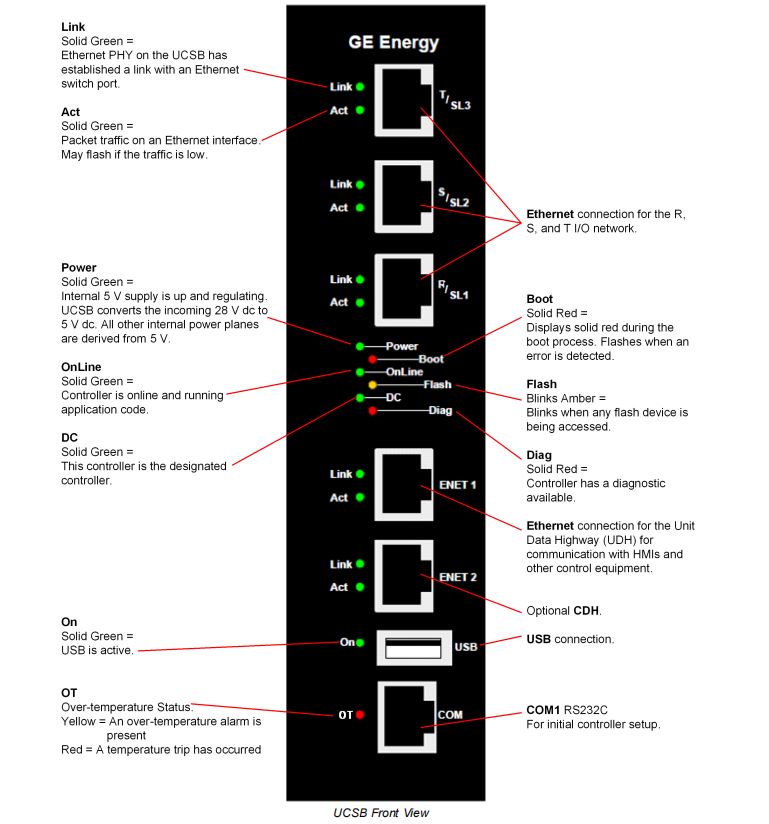
The front panel includes multiple LED indicators for real-time status monitoring:
Link/Act: Network connection and activity
Power: Power status
Online: Controller operational status
Flash: Flash memory access status
Diag: Diagnostic alarm status
Boot: Boot status (includes fault code indication)
Allows system backup and restore via a front USB port using a FAT32-formatted USB drive—no dedicated programmer required.
Operating temperature: -30°C to 65°C
Storage temperature: -40°C to 85°C
Humidity: 5% to 95% (non-condensing)
Complies with industrial standards for vibration, shock, and EMC
As the core processing unit of the Mark VIe control system, the IS420UCSBH1A communicates with distributed I/O modules (e.g., PAIC, PDIA, PTCC) via IONet—a dedicated industrial Ethernet network. It executes application code, processes input signals from sensors, runs control algorithms, and outputs control signals to actuators.
Input Handling: Receives analog, digital, temperature, vibration, and other signals from I/O modules via IONet.
Control Logic Execution: Performs computations based on predefined control strategies (e.g., PID control, sequencing, protection logic).
Output Control: Sends computed results via IONet to I/O modules to drive valves, servos, relays, and other devices.
Uses IEEE 1588 Precision Time Protocol (PTP) to synchronize clocks between the controller and I/O modules, ensuring timing accuracy within ±100 microseconds.
Supports Triple Modular Redundancy (TMR) architecture, where three controllers vote on critical signals to enhance system safety.
Continuously monitors hardware status (e.g., power, memory, communication links).
Triggers alerts via LEDs, ToolboxST software, or HMI upon detecting faults.
Supports online logic modifications without system shutdown, improving availability.
Input voltage: 28 V DC (range: 18–36 V DC)
Internal DC-DC converters provide multiple voltage levels to power the processor and interface circuits.
Low power consumption: 15.6 W typical, 26.7 W peak.
The IS420UCSBH1A is widely used in:
Gas turbine control systems (Frame 6/7/9)
Steam turbine control
Wind turbine control systems
Hydroelectric plant monitoring
Balance of Plant (BOP) auxiliary control systems
Industrial process control and protection systems
The IS420UCSBH1A is a standalone controller module in GE’s Mark VIe control system, part of the UCSB series. Designed for industrial control applications, it is especially suited for real-time monitoring and control of critical power equipment such as gas turbines, steam turbines, wind turbines, and hydroelectric systems. Equipped with a high-performance Intel processor and the reliable QNX Neutrino real-time operating system, it delivers powerful data processing capabilities, high reliability, and flexible communication interfaces to meet the demands of complex industrial environments.
The IS420UCSBH1A is powered by a 600 MHz Intel EP80579 processor, supported by 256 MB of DDR2 SDRAM with Error-Correcting Code (ECC), ensuring computational accuracy and system stability. It includes 2 GB of NAND flash memory for firmware and application storage, enabling fast boot-ups and reliable data retention.
The controller offers multiple Ethernet ports, including:
2 Main Ethernet ports: For Unit Data Highway (UDH) and optional Control Data Highway (CDH), enabling communication with HMIs, engineering stations, and other control devices.
3 IONet ports: Dedicated to communication with I/O modules (e.g., PAIC, PDIA), supporting real-time data exchange and precision clock synchronization via the IEEE 1588 protocol.
Runs on the QNX Neutrino real-time OS, supporting multitasking and high-precision timing to ensure deterministic execution of control logic—ideal for high-speed, high-reliability industrial applications.
Supports Control Block Language, including analog and digital control blocks, and Boolean logic in relay ladder diagram format. Supported data types include:
Boolean
16- and 32-bit signed/unsigned integers
32- and 64-bit floating-point values
Supports dual-network redundancy to maintain operation during network failure.
Battery-free design, requires no jumper settings, reducing maintenance needs.
Built-in watchdog timer and hardware reset circuit enhance system reliability.
The front panel includes multiple LED indicators for real-time status monitoring:
Link/Act: Network connection and activity
Power: Power status
Online: Controller operational status
Flash: Flash memory access status
Diag: Diagnostic alarm status
Boot: Boot status (includes fault code indication)
Allows system backup and restore via a front USB port using a FAT32-formatted USB drive—no dedicated programmer required.
Operating temperature: -30°C to 65°C
Storage temperature: -40°C to 85°C
Humidity: 5% to 95% (non-condensing)
Complies with industrial standards for vibration, shock, and EMC
As the core processing unit of the Mark VIe control system, the IS420UCSBH1A communicates with distributed I/O modules (e.g., PAIC, PDIA, PTCC) via IONet—a dedicated industrial Ethernet network. It executes application code, processes input signals from sensors, runs control algorithms, and outputs control signals to actuators.
Input Handling: Receives analog, digital, temperature, vibration, and other signals from I/O modules via IONet.
Control Logic Execution: Performs computations based on predefined control strategies (e.g., PID control, sequencing, protection logic).
Output Control: Sends computed results via IONet to I/O modules to drive valves, servos, relays, and other devices.
Uses IEEE 1588 Precision Time Protocol (PTP) to synchronize clocks between the controller and I/O modules, ensuring timing accuracy within ±100 microseconds.
Supports Triple Modular Redundancy (TMR) architecture, where three controllers vote on critical signals to enhance system safety.
Continuously monitors hardware status (e.g., power, memory, communication links).
Triggers alerts via LEDs, ToolboxST software, or HMI upon detecting faults.
Supports online logic modifications without system shutdown, improving availability.
Input voltage: 28 V DC (range: 18–36 V DC)
Internal DC-DC converters provide multiple voltage levels to power the processor and interface circuits.
Low power consumption: 15.6 W typical, 26.7 W peak.
The IS420UCSBH1A is widely used in:
Gas turbine control systems (Frame 6/7/9)
Steam turbine control
Wind turbine control systems
Hydroelectric plant monitoring
Balance of Plant (BOP) auxiliary control systems
Industrial process control and protection systems
| Category | Specification Details |
|---|---|
| Microprocessor | Intel EP80579, 600 MHz |
| Memory | 256 MB DDR2 SDRAM with Error-Correcting Code (ECC) |
| Flash Memory | 2 GB NAND Flash |
| Non-Volatile Memory | 8 KB Flash-backed SRAM (allocated as NVRAM for controller functions) |
| Operating System | QNX Neutrino (real-time multitasking OS) |
| Programming Support | Control block language (analog and discrete blocks); relay ladder diagram logic |
| Data Types | Boolean, 16/32-bit signed/unsigned integers, 32/64-bit floating point |
| Ethernet Interfaces | 2 × RJ-45 ports (10/100Base-TX) for UDH and optional CDH |
| IONet Interfaces | 3 × RJ-45 ports (10/100Base-TX) for I/O module communication |
| Serial Port | 1 × RS-232C (via RJ-45 connector), used for initial setup |
| USB Port | 1 × front USB 2.0 port for system backup and restore |
| Input Voltage | 28 V DC (range: 18–36 V DC) |
| Typical Power | 15.6 W |
| Peak Power | 26.7 W |
| Operating Temp. | -30°C to 65°C (-22°F to 149°F) |
| Storage Temp. | -40°C to 85°C (-40°F to 185°F) |
| Humidity | 5% to 95% non-condensing |
| Cooling | Fanless, convection cooling |
| Dimensions | Standard module form factor (exact dimensions not specified in document) |
| Weight | 2.4 lbs (1.09 kg) |
| Mounting | Panel mount or DIN-rail mount |
| LED Indicators | Link, Act, Power, Online, Flash, Diag, Boot |
| USB Recovery | Supports backup/restore via FAT32 USB drive (min. 4 GB) |
| Recovery Button | Located on rear of controller |
| Network Protocol | TCP/IP, Ethernet Global Data (EGD), Modbus TCP |
| Time Sync | IEEE 1588 Precision Time Protocol (PTP) for I/O pack synchronization |
| Redundancy Support | Simplex, Dual, or TMR architectures |
| Certifications | Complies with industrial standards for vibration, shock, and EMC (see Chapter 28) |
| Category | Specification Details |
|---|---|
| Microprocessor | Intel EP80579, 600 MHz |
| Memory | 256 MB DDR2 SDRAM with Error-Correcting Code (ECC) |
| Flash Memory | 2 GB NAND Flash |
| Non-Volatile Memory | 8 KB Flash-backed SRAM (allocated as NVRAM for controller functions) |
| Operating System | QNX Neutrino (real-time multitasking OS) |
| Programming Support | Control block language (analog and discrete blocks); relay ladder diagram logic |
| Data Types | Boolean, 16/32-bit signed/unsigned integers, 32/64-bit floating point |
| Ethernet Interfaces | 2 × RJ-45 ports (10/100Base-TX) for UDH and optional CDH |
| IONet Interfaces | 3 × RJ-45 ports (10/100Base-TX) for I/O module communication |
| Serial Port | 1 × RS-232C (via RJ-45 connector), used for initial setup |
| USB Port | 1 × front USB 2.0 port for system backup and restore |
| Input Voltage | 28 V DC (range: 18–36 V DC) |
| Typical Power | 15.6 W |
| Peak Power | 26.7 W |
| Operating Temp. | -30°C to 65°C (-22°F to 149°F) |
| Storage Temp. | -40°C to 85°C (-40°F to 185°F) |
| Humidity | 5% to 95% non-condensing |
| Cooling | Fanless, convection cooling |
| Dimensions | Standard module form factor (exact dimensions not specified in document) |
| Weight | 2.4 lbs (1.09 kg) |
| Mounting | Panel mount or DIN-rail mount |
| LED Indicators | Link, Act, Power, Online, Flash, Diag, Boot |
| USB Recovery | Supports backup/restore via FAT32 USB drive (min. 4 GB) |
| Recovery Button | Located on rear of controller |
| Network Protocol | TCP/IP, Ethernet Global Data (EGD), Modbus TCP |
| Time Sync | IEEE 1588 Precision Time Protocol (PTP) for I/O pack synchronization |
| Redundancy Support | Simplex, Dual, or TMR architectures |
| Certifications | Complies with industrial standards for vibration, shock, and EMC (see Chapter 28) |