The IS220PAOCH1A is a high-performance, high-reliability analog output module designed by GE for the Mark Vle and Mark VleS control systems. As a member of the PAOC Analog Output Pack series, its core task is to accurately convert digital commands from the control system into standard 0-20 mA analog current signals, used to drive field devices such as valve positioners, actuators, and variable frequency drives. The IS220PAOCH1A module integrates an advanced processor (BPPB board), precision digital-to-analog conversion circuitry, comprehensive diagnostic functions, and safety protection mechanisms. It is suitable for industrial automation fields with high demands for control accuracy and system safety, such as power generation, oil & gas, and chemical processing.
Detailed Features
The IS220PAOCH1A module offers a series of powerful and practical features ensuring stability and reliability in complex industrial environments.
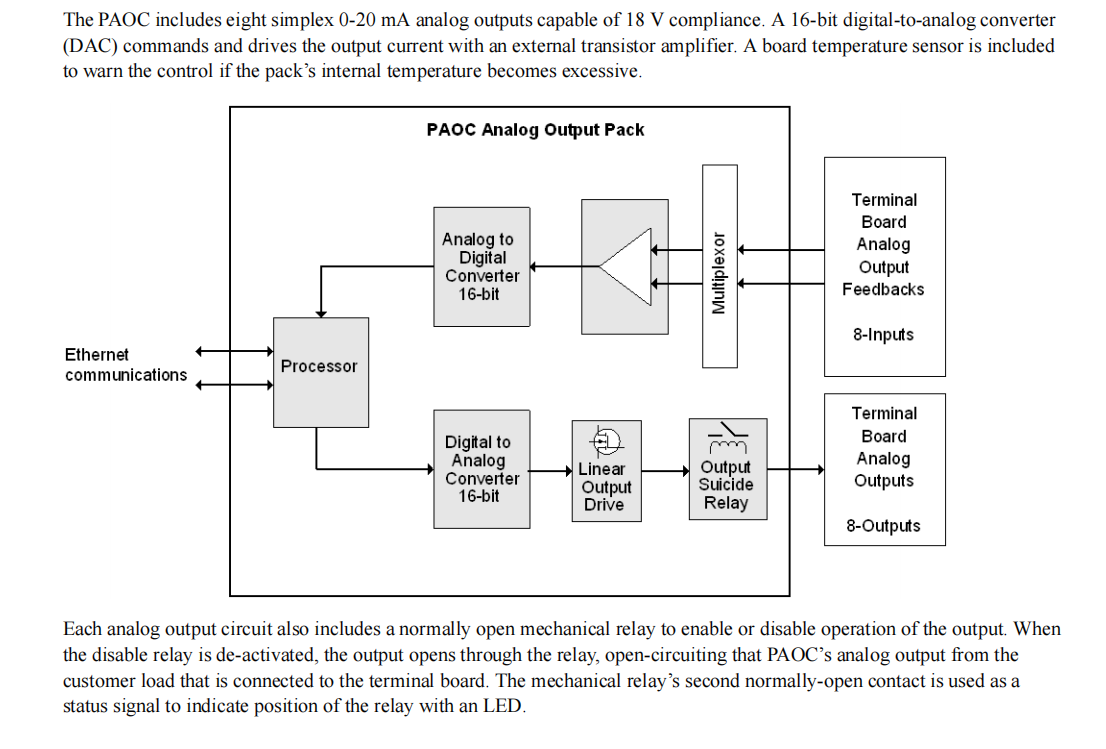
Analog Signal Output
Channel Count: Provides 8 fully independent analog output channels.
Signal Type: Each channel outputs a standard 0-20 mA current signal, with strong load capability, capable of driving loads up to 900 Ω with a compliance voltage of 18 V.
High Precision Output: Offers an accuracy of ±0.5% over the entire operating temperature and load range, achieving ±0.25% typical under standard conditions (25°C, 500Ω), meeting most precision control requirements.
Redundant Network Communication
The module is equipped with two RJ-45 Ethernet ports (ENET1 and ENET2), supporting connection to redundant Ethernet control networks.
This design ensures communication can be maintained via the alternate path if one network link fails, significantly enhancing system availability. Typically, ENET1 connects to the main controller network, with ENET2 serving as the redundant path.
Output Current Feedback Monitoring
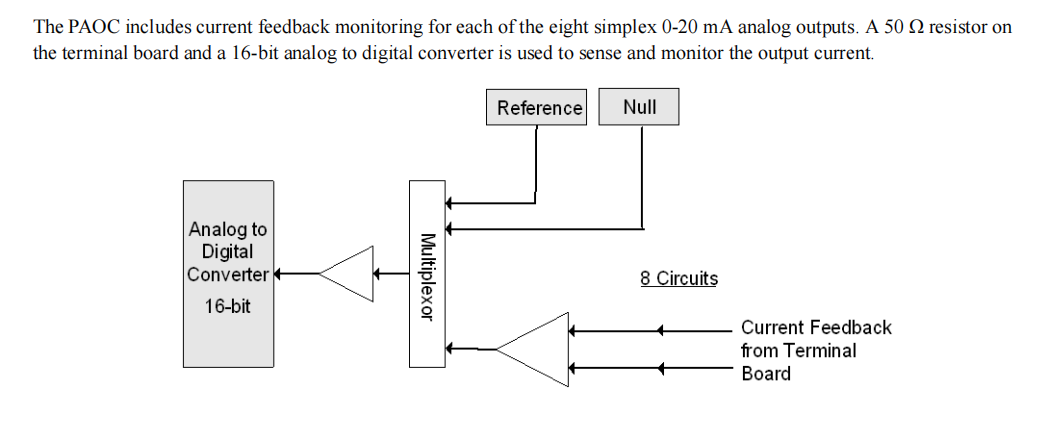
The module performs real-time sampling and measurement of the actual output current for each channel. This is achieved by converting the current signal to a voltage signal via a precision sense resistor on the terminal board, which is then read by a high-precision ADC within the module.
This function verifies whether the output current matches the controller's command and is key to diagnosing the health of the output circuit.
Output Safety Disable (Suicide Relay) Function
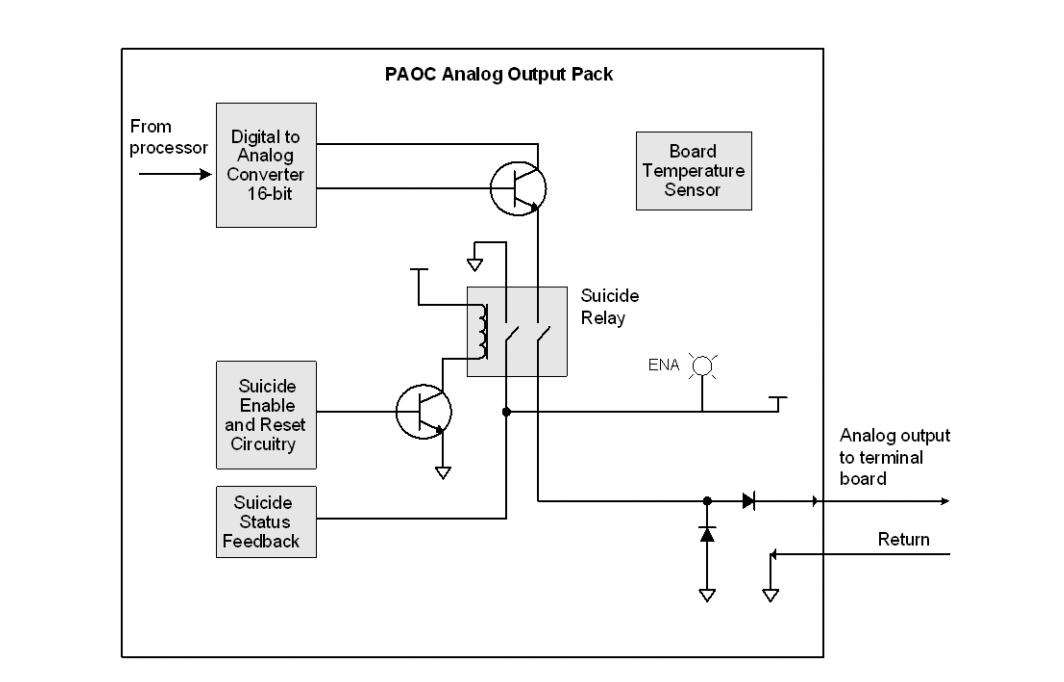
Each output channel is equipped with a normally-open mechanical relay, known as a "Suicide Relay."
Upon detection of a serious fault (e.g., output current exceeding limits, communication loss, or internal hardware fault), the module activates this relay, physically disconnecting the output channel from the field load. This prevents equipment misoperation due to erroneous signals, providing essential safety protection.
Comprehensive Self-Diagnostics and Status Monitoring
Power-Up Self-Test (POST): Automatically tests memory, communication ports, and hardware circuits upon startup.
Power Supply Monitoring: Continuously monitors the health of the internal +15V and -15V power supplies.
Hardware Identity Verification: Checks the ID information of the processor board, acquisition board, and terminal board to ensure hardware compatibility.
Communication Link Status Monitoring: Provides a "LINK_OK" signal indicating communication health with the controller.
Temperature Monitoring: Monitors the module's internal temperature in real-time and alarms upon overtemperature.
Suicide Relay Status Monitoring: Provides feedback on the relay's actual position, ensuring its action matches the command.
Flexible Offline Output Behavior Configuration
PwrDownMode: De-energizes the suicide relay (opens circuit) and drives the output current to 0mA. This is the safest mode.
HoldLastVal: Holds the output at the last value received from the controller before communication was lost.
Output_Value: Drives the output to a pre-configured safe value.
Hot-Swappable and Soft-Start Capability
Supports installation or replacement without removing power (hot-swapping), facilitating system maintenance and upgrades.
The module incorporates a soft-start circuit that effectively limits inrush current during power-up, protecting the power supply and equipment.
Detailed Working Principles
The operation of the IS220PAOCH1A module involves a closed-loop process from digital command to precise analog current generation, coupled with continuous self-verification.
Signal Generation Principle: Digital-to-Analog Conversion
Step 1: Data Reception: The main controller sends digital command packets, containing output information, to the IS220PAOCH1A's BPPB processor via Ethernet (ENET1 or ENET2).
Step 2: Data Processing: The processor parses the data packet and sends the digital value representing the target current to the dedicated 16-bit Digital-to-Analog Converter (DAC).
Step 3: Current Generation: The DAC converts the digital value into a corresponding analog reference voltage. This reference voltage drives a linear amplifier circuit (based on transistors) to generate the precise 0-20mA current signal.
Step 4: Output Drive: The generated current signal is transmitted through the DC-37 connector to the terminal board, ultimately reaching the field load.
Feedback Monitoring Principle: Forming a Diagnostic Loop
Step 1: Current Sampling: On the terminal board, a high-precision, low-temperature-drift 50Ω sense resistor is connected in series with each output loop. According to Ohm's Law (V = I * R), the output current (I) flowing through this resistor produces a corresponding voltage drop (V).
Step 2: Signal Conditioning & Digitization: This small voltage signal is routed back to the PAOCH1A module, where it is conditioned (e.g., amplified, filtered) and then sampled by a 16-bit Analog-to-Digital Converter (ADC), converting it back into a digital value.
Step 3: Comparison & Diagnosis: The processor compares the "actual current" feedback value read by the ADC with the "commanded current" value sent to the DAC. If the deviation between the two exceeds the percentage tolerance set by the user in the D/A_ErrLimit parameter, the module generates a corresponding alarm (e.g., Alarms 46-53), indicating a potential fault in that output channel.
Safety Protection (Suicide) Principle: Safe Response to Faults
Feedback current consistently exceeding 30mA (dangerous over-limit).
Persistent D/A_ErrLimit exceedance.
A "suicide" command from the processor.
This is an active protection mechanism based on diagnostic results. The protection is triggered when the module detects conditions such as:
Action Process: The processor de-energizes the coil of the "Suicide Relay." The relay, losing its magnetic force, returns to its normal state (open), thus physically breaking that output circuit and achieving safe isolation. The relay's status is monitored via auxiliary contacts fed back to the processor, forming another monitoring loop to ensure the protective action is executed correctly.
Thermal Management Principle: Thermal Derating Design
Heat Source: The module's 8 output channels utilize linear amplifier technology, which dissipates significant power (P = I * V), where V is the voltage drop across the output stage (i.e., supply voltage minus the voltage across the load). When driving low-impedance loads, the voltage drop across the output stage is high, generating substantial heat within the module.
Derating Strategy: To ensure components operate within safe temperature limits and prevent overheating damage, the module employs a "thermal derating" strategy. This means that as the number of simultaneously active output channels increases, or the load impedance decreases, the maximum allowable ambient operating temperature for the module must be correspondingly reduced. This is achieved through rigorous thermal design and the derating tables provided in the documentation, guiding users in proper environmental design for practical applications.