GE
IS200TDBSH6A(IS200TDBSH6ABC)
$4000
In Stock
T/T
Xiamen
| Availability: | |
|---|---|
| Quantity: | |
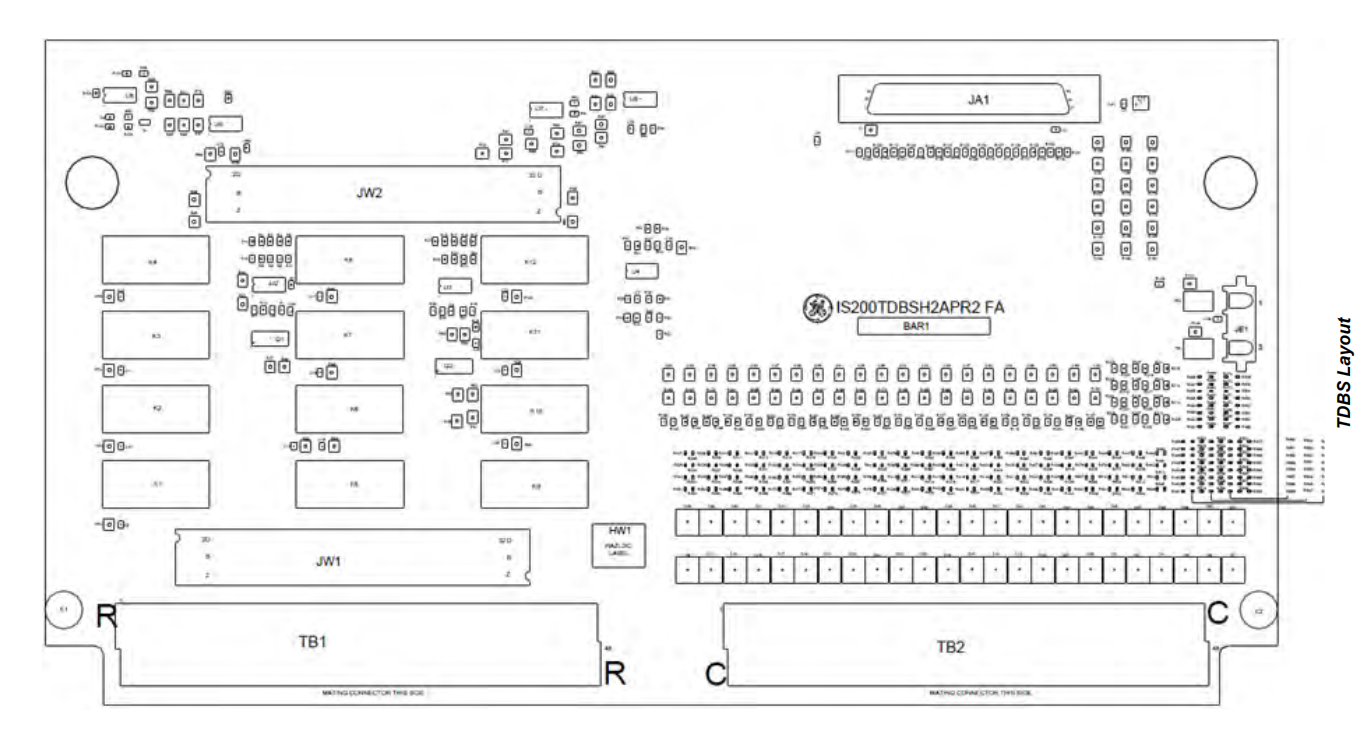
The IS200TDBSH6A is a high-voltage model within General Electric's (GE) TDBS series of Simplex Discrete Input/Output Terminal Boards, designed for the Mark VIe and Mark VIeS control systems. It is specifically engineered for industrial applications requiring a nominal 125V DC wetting voltage. Like the IS200TDBSH2A (24V DC) and IS200TDBSH4A (48V DC), which are designed for lower voltages, the IS200TDBSH6A serves as a critical interface between the PDIO I/O module and field devices, responsible for receiving field discrete signals and driving various loads. It features a robust structure supporting DIN-rail or flat mounting, with all terminal blocks being pluggable, embodying principles of high reliability, ease of maintenance, and modular design. The IS200TDBSH6A is commonly used in key control loops within power, energy, and heavy industries where field instruments and actuators operate at higher voltages.
The core functions of the IS200TDBSH6A are consistent with other series products, providing 24 discrete inputs and 12 relay outputs, but its electrical parameters are optimized for high-voltage environments.
24-Channel Discrete Input (Optimized for 125V DC)
Input Type: Accepts 24 "dry contact" signals.
Wetting Voltage: This is the most fundamental difference from the IS200TDBSH2A. The IS200TDBSH6A supports a nominal wetting voltage of 125V DC, with an operational range of 100 to 145V DC. This high-voltage input capability allows it to directly interface with many higher-voltage switches and devices commonly used in industrial environments without requiring additional signal converters.
Signal Conditioning: Possesses the same level of noise suppression and surge protection as the IS200TDBSH2A. Each input channel is equipped with a hardware filter (4ms), effectively eliminating contact bounce and electromagnetic interference, ensuring signal integrity in high-noise environments.
Input Current: Due to the higher operating voltage, the input current is approximately 2.55mA for the first 21 circuits and 10mA for the last three circuits (22-24) at the nominal 125V DC. Despite the higher voltage, the current remains limited to a safe range.
Group Isolation: All input channels are group-isolated, enhancing system noise immunity and safety.
12-Channel Relay Output (Universal Type)
125V DC: Max. 0.6A
48V DC: Max. 1.2A
24V DC / 120V or 240V AC (50/60Hz): Max. 3.15A
Relay Type: Provides 12 Form-C (break-before-make) relay contacts. Each relay provides NC, COM, and NO terminals.
Load Capacity: The relay output section is identical to the IS200TDBSH2A and H4A. Its contact capacity depends on the switched voltage type:
It is important to note that while the input side of the IS200TDBSH6A is designed for 125V DC, its relay outputs are universal and can be safely used to switch lower DC or AC voltages, provided the corresponding current ratings are not exceeded.
Life & Response: Silver-nickel alloy contacts, electrical life of 100,000 operations, mechanical life of 5,000,000 operations, typical switching response time of 25 milliseconds.
Integration with the PDIO I/O Module
Identical to the IS200TDBSH2A, the IS200TDBSH6A interfaces with the PDIO module via a D-type connector. The PDIO handles all logic and communication tasks with the upper-level Mark VIe controller over Ethernet. The IS200TDBSH6A acts as a passive interface terminal board, providing physical connection, conditioning, and protection for signals.
W-Type Option Board Expansion
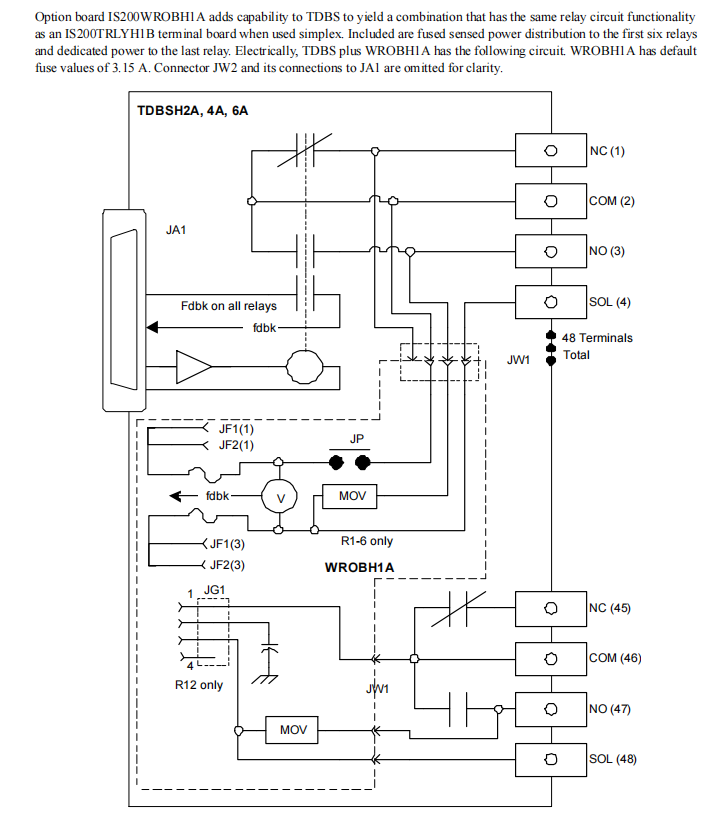
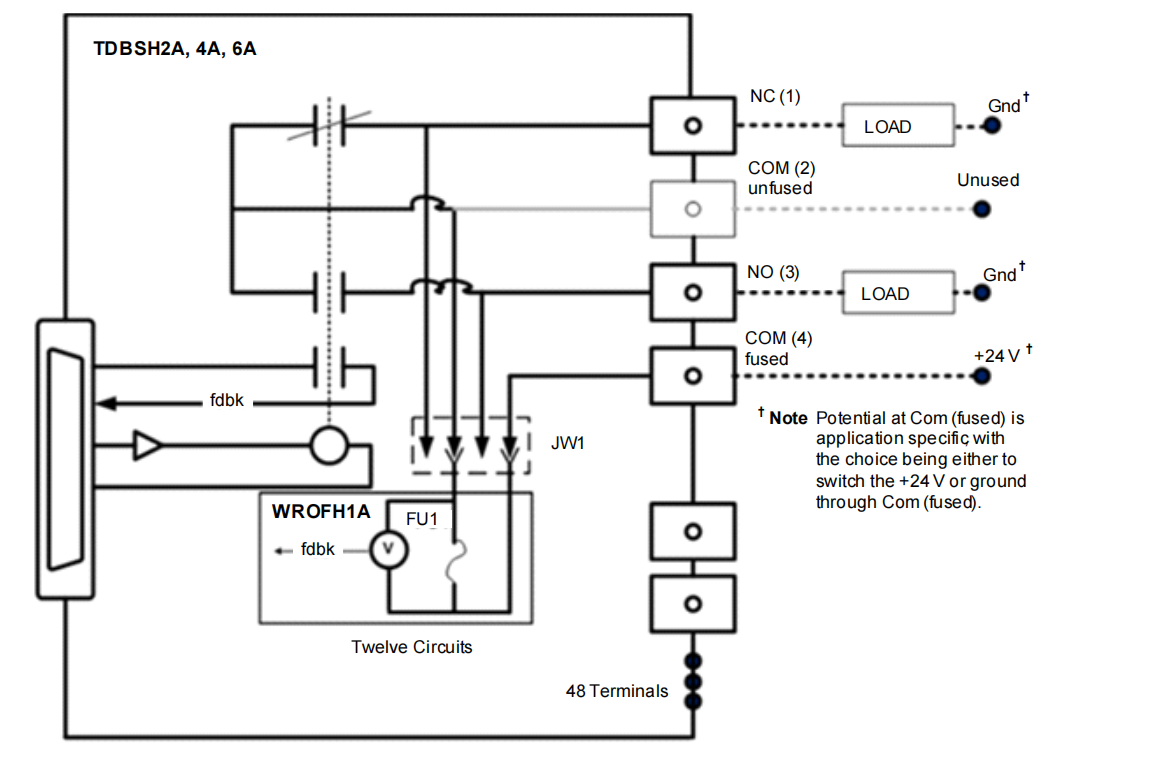
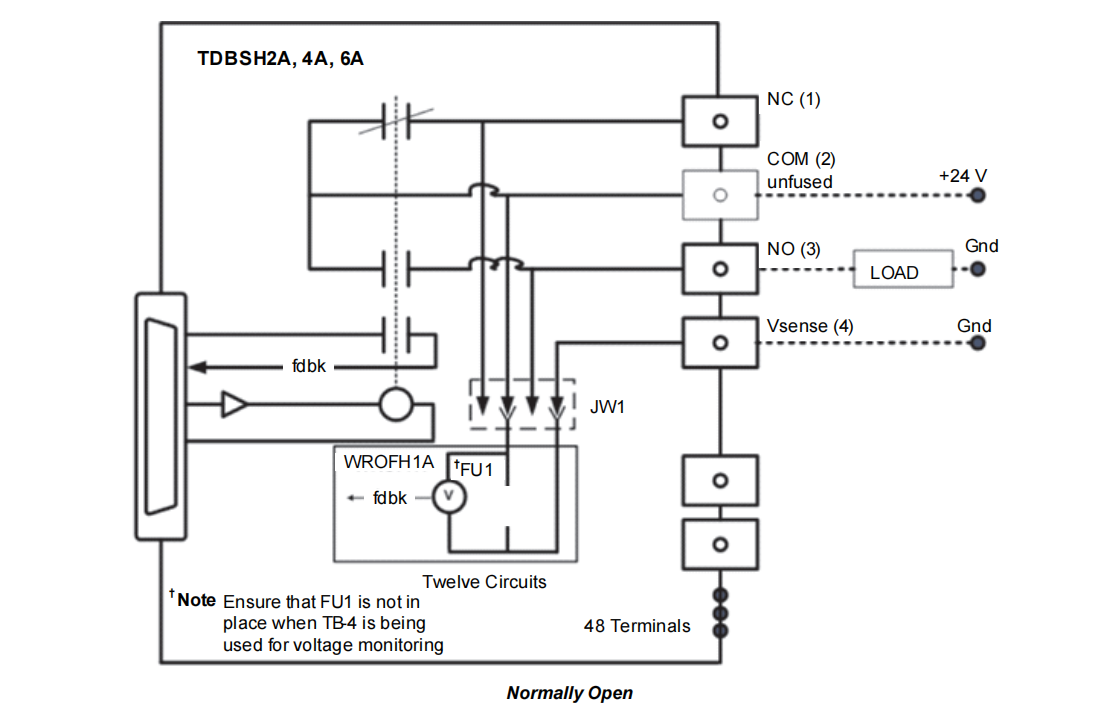
The IS200TDBSH6A is fully compatible with the same three W-type option boards as the IS200TDBSH2A and H4A, expanding its relay output functionality:
IS200WROBH1A: Provides fused and voltage-sensed power distribution (fused on both sides) for the first six relays and dedicated power for the twelfth relay.
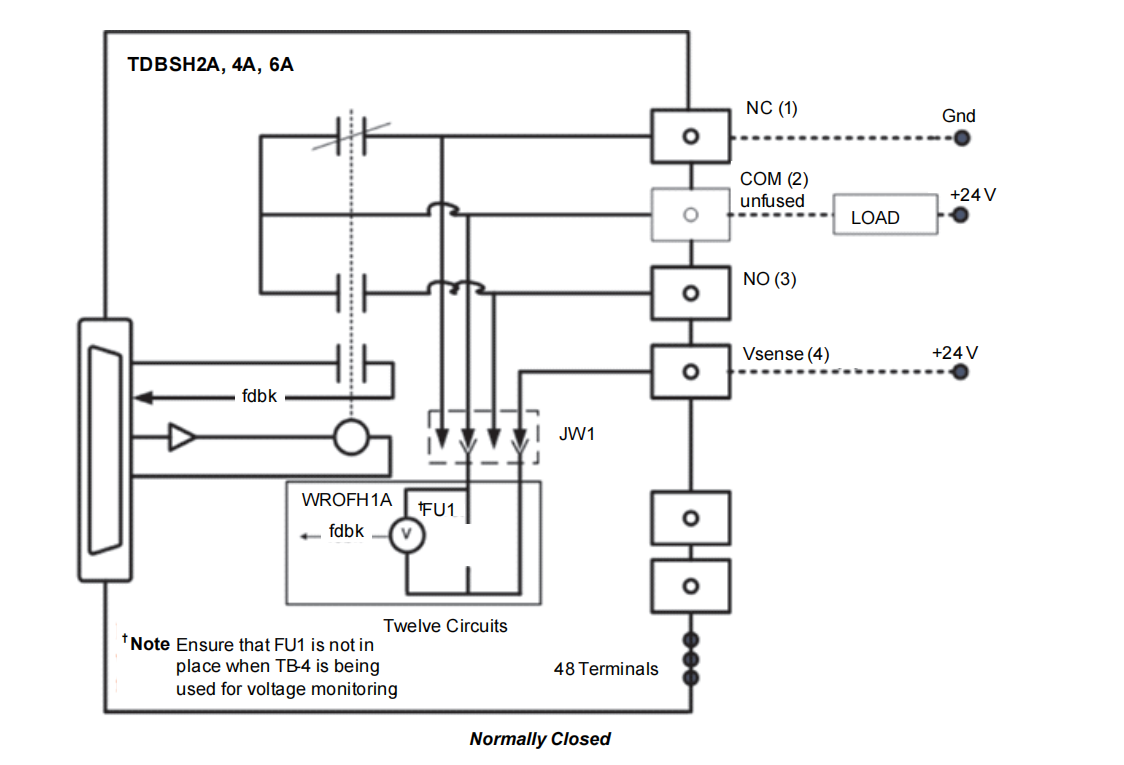
IS200WROFH1A: Places a single fuse in series with the common connection for each relay and provides isolated voltage feedback.
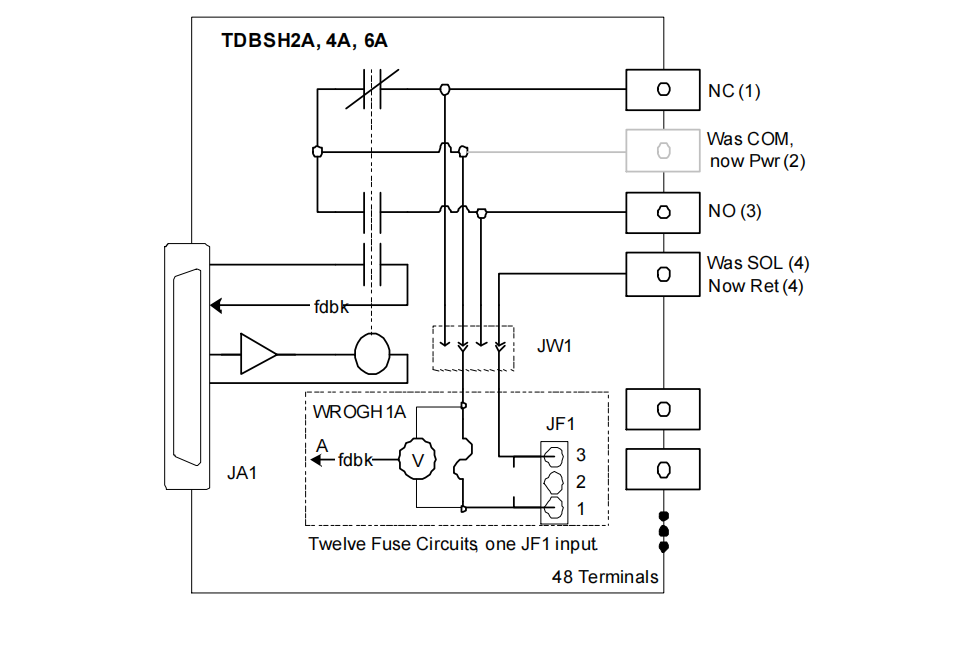
IS200WROGH1A: Provides centralized, single-side fused power distribution for all twelve relays.
The introduction of these option boards allows the TDBSH6A outputs not only to switch high voltages but also to provide power distribution, circuit protection, and advanced diagnostics.
(A) Discrete Input Section: Core Differences for High-Voltage Adaptation
The working principle of the input circuit is similar between the IS200TDBSH6A and IS200TDBSH2A, but key differences in component parameters and design exist to support 125V DC.
Wetting Voltage Distribution and Input Current:
Commonality: Similar to the IS200TDBSH2A, the 24 wetting voltage output terminals (odd-numbered terminals on TB2) of the IS200TDBSH6A are also connected in parallel internally, all sourced from pin 1 (positive) of the JE1 connector. The wiring method of "a single wetting voltage lead to the field, multiple signal lines returning" is permitted. The return path is JE1 pin 3.
Difference: Current-Limiting Resistor Values: This is the essential difference. To limit the input current to the standard range (2.55mA/10mA) at the higher input voltage (125V DC), the current-limiting resistors in series within the IS200TDBSH6A's input circuits must have a significantly higher resistance value than those in the IS200TDBSH2A. According to Ohm's Law (R = V/I), with the target current (I) being the same, a higher voltage (V) requires a larger resistance (R). Consequently, the power rating and resistance value of these resistors used on the TDBSH6A board are higher than those on the IS200TDBSH2A. This is a hardware adjustment made to adapt to the high voltage, invisible to the user but crucial.
Signal Conditioning and Isolation:
Commonality: Both include noise suppression, hardware filtering, and optical isolation. Optical isolation remains key for system safety, separating the high-voltage field side from the control side.
Difference: Threshold Voltage and Noise Margin: The input state threshold voltage is set at 50% of the wetting voltage. For the TDBSH6A, this means a threshold voltage of approximately 62.5V DC (50% of 125V DC), much higher than the TDBSH2A's 12V DC (50% of 24V DC). This higher threshold provides superior noise immunity. In industrial environments, low-frequency AC-induced voltages are common interference. The TDBSH6A can reject up to 60V RMS of AC common-mode voltage (at 125V DC wetting), compared to 12V RMS (at 24V DC wetting) for the TDBSH2A. This makes the TDBSH6A more robust in extremely harsh electrical environments (e.g., near large motors).
Fundamental Architectural Difference from IS200TDBSH8A:
It is important to note that the IS200TDBSH6A, like the IS200TDBSH2A/H4A, has its wetting voltage terminals connected in parallel and does not have individual current-limiting resistors for each channel like the IS200TDBSH8A. Therefore, regarding wiring methods, the TDBSH6A is the same as the TDBSH2A, allowing shared wetting voltage leads, whereas the TDBSH8A requires individual wiring per input.
(B) Relay Output Section: High Universality and Option Board Application
Basic Output Circuit:
Commonality: The relay output section of the IS200TDBSH6A is physically and electrically identical to that of the IS200TDBSH2A and H4A. This is a key design feature of the TDBS series: the relay module is universal; the difference between models (H2A, H4A, H6A) lies solely in the configuration of the contact input circuits to adapt to different wetting voltages. Therefore, the relays of the IS200TDBSH6A can be used just like those of the IS200TDBSH2A to switch loads at various voltages such as 24V DC or 120V AC, ensuring the load current does not exceed the rating for the corresponding voltage.
Operation of Option Boards:
Full Compatibility: Because the relay section is identical, the function, wiring, and operating principles of the WROBH1A, WROFH1A, and WROGH1A option boards on the IS200TDBSH6A are exactly the same as on the IS200TDBSH2A.
Application Consideration: When using option boards like WROBH1A or WROGH1A to distribute power for the relays, it's important to note that the voltage and current handled by the option board itself and the relay contacts are independent. For example, you can use the TDBSH6A's inputs to monitor 125V DC signals while using the WROGH1A option board to distribute 24V DC power to the relay outputs to drive solenoid valves. This flexibility allows the TDBSH6A to handle signals of different voltage levels within a single unit.
| Feature | IS200TDBSH6A | IS200TDBSH2A | Comparison Explanation |
|---|---|---|---|
| Core Application Voltage | Nominal 125V DC (Range: 100-145V DC) | Nominal 24V DC (Range: 16-32V DC) | The most fundamental difference. H6A for high-voltage field instruments, H2A for standard low-voltage applications. |
| Input Current | ~2.55mA (first 21), ~10mA (last 3) @125V DC | ~2.5mA (first 21), ~10mA (last 3) @24V DC | Current values are similar, but H6A achieves this with higher-value current-limiting resistors to withstand the high voltage. |
| AC Voltage Rejection | 60V RMS (at 125V DC wetting) | 12V RMS (at 24V DC wetting) | H6A has significantly higher noise immunity, suitable for harsher EMI environments. |
| Input Threshold Voltage | ~62.5V DC (50% of 125V DC) | ~12V DC (50% of 24V DC) | The high threshold is the basis for H6A's high noise immunity. |
| Internal Current Limiting | High-resistance current-limiting resistors in input circuits | Low-resistance current-limiting resistors in input circuits | A key hardware difference to adapt to different voltages. |
| Wetting Voltage Wiring | Parallel wetting terminals, allows shared leads like H2A | Parallel wetting terminals, allows shared leads | Wiring method is the same, advantageous over the H8A model which requires individual leads. |
| Relay Output Section | Identical to TDBSH2A (12 Form-C relays) | Identical to TDBSH6A (12 Form-C relays) | Output universality is a major advantage of the TDBS series. Model difference does not affect output capability. |
| W-Type Option Board Compatibility | Fully Compatible (WROBH1A, WROFH1A, WROGH1A) | Fully Compatible (WROBH1A, WROFH1A, WROGH1A) | Option board functionality is consistent, providing the same expansion capabilities. |
| Typical Application Scenario | High-voltage switch status monitoring, power system control, interfacing with high-voltage equipment in older plants | Standard PLC/DCS I/O applications, low-voltage sensor and switch interfaces, modern automation equipment | Selection depends on the voltage level of field devices and environmental noise levels. |
Installation: The installation method is identical to the IS200TDBSH2A (DIN-rail or panel mounting), using the same plastic insulator and sheet metal carrier. Wiring guidelines are also the same, using #24 - #12 AWG wires.
Diagnostics: The PDIO's diagnostic monitoring for the IS200TDBSH6A is identical to that for the TDBSH2A, including wetting voltage loss (threshold <40% of nominal), relay position feedback, option board fuse status monitoring, and hardware ID recognition to prevent incompatibility.
Safety Warning: Like the IS200TDBSH2A, the IS200TDBSH6A is not suitable for hazardous locations (require TDBSH8A), and its option boards are also prohibited for use in hazardous areas.
The IS200TDBSH6A is a high-voltage model within General Electric's (GE) TDBS series of Simplex Discrete Input/Output Terminal Boards, designed for the Mark VIe and Mark VIeS control systems. It is specifically engineered for industrial applications requiring a nominal 125V DC wetting voltage. Like the IS200TDBSH2A (24V DC) and IS200TDBSH4A (48V DC), which are designed for lower voltages, the IS200TDBSH6A serves as a critical interface between the PDIO I/O module and field devices, responsible for receiving field discrete signals and driving various loads. It features a robust structure supporting DIN-rail or flat mounting, with all terminal blocks being pluggable, embodying principles of high reliability, ease of maintenance, and modular design. The IS200TDBSH6A is commonly used in key control loops within power, energy, and heavy industries where field instruments and actuators operate at higher voltages.
The core functions of the IS200TDBSH6A are consistent with other series products, providing 24 discrete inputs and 12 relay outputs, but its electrical parameters are optimized for high-voltage environments.
24-Channel Discrete Input (Optimized for 125V DC)
Input Type: Accepts 24 "dry contact" signals.
Wetting Voltage: This is the most fundamental difference from the IS200TDBSH2A. The IS200TDBSH6A supports a nominal wetting voltage of 125V DC, with an operational range of 100 to 145V DC. This high-voltage input capability allows it to directly interface with many higher-voltage switches and devices commonly used in industrial environments without requiring additional signal converters.
Signal Conditioning: Possesses the same level of noise suppression and surge protection as the IS200TDBSH2A. Each input channel is equipped with a hardware filter (4ms), effectively eliminating contact bounce and electromagnetic interference, ensuring signal integrity in high-noise environments.
Input Current: Due to the higher operating voltage, the input current is approximately 2.55mA for the first 21 circuits and 10mA for the last three circuits (22-24) at the nominal 125V DC. Despite the higher voltage, the current remains limited to a safe range.
Group Isolation: All input channels are group-isolated, enhancing system noise immunity and safety.
12-Channel Relay Output (Universal Type)
125V DC: Max. 0.6A
48V DC: Max. 1.2A
24V DC / 120V or 240V AC (50/60Hz): Max. 3.15A
Relay Type: Provides 12 Form-C (break-before-make) relay contacts. Each relay provides NC, COM, and NO terminals.
Load Capacity: The relay output section is identical to the IS200TDBSH2A and H4A. Its contact capacity depends on the switched voltage type:
It is important to note that while the input side of the IS200TDBSH6A is designed for 125V DC, its relay outputs are universal and can be safely used to switch lower DC or AC voltages, provided the corresponding current ratings are not exceeded.
Life & Response: Silver-nickel alloy contacts, electrical life of 100,000 operations, mechanical life of 5,000,000 operations, typical switching response time of 25 milliseconds.
Integration with the PDIO I/O Module
Identical to the IS200TDBSH2A, the IS200TDBSH6A interfaces with the PDIO module via a D-type connector. The PDIO handles all logic and communication tasks with the upper-level Mark VIe controller over Ethernet. The IS200TDBSH6A acts as a passive interface terminal board, providing physical connection, conditioning, and protection for signals.
W-Type Option Board Expansion
The IS200TDBSH6A is fully compatible with the same three W-type option boards as the IS200TDBSH2A and H4A, expanding its relay output functionality:
IS200WROBH1A: Provides fused and voltage-sensed power distribution (fused on both sides) for the first six relays and dedicated power for the twelfth relay.
IS200WROFH1A: Places a single fuse in series with the common connection for each relay and provides isolated voltage feedback.
IS200WROGH1A: Provides centralized, single-side fused power distribution for all twelve relays.
The introduction of these option boards allows the TDBSH6A outputs not only to switch high voltages but also to provide power distribution, circuit protection, and advanced diagnostics.
(A) Discrete Input Section: Core Differences for High-Voltage Adaptation
The working principle of the input circuit is similar between the IS200TDBSH6A and IS200TDBSH2A, but key differences in component parameters and design exist to support 125V DC.
Wetting Voltage Distribution and Input Current:
Commonality: Similar to the IS200TDBSH2A, the 24 wetting voltage output terminals (odd-numbered terminals on TB2) of the IS200TDBSH6A are also connected in parallel internally, all sourced from pin 1 (positive) of the JE1 connector. The wiring method of "a single wetting voltage lead to the field, multiple signal lines returning" is permitted. The return path is JE1 pin 3.
Difference: Current-Limiting Resistor Values: This is the essential difference. To limit the input current to the standard range (2.55mA/10mA) at the higher input voltage (125V DC), the current-limiting resistors in series within the IS200TDBSH6A's input circuits must have a significantly higher resistance value than those in the IS200TDBSH2A. According to Ohm's Law (R = V/I), with the target current (I) being the same, a higher voltage (V) requires a larger resistance (R). Consequently, the power rating and resistance value of these resistors used on the TDBSH6A board are higher than those on the IS200TDBSH2A. This is a hardware adjustment made to adapt to the high voltage, invisible to the user but crucial.
Signal Conditioning and Isolation:
Commonality: Both include noise suppression, hardware filtering, and optical isolation. Optical isolation remains key for system safety, separating the high-voltage field side from the control side.
Difference: Threshold Voltage and Noise Margin: The input state threshold voltage is set at 50% of the wetting voltage. For the TDBSH6A, this means a threshold voltage of approximately 62.5V DC (50% of 125V DC), much higher than the TDBSH2A's 12V DC (50% of 24V DC). This higher threshold provides superior noise immunity. In industrial environments, low-frequency AC-induced voltages are common interference. The TDBSH6A can reject up to 60V RMS of AC common-mode voltage (at 125V DC wetting), compared to 12V RMS (at 24V DC wetting) for the TDBSH2A. This makes the TDBSH6A more robust in extremely harsh electrical environments (e.g., near large motors).
Fundamental Architectural Difference from IS200TDBSH8A:
It is important to note that the IS200TDBSH6A, like the IS200TDBSH2A/H4A, has its wetting voltage terminals connected in parallel and does not have individual current-limiting resistors for each channel like the IS200TDBSH8A. Therefore, regarding wiring methods, the TDBSH6A is the same as the TDBSH2A, allowing shared wetting voltage leads, whereas the TDBSH8A requires individual wiring per input.
(B) Relay Output Section: High Universality and Option Board Application
Basic Output Circuit:
Commonality: The relay output section of the IS200TDBSH6A is physically and electrically identical to that of the IS200TDBSH2A and H4A. This is a key design feature of the TDBS series: the relay module is universal; the difference between models (H2A, H4A, H6A) lies solely in the configuration of the contact input circuits to adapt to different wetting voltages. Therefore, the relays of the IS200TDBSH6A can be used just like those of the IS200TDBSH2A to switch loads at various voltages such as 24V DC or 120V AC, ensuring the load current does not exceed the rating for the corresponding voltage.
Operation of Option Boards:
Full Compatibility: Because the relay section is identical, the function, wiring, and operating principles of the WROBH1A, WROFH1A, and WROGH1A option boards on the IS200TDBSH6A are exactly the same as on the IS200TDBSH2A.
Application Consideration: When using option boards like WROBH1A or WROGH1A to distribute power for the relays, it's important to note that the voltage and current handled by the option board itself and the relay contacts are independent. For example, you can use the TDBSH6A's inputs to monitor 125V DC signals while using the WROGH1A option board to distribute 24V DC power to the relay outputs to drive solenoid valves. This flexibility allows the TDBSH6A to handle signals of different voltage levels within a single unit.
| Feature | IS200TDBSH6A | IS200TDBSH2A | Comparison Explanation |
|---|---|---|---|
| Core Application Voltage | Nominal 125V DC (Range: 100-145V DC) | Nominal 24V DC (Range: 16-32V DC) | The most fundamental difference. H6A for high-voltage field instruments, H2A for standard low-voltage applications. |
| Input Current | ~2.55mA (first 21), ~10mA (last 3) @125V DC | ~2.5mA (first 21), ~10mA (last 3) @24V DC | Current values are similar, but H6A achieves this with higher-value current-limiting resistors to withstand the high voltage. |
| AC Voltage Rejection | 60V RMS (at 125V DC wetting) | 12V RMS (at 24V DC wetting) | H6A has significantly higher noise immunity, suitable for harsher EMI environments. |
| Input Threshold Voltage | ~62.5V DC (50% of 125V DC) | ~12V DC (50% of 24V DC) | The high threshold is the basis for H6A's high noise immunity. |
| Internal Current Limiting | High-resistance current-limiting resistors in input circuits | Low-resistance current-limiting resistors in input circuits | A key hardware difference to adapt to different voltages. |
| Wetting Voltage Wiring | Parallel wetting terminals, allows shared leads like H2A | Parallel wetting terminals, allows shared leads | Wiring method is the same, advantageous over the H8A model which requires individual leads. |
| Relay Output Section | Identical to TDBSH2A (12 Form-C relays) | Identical to TDBSH6A (12 Form-C relays) | Output universality is a major advantage of the TDBS series. Model difference does not affect output capability. |
| W-Type Option Board Compatibility | Fully Compatible (WROBH1A, WROFH1A, WROGH1A) | Fully Compatible (WROBH1A, WROFH1A, WROGH1A) | Option board functionality is consistent, providing the same expansion capabilities. |
| Typical Application Scenario | High-voltage switch status monitoring, power system control, interfacing with high-voltage equipment in older plants | Standard PLC/DCS I/O applications, low-voltage sensor and switch interfaces, modern automation equipment | Selection depends on the voltage level of field devices and environmental noise levels. |
Installation: The installation method is identical to the IS200TDBSH2A (DIN-rail or panel mounting), using the same plastic insulator and sheet metal carrier. Wiring guidelines are also the same, using #24 - #12 AWG wires.
Diagnostics: The PDIO's diagnostic monitoring for the IS200TDBSH6A is identical to that for the TDBSH2A, including wetting voltage loss (threshold <40% of nominal), relay position feedback, option board fuse status monitoring, and hardware ID recognition to prevent incompatibility.
Safety Warning: Like the IS200TDBSH2A, the IS200TDBSH6A is not suitable for hazardous locations (require TDBSH8A), and its option boards are also prohibited for use in hazardous areas.