GE
IS420YDIAS1B
$5000
In Stock
T/T
Xiamen
| Availability: | |
|---|---|
| Quantity: | |
The IS420YDIAS1B represents the evolution of discrete input technology within GE's Mark VIeS distributed control architecture, engineered as an advanced iteration in the YDIA series. This sophisticated module serves as a critical data acquisition component specifically designed for high-reliability binary signal processing in demanding industrial environments. Unlike conventional input modules, the YDIAS1B incorporates next-generation processing capabilities that enable enhanced diagnostic intelligence and communication performance.
Positioned within the broader control system ecosystem, this module functions as the primary interface for critical status monitoring applications including protective relay status, emergency stop circuits, valve position feedback, and equipment run status. The module's design philosophy emphasizes not only signal acquisition accuracy but also predictive maintenance capabilities through its advanced self-diagnostic features. In complex industrial systems where operational availability is paramount, the YDIAS1B provides the signal integrity and fault detection mechanisms necessary for maintaining continuous process operations.
With its specific hardware configuration and software requirements, the IS220YDIAS1B is ideally suited for new installations and system upgrades where the latest control system features and enhanced performance characteristics are required.
The IS420YDIAS1B embodies a significant technological advancement through its sophisticated hardware implementation, featuring components specifically selected for enhanced performance and longevity:
High-Performance Processor Board (BPPC): The core differentiator of the IS420YDIAS1B is its integration of the advanced BPPC processor board. This processor delivers substantially increased computational capacity, enabling more sophisticated signal processing algorithms, enhanced communication throughput, and more comprehensive diagnostic routines. The BPPC's architecture supports the module's requirement for ControlST® V06.01 or later, ensuring compatibility with contemporary system cybersecurity protocols and software features.
Enhanced Discrete Input Acquisition Board: This specialized board incorporates improved signal conditioning circuitry with optimized noise immunity characteristics. The acquisition path employs premium components that maintain signal integrity even in electrically noisy environments, with enhanced filtering capabilities that surpass previous generations.
The module's physical interface system maintains backward compatibility while delivering improved reliability:
High-Density Field Interface:
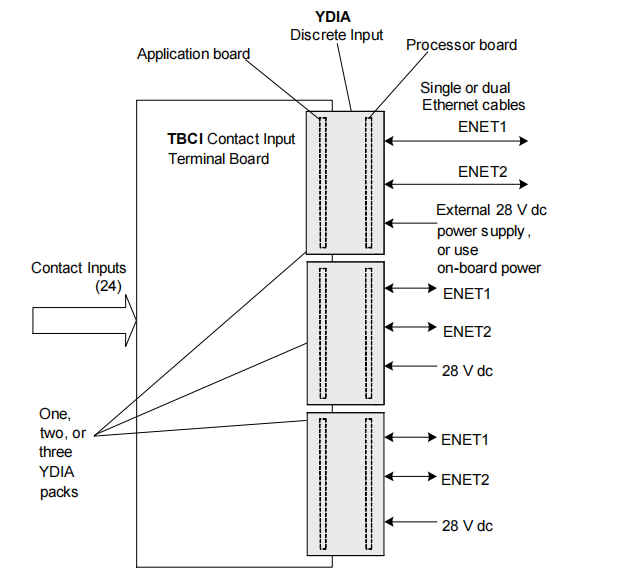
DC-37 Pin Industrial Connector: This robust connector interface provides secure connection to compatible terminal boards, transmitting 24 discrete signals alongside identification and control communications. The connector design ensures maintained signal integrity through superior contact materials and mechanical stability.
Advanced System Connectivity:
Dual Auto-Negotiating Ethernet Ports: The enhanced network interface controller provides improved communication reliability and faster data transmission to the IONet. The dual-port architecture supports sophisticated redundancy protocols with seamless failover capabilities.
Industrial Power Input: The 3-pin power connector incorporates advanced soft-start circuitry that provides superior inrush current management, reducing stress on system power supplies during module insertion.
Enhanced Visual Indicators:
Each of the 24 channels features high-brightness yellow LEDs with optimized viewing angles, providing unambiguous channel status indication even in high-ambient-light conditions.
System status indicators employ multi-color LEDs that convey comprehensive module health information through color-coded patterns.
The IS420YDIAS1B implements advanced operational methodologies that distinguish it from previous generations through enhanced intelligence and reliability:
The module's signal processing chain incorporates multiple stages of precision conditioning:
Intelligent Threshold Management: Building upon the variable threshold concept, the IS420YDIAS1B implements an adaptive threshold system that continuously monitors wetting voltage characteristics and dynamically adjusts detection parameters. This intelligent adaptation ensures consistent performance despite fluctuations in field power quality.
Enhanced Noise Immunity: The input circuitry incorporates multi-stage filtering with both hardware and digital components. The hardware filter provides 4ms of inherent noise rejection, while configurable digital filtering enables application-specific optimization. The enhanced design delivers superior common-mode noise rejection exceeding industry standards.
Advanced Isolation Technology: Each input channel employs high-performance optocouplers with reinforced isolation barriers rated for 1500V continuous operation. The isolation system incorporates monitoring circuitry that detects insulation degradation, providing early warning of potential failure conditions.
The IS420YDIAS1B features a comprehensive diagnostic architecture that provides unprecedented visibility into module and field device health:
Predictive Channel Analysis: The module continuously monitors each input channel for characteristic signatures that indicate potential field device issues, such as contact bounce patterns, abnormal operating frequencies, and timing irregularities. This analysis occurs transparently during normal operation without impacting scanning performance.
Enhanced Automatic Testing: The diagnostic test sequence employs an advanced pattern that exercises each input channel through a comprehensive validation routine. This testing verifies both the input circuitry and the associated isolation components, providing complete channel integrity verification.
Intelligent Excitation Monitoring: The module's undervoltage detection system incorporates sophisticated analysis of excitation power quality, identifying not only complete loss but also degradation patterns that may indicate impending power supply issues.
For critical applications requiring precise timing information, the IS420YDIAS1B delivers enhanced sequence of events capabilities:
Precision Timestamping: The module incorporates a high-resolution timing system that captures state transitions with 1ms accuracy, synchronized to the control system clock. This enables precise event correlation across the entire control system.
Intelligent Event Buffering: The module includes enhanced memory resources that allow for extensive event buffering, ensuring no state transitions are lost during communication bursts or system network events.
Configurable Event Filtering: Advanced filtering options allow engineers to optimize the balance between response speed and noise immunity based on specific application requirements.
In redundant configurations, the IS420YDIAS1B implements sophisticated coordination algorithms:
Intelligent Voting Synchronization: In TMR applications, the modules employ enhanced synchronization protocols that minimize voting discrepancies while maintaining independent signal acquisition integrity.
Cross-Module Diagnostics: The modules continuously intercommunicate to verify coordinated operation and identify potential synchronization issues before they impact system performance.
Graceful Degradation Management: The system incorporates intelligent algorithms that manage module failure scenarios while maintaining maximum possible system functionality.
The IS420YDIAS1B leverages the full capabilities of the ToolboxST software platform for comprehensive configuration management:
Advanced Parameter Optimization:
Application-specific filter tuning with precision timing parameters
Intelligent voting configuration for redundant systems
Customizable diagnostic sensitivity settings
Event recording prioritization and management
Enhanced System Integration:
Seamless integration with Mark VIeS control architecture
Support for advanced network configurations
Compatibility with contemporary cybersecurity protocols
The module provides comprehensive maintenance support capabilities:
Predictive Maintenance Intelligence: Advanced algorithms analyze operational patterns to identify developing issues before they impact system performance.
Detailed Diagnostic Reporting: The module generates comprehensive diagnostic information that enables precise fault isolation and rapid resolution.
Hot-Swap Capability: The module's robust mechanical design and sophisticated power management ensure reliable insertion and removal during system operation.
| Feature | IS420YDIAS1B (YDIAS1B) | IS220YDIAS1A (YDIAS1A) |
|---|---|---|
| Processor Architecture | BPPC Processor - Advanced computational capabilities supporting enhanced diagnostics and communication performance | BPPB Processor - Standard processing capabilities adequate for basic discrete input functions |
| Software Compatibility | Requires ControlST® V06.01 or later - Compatible with current software ecosystems and security standards | Compatible with ControlST® V04.06 and later - Suitable for legacy system configurations |
| Firmware Requirements | V05.01 and later firmware - Incorporates advanced features and performance enhancements | V04.06 firmware - Basic functionality with standard feature set |
| System Integration | Optimized for Mark VIeS platform with enhanced communication protocols and diagnostics | Compatible with standard Mark VIe systems with conventional communication capabilities |
| Diagnostic Intelligence | Predictive diagnostics with advanced pattern analysis and early warning capabilities | Standard diagnostics with basic fault detection and reporting |
| Communication Performance | Enhanced data throughput with optimized network utilization and faster system response | Standard communication performance adequate for conventional applications |
| Configuration Flexibility | Advanced parameter tuning with application-specific optimization capabilities | Standard configuration options suitable for typical applications |
Application Guidance: The IS420YDIAS1B is recommended for new installations, system expansions, and upgrades where the latest control system features and enhanced diagnostic capabilities provide operational benefits. The IS220YDIAS1A continues to be supported for existing installations where software platform upgrades are not planned or where the advanced capabilities of the IS420YDIAS1B are not required for the application.
The IS420YDIAS1B represents the evolution of discrete input technology within GE's Mark VIeS distributed control architecture, engineered as an advanced iteration in the YDIA series. This sophisticated module serves as a critical data acquisition component specifically designed for high-reliability binary signal processing in demanding industrial environments. Unlike conventional input modules, the YDIAS1B incorporates next-generation processing capabilities that enable enhanced diagnostic intelligence and communication performance.
Positioned within the broader control system ecosystem, this module functions as the primary interface for critical status monitoring applications including protective relay status, emergency stop circuits, valve position feedback, and equipment run status. The module's design philosophy emphasizes not only signal acquisition accuracy but also predictive maintenance capabilities through its advanced self-diagnostic features. In complex industrial systems where operational availability is paramount, the YDIAS1B provides the signal integrity and fault detection mechanisms necessary for maintaining continuous process operations.
With its specific hardware configuration and software requirements, the IS220YDIAS1B is ideally suited for new installations and system upgrades where the latest control system features and enhanced performance characteristics are required.
The IS420YDIAS1B embodies a significant technological advancement through its sophisticated hardware implementation, featuring components specifically selected for enhanced performance and longevity:
High-Performance Processor Board (BPPC): The core differentiator of the IS420YDIAS1B is its integration of the advanced BPPC processor board. This processor delivers substantially increased computational capacity, enabling more sophisticated signal processing algorithms, enhanced communication throughput, and more comprehensive diagnostic routines. The BPPC's architecture supports the module's requirement for ControlST® V06.01 or later, ensuring compatibility with contemporary system cybersecurity protocols and software features.
Enhanced Discrete Input Acquisition Board: This specialized board incorporates improved signal conditioning circuitry with optimized noise immunity characteristics. The acquisition path employs premium components that maintain signal integrity even in electrically noisy environments, with enhanced filtering capabilities that surpass previous generations.
The module's physical interface system maintains backward compatibility while delivering improved reliability:
High-Density Field Interface:
DC-37 Pin Industrial Connector: This robust connector interface provides secure connection to compatible terminal boards, transmitting 24 discrete signals alongside identification and control communications. The connector design ensures maintained signal integrity through superior contact materials and mechanical stability.
Advanced System Connectivity:
Dual Auto-Negotiating Ethernet Ports: The enhanced network interface controller provides improved communication reliability and faster data transmission to the IONet. The dual-port architecture supports sophisticated redundancy protocols with seamless failover capabilities.
Industrial Power Input: The 3-pin power connector incorporates advanced soft-start circuitry that provides superior inrush current management, reducing stress on system power supplies during module insertion.
Enhanced Visual Indicators:
Each of the 24 channels features high-brightness yellow LEDs with optimized viewing angles, providing unambiguous channel status indication even in high-ambient-light conditions.
System status indicators employ multi-color LEDs that convey comprehensive module health information through color-coded patterns.
The IS420YDIAS1B implements advanced operational methodologies that distinguish it from previous generations through enhanced intelligence and reliability:
The module's signal processing chain incorporates multiple stages of precision conditioning:
Intelligent Threshold Management: Building upon the variable threshold concept, the IS420YDIAS1B implements an adaptive threshold system that continuously monitors wetting voltage characteristics and dynamically adjusts detection parameters. This intelligent adaptation ensures consistent performance despite fluctuations in field power quality.
Enhanced Noise Immunity: The input circuitry incorporates multi-stage filtering with both hardware and digital components. The hardware filter provides 4ms of inherent noise rejection, while configurable digital filtering enables application-specific optimization. The enhanced design delivers superior common-mode noise rejection exceeding industry standards.
Advanced Isolation Technology: Each input channel employs high-performance optocouplers with reinforced isolation barriers rated for 1500V continuous operation. The isolation system incorporates monitoring circuitry that detects insulation degradation, providing early warning of potential failure conditions.
The IS420YDIAS1B features a comprehensive diagnostic architecture that provides unprecedented visibility into module and field device health:
Predictive Channel Analysis: The module continuously monitors each input channel for characteristic signatures that indicate potential field device issues, such as contact bounce patterns, abnormal operating frequencies, and timing irregularities. This analysis occurs transparently during normal operation without impacting scanning performance.
Enhanced Automatic Testing: The diagnostic test sequence employs an advanced pattern that exercises each input channel through a comprehensive validation routine. This testing verifies both the input circuitry and the associated isolation components, providing complete channel integrity verification.
Intelligent Excitation Monitoring: The module's undervoltage detection system incorporates sophisticated analysis of excitation power quality, identifying not only complete loss but also degradation patterns that may indicate impending power supply issues.
For critical applications requiring precise timing information, the IS420YDIAS1B delivers enhanced sequence of events capabilities:
Precision Timestamping: The module incorporates a high-resolution timing system that captures state transitions with 1ms accuracy, synchronized to the control system clock. This enables precise event correlation across the entire control system.
Intelligent Event Buffering: The module includes enhanced memory resources that allow for extensive event buffering, ensuring no state transitions are lost during communication bursts or system network events.
Configurable Event Filtering: Advanced filtering options allow engineers to optimize the balance between response speed and noise immunity based on specific application requirements.
In redundant configurations, the IS420YDIAS1B implements sophisticated coordination algorithms:
Intelligent Voting Synchronization: In TMR applications, the modules employ enhanced synchronization protocols that minimize voting discrepancies while maintaining independent signal acquisition integrity.
Cross-Module Diagnostics: The modules continuously intercommunicate to verify coordinated operation and identify potential synchronization issues before they impact system performance.
Graceful Degradation Management: The system incorporates intelligent algorithms that manage module failure scenarios while maintaining maximum possible system functionality.
The IS420YDIAS1B leverages the full capabilities of the ToolboxST software platform for comprehensive configuration management:
Advanced Parameter Optimization:
Application-specific filter tuning with precision timing parameters
Intelligent voting configuration for redundant systems
Customizable diagnostic sensitivity settings
Event recording prioritization and management
Enhanced System Integration:
Seamless integration with Mark VIeS control architecture
Support for advanced network configurations
Compatibility with contemporary cybersecurity protocols
The module provides comprehensive maintenance support capabilities:
Predictive Maintenance Intelligence: Advanced algorithms analyze operational patterns to identify developing issues before they impact system performance.
Detailed Diagnostic Reporting: The module generates comprehensive diagnostic information that enables precise fault isolation and rapid resolution.
Hot-Swap Capability: The module's robust mechanical design and sophisticated power management ensure reliable insertion and removal during system operation.
| Feature | IS420YDIAS1B (YDIAS1B) | IS220YDIAS1A (YDIAS1A) |
|---|---|---|
| Processor Architecture | BPPC Processor - Advanced computational capabilities supporting enhanced diagnostics and communication performance | BPPB Processor - Standard processing capabilities adequate for basic discrete input functions |
| Software Compatibility | Requires ControlST® V06.01 or later - Compatible with current software ecosystems and security standards | Compatible with ControlST® V04.06 and later - Suitable for legacy system configurations |
| Firmware Requirements | V05.01 and later firmware - Incorporates advanced features and performance enhancements | V04.06 firmware - Basic functionality with standard feature set |
| System Integration | Optimized for Mark VIeS platform with enhanced communication protocols and diagnostics | Compatible with standard Mark VIe systems with conventional communication capabilities |
| Diagnostic Intelligence | Predictive diagnostics with advanced pattern analysis and early warning capabilities | Standard diagnostics with basic fault detection and reporting |
| Communication Performance | Enhanced data throughput with optimized network utilization and faster system response | Standard communication performance adequate for conventional applications |
| Configuration Flexibility | Advanced parameter tuning with application-specific optimization capabilities | Standard configuration options suitable for typical applications |
Application Guidance: The IS420YDIAS1B is recommended for new installations, system expansions, and upgrades where the latest control system features and enhanced diagnostic capabilities provide operational benefits. The IS220YDIAS1A continues to be supported for existing installations where software platform upgrades are not planned or where the advanced capabilities of the IS420YDIAS1B are not required for the application.
| Category | Specification Details |
|---|---|
| General Parameters | |
| Processor Board | BPPC |
| Input Channels | 24 dry contact voltage inputs |
| Firmware Requirement | V05.01 and later |
| ControlST Software | V06.01 and later versions |
| Physical Dimensions | 82.6mm(H) × 41.9mm(W) × 121mm(D) |
| Manufacturing Technology | Surface Mount Technology |
| Electrical Performance | |
| Input Isolation | 1500V optical isolation all channels |
| Input Filter | Hardware filtering, 4ms time constant |
| AC Rejection | 60V RMS @ 50/60Hz, 125VDC excitation |
| Scanning Performance | Control scanning: System dependent SOE monitoring: 1000Hz |
| Environmental Ratings | |
| Operating Temperature | -30°C to +65°C (-22°F to +149°F) |
| Diagnostic Capabilities | |
| Fault Detection | Excitation voltage monitoring Input response validation Terminal board compatibility verification Advanced predictive diagnostics |
| Category | Specification Details |
|---|---|
| General Parameters | |
| Processor Board | BPPC |
| Input Channels | 24 dry contact voltage inputs |
| Firmware Requirement | V05.01 and later |
| ControlST Software | V06.01 and later versions |
| Physical Dimensions | 82.6mm(H) × 41.9mm(W) × 121mm(D) |
| Manufacturing Technology | Surface Mount Technology |
| Electrical Performance | |
| Input Isolation | 1500V optical isolation all channels |
| Input Filter | Hardware filtering, 4ms time constant |
| AC Rejection | 60V RMS @ 50/60Hz, 125VDC excitation |
| Scanning Performance | Control scanning: System dependent SOE monitoring: 1000Hz |
| Environmental Ratings | |
| Operating Temperature | -30°C to +65°C (-22°F to +149°F) |
| Diagnostic Capabilities | |
| Fault Detection | Excitation voltage monitoring Input response validation Terminal board compatibility verification Advanced predictive diagnostics |