The IS200SDIIH1A is an S-type point-isolated contact input terminal board designed for Mark VIe and Mark VIeS control systems. Its core function is to provide 16 completely independent voltage detection channels for reliably monitoring the status of contacts on devices such as relays, switches, fuses, and other equipment. The board supports a wide range of voltages from 24V DC to 250V DC and 115V AC to 230V AC, and offers exceptional flexibility and robust diagnostic capabilities. By opting for different WDII series option boards, it can easily switch between point isolation and system-wetting (group-isolated) modes, or even enable mixed configurations, meeting the highest requirements for signal integrity, safety, and maintainability in complex industrial applications.
2. Core Features & Capabilities
16 Fully Point-Isolated Channels: Each input channel is optically isolated to 1500V from other channels and from the control system. This eliminates channel-to-channel interference, ensuring signal accuracy and high system reliability.
Broad Voltage Compatibility: Each channel can be individually configured to one of six standard voltage ranges, supporting mixed use on the same board:
24 V DC (Nominal Range: 14 - 32 V DC)
48 V DC (Nominal Range: 19 - 64 V DC)
125 V DC (Nominal Range: 50 - 156 V DC)
250 V DC (Nominal Range: 100 - 264 V DC)
115 V AC RMS (Nominal Range: 90 - 143 V AC, 47-63 Hz)
230 V AC RMS (Nominal Range: 90 - 264 V AC, 47-63 Hz)
Flexible Wetting Voltage Modes:
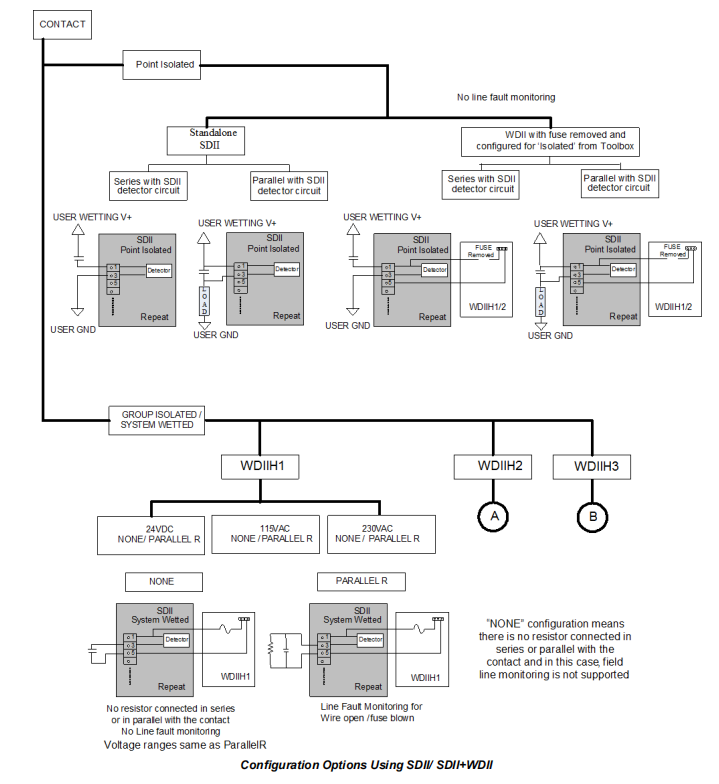
Pure Point Isolation Mode: When IS200SDIIH1A is used alone, all 16 channels are powered by external user-supplied wetting voltage, achieving full point isolation.
System-Wetting Mode: By connecting a WDII option board, the wetting voltage is provided uniformly by the control system, converting to group isolation. This simplifies external wiring and enables advanced diagnostics.
Mixed Configuration Mode: When using WDIIH1 or WDIIH2, flexible configuration is possible where some channels are system-wetted and others remain point-isolated, achieved by retaining or removing channel fuses.
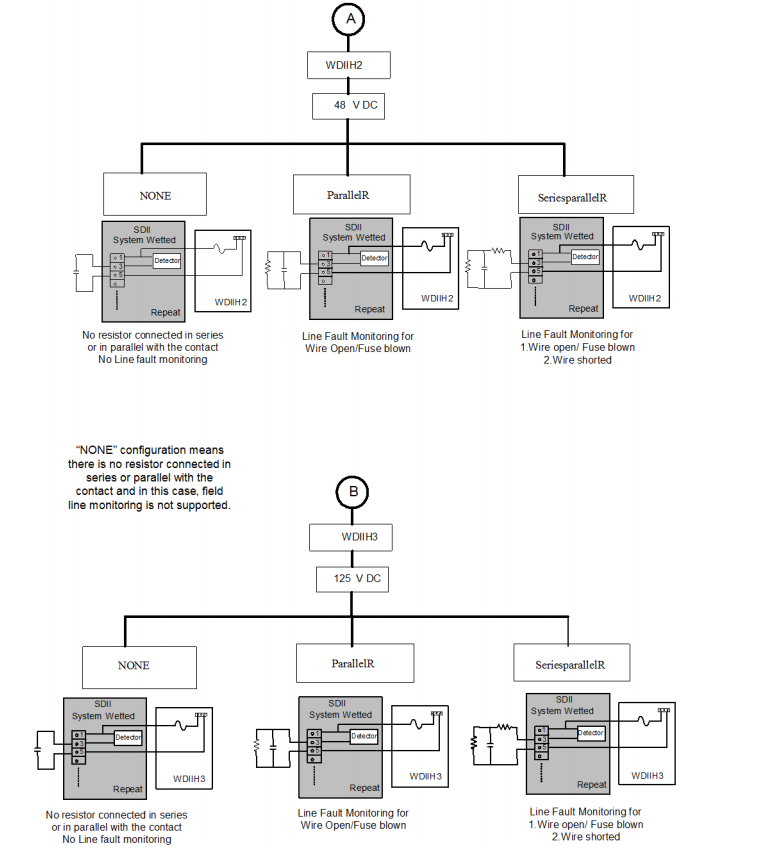
Advanced Field Line Fault Monitoring: In conjunction with WDII option boards and by adding precision resistors at the field contacts, it enables:
Parallel Resistor Configuration: Detects open circuit faults (e.g., fuse blown, field wire break).
Series-Parallel Resistor Configuration: Detects both open circuit and line-to-line short circuit faults.
High-Accuracy Sequence of Events (SOE): Optimized for SOE functionality with high-precision timestamping:
Invalid Voltage Monitoring & Alarm: The board continuously monitors the input voltage for each channel. If the voltage deviates outside the configured range, it triggers an invalid voltage alarm (accuracy ±6%), turns the LED status indicator red, and stops reporting the contact status for that channel.
Industrial-Grade Construction:
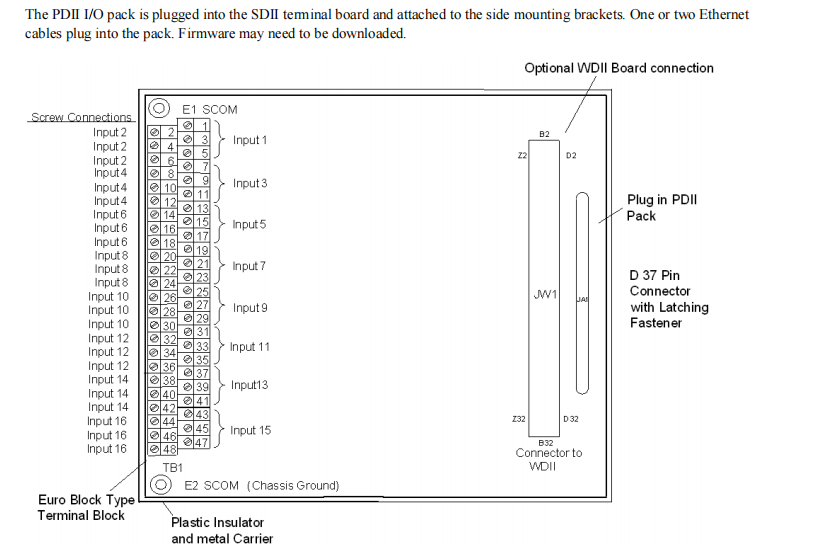
Uses 48-pin pluggable Euro-style box-type terminal blocks for easy installation and maintenance.
Supports wires from #18 AWG to #12 AWG (0.2 mm² to 2.5 mm²).
Offers both standard (SDIIH1A) and enhanced (SDIIH2A) vibration protection ratings for different environments.
Comprehensive Protection & Diagnostics:
WDIIH1/H2 use one replaceable 200mA, 250V radial fuse per channel.
WDIIH3 uses non-removable thermal fuses (PTCs).
Detects faults such as incorrect terminal board type and loss of excitation voltage.
3. Detailed Working Principle
3.1 Signal Sensing & Isolation
The core of the IS200SDIIH1A is 16 identical contact sensing circuits. When a voltage is present at the terminal board's input terminals, this circuit converts it into a small, current-limited sense current (typically 2-7 mA, depending on wetting voltage). This current then drives an opto-isolator, producing an isolated digital signal received by the system. By analyzing this signal, the system determines the contact's open/close status and can calculate the actual voltage value at the input.
3.2 Point-Isolated Mode Operation
In this mode, the user independently provides the wetting voltage and connects the contact for each channel. Logic varies based on wiring:
Series Connection (Default): The contact is in series with the sense circuit. Contact closure applies voltage to the sense circuit, reported as "True"; contact opening removes voltage, reported as "False".
Parallel Connection: The contact is in parallel with the sense circuit. This is often used for sensing contacts in series with loads (e.g., motors). Note: The parallel configuration has a leakage current (2-7 mA) when the contact is open, making it unsuitable for devices sensitive to small currents like LED indicators.
3.3 System-Wetting Mode Operation
When a WDII option board is installed, the wetting voltage is provided by the system via the option board's JE1 or JE2 connectors. The contact must be connected to the last two terminals of each channel (e.g., screws 3 & 5). The sense circuit on the option board monitors this system-provided wetting voltage. This mode is the foundation for line fault monitoring.
3.4 Fault Detection Mechanism
Parallel Resistor Configuration: A resistor of a specific value (e.g., 3.01 kΩ for WDIIH1 at 24V DC) is connected in parallel with the contact. When the contact is open, the sense current flows through this resistor, creating a loop. An open circuit fault breaks this loop, which the system detects.
Series-Parallel Resistor Configuration: Adds a series resistor (e.g., 3.32 kΩ for WDIIH2 at 48V DC) in line with the contact, in addition to the parallel resistor (e.g., 6.04 kΩ). By monitoring the voltage drop across the series resistor, the system can determine if a line-to-line short has occurred.
4. Configuration & Wiring Guide
4.1 Option Board Selection & Capabilities
| Option Board | System Wetting Voltage | Supports Point Isolation / Mixed Config? | Fault Detection Configurations |
| WDIIH1 | 24 V DC, 115/230 V AC | Yes | None, Parallel Resistor |
| WDIIH2 | 48 V DC | Yes | None, Parallel Resistor, Series-Parallel Resistor |
| WDIIH3 | 125 V DC | No (System Wetted only) | None, Parallel Resistor, Series-Parallel Resistor |
4.2 Terminal Definitions & Wiring
Each channel has 3 terminal screws (e.g., Channel 1: Screws 1, 3, 5).
Point Isolation Mode: Contact connects to the first two screws (e.g., 1 & 3).
System Wetted Mode: Contact connects to the last two screws (e.g., 3 & 5).
Shielding: A shield terminal strip connected to chassis ground is located immediately to the left of each terminal block.
5. Fault Diagnosis & SOE
When line fault monitoring is enabled, the system reports contact health status (TRUE-U / FALSE-U). SOE logging behavior requires special attention:
Some transitions directly from a normal state to a fault state (e.g., FALSE to TRUE-U) log an SOE, but this SOE should be ignored as the actual contact state did not change.
If the wetting voltage changes suddenly by more than 7.5% within 100ms, it may cause incorrect contact state declaration and erroneous SOE logging.
Line faults are typically declared within 20ms of the state change.
6. Ordering Information
Main Terminal Board: IS200SDIIH1A (Standard Vibration) or IS200SDIIH2A (Enhanced Vibration)
System Wetting Option Boards:
WDIIH1: For 24V DC / 115-230V AC system wetting & mixed configuration.
WDIIH2: For 48V DC system wetting & mixed configuration.
WDIIH3: For 125V DC system wetting (System Wetted only).
Important Note: When replacing fuses, use the specified type: Littelfuse 372 series, 200 mA, 250 V radial fuse (Part number 3720200051 / 37202000511) or GE part number 342A4908AFP1.