The TQ412 111-412-000-012 is a high‑performance, non‑contacting eddy‑current proximity transducer from the Vibro‑Meter product line, specifically designed for reverse‑mount applications where installation access is limited to the rear of the machine housing. This transducer is the sensing element of a complete proximity system that includes the IQS 450 signal conditioner and, optionally, the EA 402 extension cable. The TQ412 111-412-000-012 features a metric M10x1 thread, a standard (non‑explosive) environmental rating, no flexible protection tube (bare FEP cable), and a total system length of 1 metre. It is fully interchangeable with other components in the system and conforms to API 670 recommendations, making it suitable for critical turbomachinery monitoring in power generation, oil and gas, and heavy industry.
The TQ412 111-412-000-012 operates on the well‑established eddy‑current principle. A high‑frequency oscillator in the IQS 450 conditioner drives a coil encapsulated in the transducer tip. When the tip approaches a metallic target (e.g., a rotating shaft), eddy currents are induced in the target surface, which alter the coil’s impedance. This impedance change is linearly proportional to the gap distance, and the conditioner demodulates the signal to produce a voltage or current output proportional to the gap. The system offers a frequency response from DC to 20 kHz (‑3 dB), enabling both static position measurement and dynamic vibration analysis up to high rotational speeds.
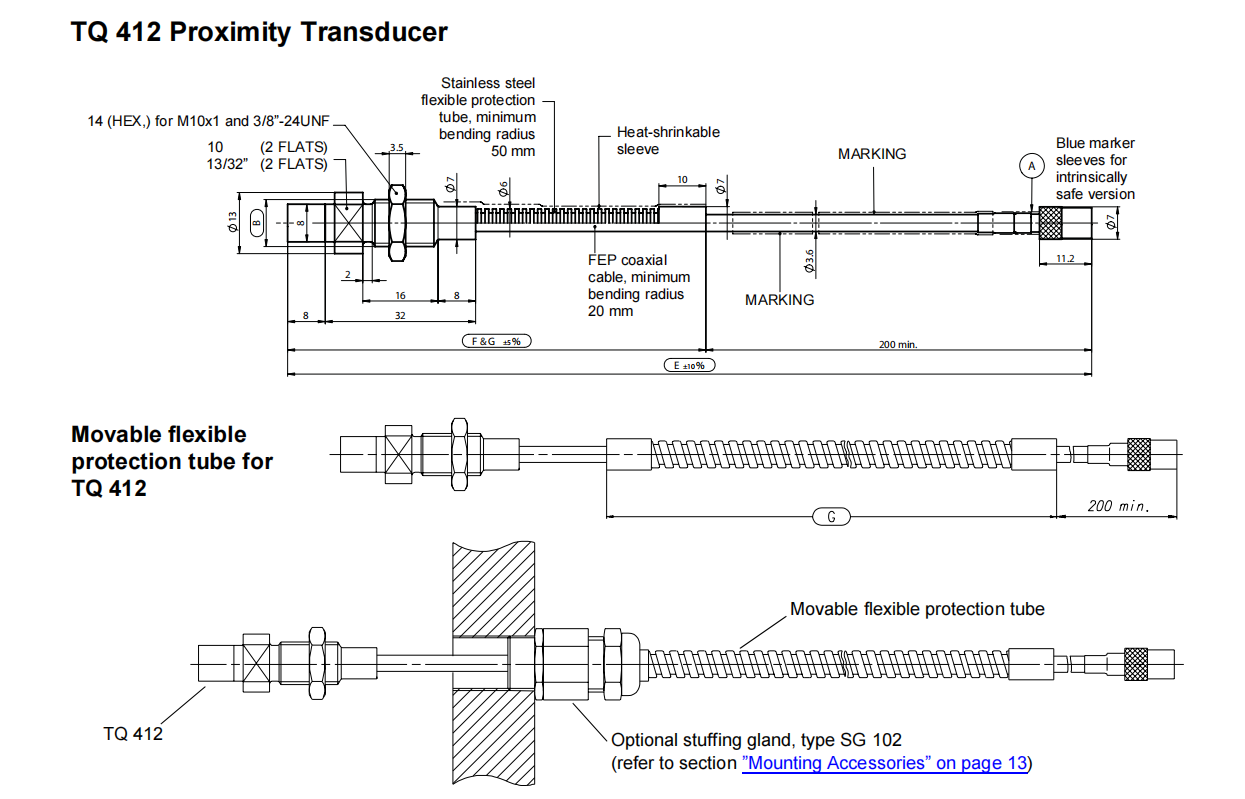
The key distinction of the TQ412 111-412-000-012 compared to the standard TQ402 is its reverse‑mount geometry. In a reverse‑mount configuration, the probe is inserted from the rear (inside) of the housing, with the tip extending toward the shaft. This is particularly useful in bearing housings, thrust bearing compartments, or other confined spaces where a forward‑mount probe cannot be easily installed. The TQ412 has a different mechanical profile: it features a 10 mm (two‑flats) wrench flat instead of a hexagon, and the thread is positioned closer to the tip. The overall length and cable exit are optimised for rear‑entry installation.
The TQ412 111-412-000-012 is built for durability. Its active coil is moulded inside a Torlon (polyamide‑imide) tip, which offers excellent mechanical strength, low thermal expansion, and resistance to chemicals. The transducer body is constructed from AISI 316L stainless steel, providing outstanding corrosion resistance. The integral coaxial cable is FEP‑insulated, rated for temperatures from –100°C to +200°C, and terminated with a miniature coaxial male AMP‑type connector (hand‑tight only). The tip is rated IP67, and the cable‑to‑body junction is rated IP64, ensuring protection against dust and splashing water.
This product introduction provides a comprehensive technical overview of the TQ412 111-412-000-012, covering its design, operating principles, performance specifications, environmental ratings, installation considerations, and ordering details. All information is derived from the official Vibro‑Meter datasheet (TQ 402 & TQ 412 / EA 402 / IQS 450, document 265‑062, version 3).
Construction and Design Features
The TQ412 111-412-000-012 is a reverse‑mount transducer, meaning it is installed from the rear of the machine housing, with the tip facing the target from the inside. Its key structural components are as follows:
Tip Material: Torlon (polyamide‑imide) – a high‑performance engineering plastic that offers excellent dimensional stability, low thermal expansion, and resistance to wear and chemicals. The coil is fully encapsulated within the tip, providing protection against moisture and mechanical damage.
Transducer Body: AISI 316L stainless steel – a low‑carbon, molybdenum‑bearing austenitic grade that provides outstanding resistance to pitting and crevice corrosion in chloride‑containing environments. The body is precision‑machined with an M10x1 metric thread and includes a 10 mm two‑flats wrench surface for torque application (instead of a hexagon on the TQ402). This flat design is typical for reverse‑mount probes to allow installation in tight spaces.
Integral Coaxial Cable: FEP (fluorinated ethylene propylene) insulated 70 Ω coaxial cable, with an outer diameter of 3.6 mm. FEP provides excellent dielectric properties, low signal attenuation, and resistance to high temperatures and chemicals. The cable is permanently attached to the transducer body and is not field‑replaceable.
Connector: Miniature coaxial male connector, type AMP 1‑330 723‑0. This connector is gold‑plated for low contact resistance and corrosion resistance. It must be hand‑tightened only when mating with the extension cable or signal conditioner – over‑tightening can damage the connector.
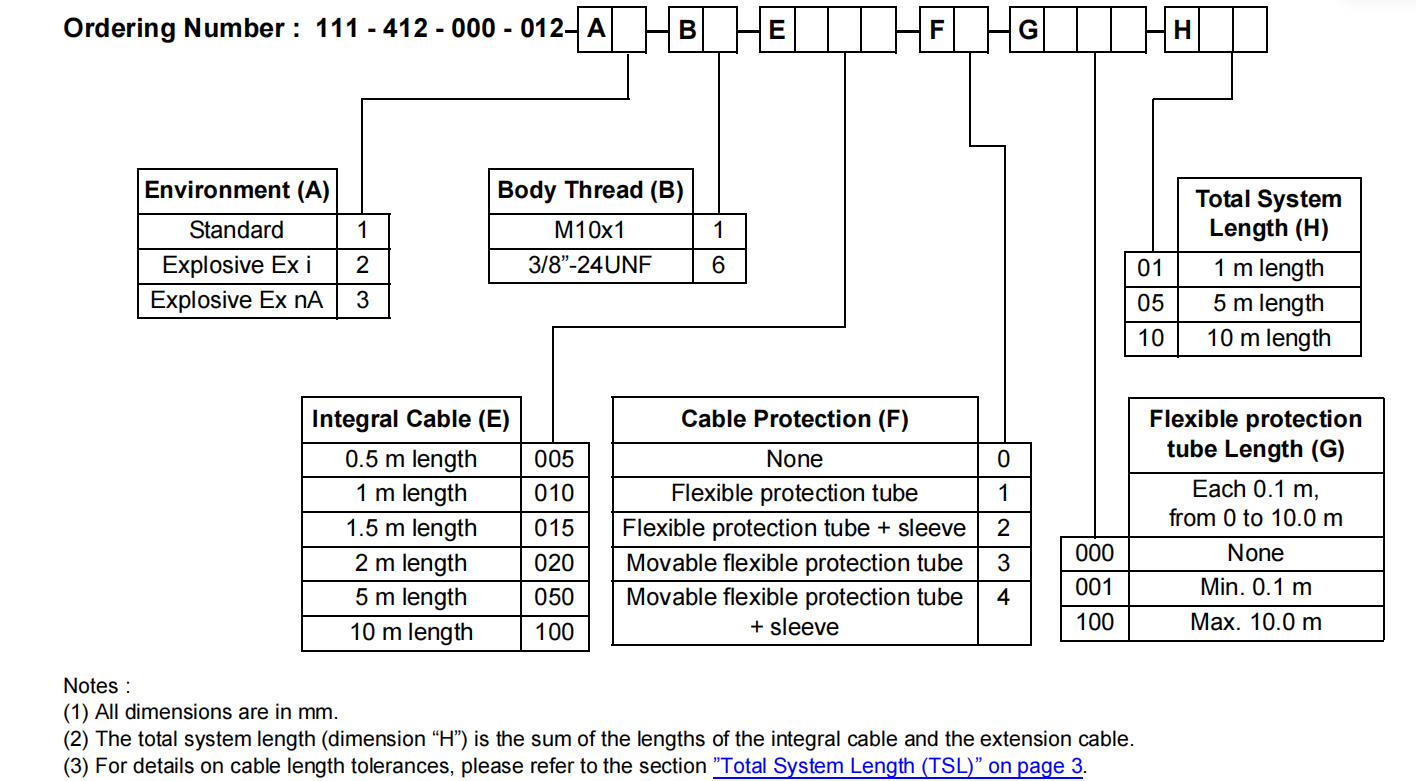
Cable Protection: The TQ412 111-412-000-012 is ordered with no flexible protection tube (option F=0) and no heat‑shrinkable sleeve (option G=000). Therefore, the integral cable is exposed, which is acceptable for clean, dry, or protected routing environments. However, the cable itself is rated for temperatures up to +200°C and has a minimum bending radius of 20 mm.
Total System Length: The ordering code 012 indicates a total system length of 1 metre. For a 1‑metre system, the minimum electrical trimmed length is 0.9 metre (per the TSL specification). The integral cable is selected such that the sum of the integral and extension cable lengths equals the nominal 1 metre. In this configuration, the transducer is typically supplied with an integral cable of 0.5 metre or 1.0 metre, with no extension cable, or with an extension cable added to reach exactly 1 m TSL.
Reverse‑Mount Specifics: The TQ412 is designed for housings where the probe must be inserted from the inside. The cable exits from the rear, and the overall length (dimension "E" for integral cable) and the movable flexible protection tube (optional) are arranged accordingly. The probe includes a movable flexible protection tube option for those who need to adjust the tube position, but the base model has no tube.
Operating Principle and System Integration
The TQ412 111-412-000-012 is designed to work exclusively with the IQS 450 signal conditioner. The conditioner supplies a high‑frequency carrier signal to the transducer, which energises the coil. The coil’s impedance varies with the distance to the target, and this variation is demodulated by the IQS 450 to produce a DC output voltage or current that is linearly proportional to the gap.
The system offers four ordering options for sensitivity and measuring range:
B21: 8 mV/μm (200 mV/mil) voltage output, 0.15‑2.15 mm range (‑1.6 V to ‑17.6 V)
B22: 2.5 μA/μm (62.5 μA/mil) current output, 0.15‑2.15 mm range (15.5‑20.5 mA)
B23: 4 mV/μm (100 mV/mil) voltage output, 0.3‑4.3 mm range (‑1.6 V to ‑17.6 V)
B24: 1.25 μA/μm (31.2 μA/mil) current output, 0.3‑4.3 mm range (15.5‑20.5 mA)
The TQ412 111-412-000-012 is a transducer only; the sensitivity and output type are determined by the IQS 450 conditioner ordered separately. However, the transducer itself is mechanically and electrically compatible with all four options. The system is calibrated at +23°C ±5°C using a VCL 140 steel target (1.7225). If the target material differs, a custom calibration is required – the user must supply a sample of the alloy (minimum Ø50 mm / 1 cm thick).
Interchangeability is a key feature: all components (transducer, extension cable, conditioner) within the same system length are interchangeable without recalibration, thanks to the electrical trimming of the coaxial cable lengths. This simplifies maintenance and reduces downtime.
Intended Applications
The TQ412 111-412-000-012 is ideally suited for a wide range of rotating machinery monitoring tasks, particularly where reverse mounting is required:
Steam, gas, and hydraulic turbines – measurement of shaft vibration and axial position in bearing housings where the probe must be installed from the rear.
Alternators and generators – monitoring of air gap, bearing wear, and shaft displacement in confined spaces.
Turbo‑compressors and pumps – detection of shaft run‑out, imbalance, and bearing degradation, especially in housings with limited front access.
Fans, blowers, and motors – general‑purpose vibration monitoring in industrial plants where the probe must be inserted from the inside.
Bently Nevada 31000/21000 series housings – the TQ412 reverse‑mount design is compatible with such housings, similar to the Bently Nevada 146055.
**Any application where the target is metallic and the environment requires a robust, temperature‑resistant transducer (up to +180°C for continuous operation).
The system conforms to API 670 recommendations, making it suitable for use in the oil and gas industry for critical machinery protection.
Installation and Handling Recommendations
Proper installation of the TQ412 111-412-000-012 is crucial for accurate measurements and long service life. The following guidelines should be observed, with special attention to the reverse‑mount nature:
Mounting: The transducer is installed from the inside (rear) of the housing. Thread the M10x1 body into a suitable tapped hole, with the tip facing the shaft. Use the 10 mm two‑flats wrench surface to apply torque – do not exceed the recommended maximum to avoid damaging the thread or body. Ensure the target (shaft) is metallic and has a diameter at least 5 times the transducer tip diameter (i.e., ≥40 mm) to avoid edge effects.
Gapping: The gap between the tip and the target must be set within the linear measuring range (0.15‑2.15 mm or 0.3‑4.3 mm depending on the conditioner option). Use a feeler gauge or precision shim to set the initial gap, then connect the system and monitor the output to fine‑tune. The mid‑range gap (corresponding to approximately –9.6 V or 18 mA) is typically recommended for maximum dynamic range.
Cable Routing: The integral FEP cable must be routed with a minimum bend radius of 20 mm. Avoid sharp bends, crushing, or abrasion. Since the cable exits from the rear of the housing, ensure it is secured with cable ties at intervals and protected from mechanical stress. The cable is not designed for continuous flexing.
Connector Handling: The AMP connector must be hand‑tightened only – never use pliers or wrenches. Over‑tightening can damage the centre pin or deform the outer shell. Ensure the mating connector is clean and dry before connection.
Environmental Protection: Although the tip is rated IP67, the cable‑to‑body junction is only IP64. Avoid directing high‑pressure water jets at the junction. If the installation is in a wet or dusty area, consider using a flexible protection tube (ordered separately) or heat‑shrink sleeve.
Target Material: The system is calibrated for VCL 140 steel. If the actual shaft material differs, the system output will shift. For best accuracy, either order a custom calibration or perform an in‑situ calibration using known gap references.
Temperature Effects: The transducer has a temperature coefficient of <5% drift over the –40°C to +180°C range. However, for high‑precision measurements, it is advisable to compensate for temperature variations using the conditioner’s built‑in temperature compensation (if available) or by performing periodic recalibration.
Reverse‑Mount Specifics: Since the probe is inserted from the rear, ensure that the cable exit does not interfere with rotating parts or other components. The movable flexible protection tube (if fitted) can be adjusted to the desired position, but for this variant there is no tube.
System Interchangeability and Total System Length (TSL)
The TQ412 111-412-000-012 is part of a fully interchangeable system. Each component – transducer, extension cable, and conditioner – is individually calibrated and marked. When replacing any component, the system output remains within tolerance without recalibration, provided the total system length (TSL) is maintained.
For a 1‑metre system, the TSL must be at least 0.9 metre due to the electrical trimming requirements. The integral cable length is chosen such that when combined with the extension cable (if used) the total is 1 metre nominal. The actual lengths are trimmed at the factory to optimise the high‑frequency response and ensure interchangeability.
If an extension cable is required, the EA 402 is available with lengths of 0.5, 1, 2, 5, or 10 metres. The sum of the integral cable (selected at order) and extension cable must equal the desired TSL. For the TQ412 111-412-000-012, the integral cable length is typically 0.5 metre or 1.0 metre to reach a total of 1 metre (with or without extension). The user should check the marking on the cable to confirm the actual length.
Compliance and Certifications (for the Standard Version)
The TQ412 111-412-000-012 with environment code 1 (standard) does not carry ATEX or CSA hazardous area certifications. It is designed for use in safe, non‑explosive environments. However, the transducer family is available with Ex i (intrinsic safety) and Ex nA (non‑sparking) certifications for use in Zone 1, 2, and Class I Division 1/2 areas – those are ordered with environment codes 2 or 3.
The standard version still meets general industrial EMC and safety requirements as part of the IQS 450 system. The signal conditioner itself complies with relevant EMC directives (though not listed in this excerpt, the system is designed for industrial environments).
Accessories and Complementary Products
To complete the installation, the following accessories may be ordered separately:
Accessory | Part Number / Description |
EA 402 Extension Cable | Various lengths (0.5, 1, 2, 5, 10 m) with female AMP connector and male connector for conditioner |
IQS 450 Signal Conditioner | Order with desired output option (B21‑B24) |
Flexible Protection Tube | For mechanical protection of the cable (optional) – for TQ412, a movable tube is available |
Heat‑shrinkable Sleeve | Splash‑proof protection for cable‑connector junction |
Junction Boxes | For housing connectors and providing strain relief |
Mounting Brackets | For conditioner mounting |
Stuffing Gland SG 102 | For cable entry into enclosures |
Movable Flexible Protection Tube | Specifically for TQ412 reverse‑mount, allows adjustment of tube position |
For the TQ412 111-412-000-012, no protection tube is included; if required, order a variant with F=3 or F=4 (movable tube) or add aftermarket protection.
Maintenance and Troubleshooting
The TQ412 111-412-000-012 is a maintenance‑free device under normal operating conditions. However, periodic inspections are recommended:
Check the cable for cuts, abrasions, or signs of overheating (discoloration).
Verify the connector is clean and securely mated.
Monitor the system output for drift – if excessive, recalibrate using a known gap.
If the transducer is exposed to high temperatures (>180°C) for prolonged periods, performance may degrade – consider replacement.
Common issues and solutions:
No output or erratic signal: Check cable continuity, connector integrity, and conditioner power supply.
Non‑linear output: Verify target material is compatible and gap is within linear range.
Temperature drift: Allow warm‑up time and use temperature‑compensated conditioner.
Comparison with TQ402 Forward‑Mount
The TQ412 111-412-000-012 differs from the TQ402 in several key aspects:
Mounting Orientation: TQ412 is reverse‑mount (from rear), TQ402 is forward‑mount (from front).
Wrench Flats: TQ412 uses 10 mm two‑flats, TQ402 uses 14 mm hexagon.
Cable Exit: TQ412 cable exits from the rear, TQ402 from the front (relative to tip).
Application: TQ412 is ideal for 31000/21000 housings and other reverse‑mount designs; TQ402 is general‑purpose.
The electrical and performance characteristics are identical.