ABB
TB840A 3BSE037760R1
$400
In Stock
T/T
Xiamen
| Availability: | |
|---|---|
| Quantity: | |
The TB840A ModuleBus Modem is a critical component within the ABB Ability™ System 800xA® hardware selector series. It is a high-performance, highly reliable fiber optic interface device specifically designed for connecting to the Optical ModuleBus. This device serves as a communication bridge between S800 I/O modules and upper-level controllers in industrial automation and control systems. It is ideally suited for complex industrial environments requiring high availability, distributed I/O expansion, and redundant configurations.
The TB840A excels in redundancy configurations, supporting connections where each module is linked to different optical ModuleBus lines while remaining connected to the same electrical ModuleBus. This design achieves communication path redundancy, significantly enhancing system availability. Its electrical and optical interfaces are logically the same bus. It supports up to 12 I/O modules on the electrical ModuleBus and can extend via fiber optics to a maximum of 7 remote I/O clusters, greatly expanding the capacity and layout flexibility of a single I/O station.
As a core component of ABB's industrial automation solutions, the TB840A is widely used in critical sectors such as power generation, chemicals, oil & gas, marine, and manufacturing, meeting their stringent requirements for system stability, real-time performance, and scalability.
Line and Module Redundancy: Supports 1+1 redundancy configurations, ensuring single-point failures do not affect continuous system operation.
Dual Fiber Optic Ports: Provides two independent fiber optic ports for connection to the Optical ModuleBus, supporting ring or daisy-chain topologies.
Dual Electrical ModuleBus Interfaces: Features two internal electrical ModuleBus interfaces that are logically unified but can be physically connected for redundancy.
Redundant Power Supply Monitoring: Equipped with SA and SB monitoring inputs for real-time supervision of redundant power supply status, reported back to the controller.
Local and Remote Cluster Support: The local electrical bus supports a maximum of 12 I/O modules; fiber optics enable expansion to 7 remote I/O clusters.
Modular Distribution: Suitable for localized distributed layouts in stations requiring more than 12 I/O modules.
Mixed Topology Support: Compatible with both simplex and duplex fiber optic connections, which can be mixed within the same Optical ModuleBus.
Isolated Power Conversion: Incorporates an isolated DC/DC converter, providing a stable, short-circuit-protected +5V supply for itself and connected I/O modules.
Input Power Fuse Protection: Includes an internal fuse for enhanced electrical system safety.
Power Status Indication: Clear indication of internal and bus power status via the POWER LED.
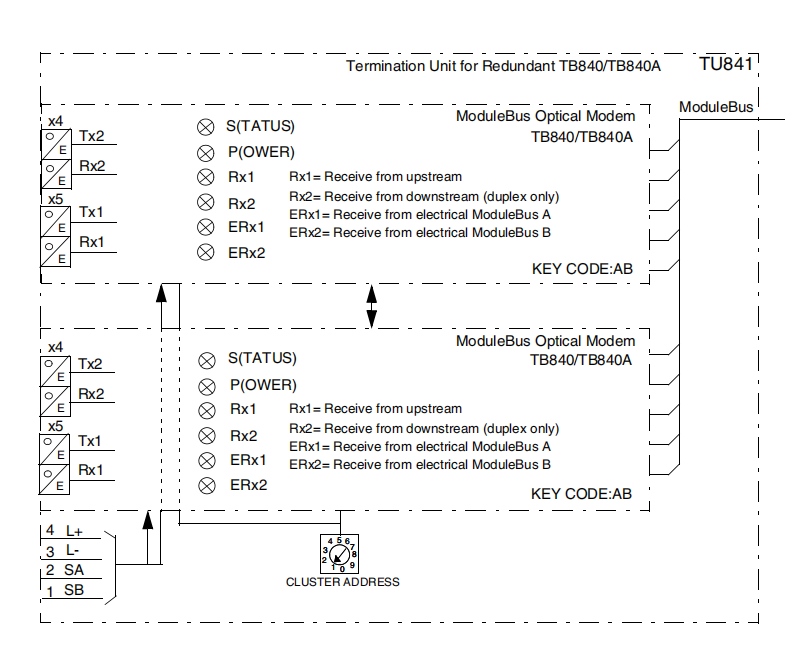
Multiple Status LED Indicators: Provides Status (S), Power (P), Optical Receive (Rx1, Rx2), and Electrical Bus Receive (ERx1, ERx2) LEDs for rapid on-site diagnostics.
ModuleBus and Power Supply Supervision: Features supervisory functions for monitoring the communication status of the I/O ModuleBus and the power supply status.
Compatibility with Multiple Termination Units: Must be installed on Module Termination Units such as TU807, TU840, TU841, TU848, or TU849.
Support for Multiple Fiber Types: Compatible with Plastic Optical Fiber (POF, up to 15 meters) and Hard Clad Silica fiber (HCS, up to 200 meters).
Global Mainstream Certifications: Holds various safety and industry certifications including CE, cULus (C1 Div 2 / Zone 2), ATEX Zone 2, ABS, BV, DNV-GL, and LR.
The TB840A ModuleBus Modem plays a pivotal intermediary role in the System 800xA architecture:
Upstream Connection: Connects to the Optical ModuleBus network via fiber optic ports (X4, X5), communicating with the superior controller or FCI (Field Communication Interface).
Downstream Connection: Connects to S800 series I/O modules (e.g., AI, DI, DO) via the electrical ModuleBus interface on the shared termination unit.
Address Setting: The address (1-7) of the associated I/O cluster is set via a rotary switch on the installed Termination Unit (e.g., TU841).
Typical Configuration Combinations:
Single Configuration: A single TB840A installed on a TU807, connected to a single ModuleBus.
Redundant Configuration (Dual Bus): Two TB840A units installed on a TU840 or TU848, achieving dual redundancy for both modules and ModuleBuses.
Redundant Configuration (Single Bus): Two TB840A units installed on a TU841 or TU849, achieving module redundancy while sharing a single ModuleBus.
Physical Installation: The TB840A must be installed on the designated Module Termination Unit. Correct installation and electrical connection are ensured by the unit's latch and code keys (Key Code: AB).
Fiber Optic Connection:
Use simplex or duplex fiber optic cables with Agilent (HP) Versatile Link type connectors.
Duplex Connection: Provides bidirectional communication. A node failure affects only downstream clusters.
Simplex Connection: Forms a ring topology. A node or cable failure affects all expansion clusters on the bus.
Pay attention to the correspondence between Tx (Transmit) and Rx (Receive) ports during connection.
Power Supply Connection:
Input Power: 24V DC (range 19.2 - 30V), maximum current approximately 1.7A.
Single or redundant power supplies can be used. For redundant supply, connect to the L+/L- terminals on the termination unit and connect the SA, SB monitoring wires.
Power cable specifications: Supports 0.2 - 2.5 mm² (24 - 14 AWG).
Address Setting: Set a unique cluster address (1-7) using the rotary switch on the termination unit with system power off. Changing the address during operation may disrupt cluster communication.
Electrical ModuleBus Connection: Connect to the I/O module baseplate via the interface on the termination unit.
With its high reliability, flexible expandability, and powerful diagnostic features, the TB840A is an ideal choice for the following application scenarios:
Process Industries: Petrochemicals, pharmaceuticals, power generation, and other processes requiring continuous production and high availability.
Discrete Manufacturing: Automotive, food & beverage production lines with high demands on production cycle time and reliability.
Marine & Shipping: Compliant with multiple marine classification society certifications, suitable for shipboard power and automation control systems.
Critical Infrastructure: Water treatment, energy distribution, and other sites with extremely high demands on system stability.
The TB840A ModuleBus Modem is a critical component within the ABB Ability™ System 800xA® hardware selector series. It is a high-performance, highly reliable fiber optic interface device specifically designed for connecting to the Optical ModuleBus. This device serves as a communication bridge between S800 I/O modules and upper-level controllers in industrial automation and control systems. It is ideally suited for complex industrial environments requiring high availability, distributed I/O expansion, and redundant configurations.
The TB840A excels in redundancy configurations, supporting connections where each module is linked to different optical ModuleBus lines while remaining connected to the same electrical ModuleBus. This design achieves communication path redundancy, significantly enhancing system availability. Its electrical and optical interfaces are logically the same bus. It supports up to 12 I/O modules on the electrical ModuleBus and can extend via fiber optics to a maximum of 7 remote I/O clusters, greatly expanding the capacity and layout flexibility of a single I/O station.
As a core component of ABB's industrial automation solutions, the TB840A is widely used in critical sectors such as power generation, chemicals, oil & gas, marine, and manufacturing, meeting their stringent requirements for system stability, real-time performance, and scalability.
Line and Module Redundancy: Supports 1+1 redundancy configurations, ensuring single-point failures do not affect continuous system operation.
Dual Fiber Optic Ports: Provides two independent fiber optic ports for connection to the Optical ModuleBus, supporting ring or daisy-chain topologies.
Dual Electrical ModuleBus Interfaces: Features two internal electrical ModuleBus interfaces that are logically unified but can be physically connected for redundancy.
Redundant Power Supply Monitoring: Equipped with SA and SB monitoring inputs for real-time supervision of redundant power supply status, reported back to the controller.
Local and Remote Cluster Support: The local electrical bus supports a maximum of 12 I/O modules; fiber optics enable expansion to 7 remote I/O clusters.
Modular Distribution: Suitable for localized distributed layouts in stations requiring more than 12 I/O modules.
Mixed Topology Support: Compatible with both simplex and duplex fiber optic connections, which can be mixed within the same Optical ModuleBus.
Isolated Power Conversion: Incorporates an isolated DC/DC converter, providing a stable, short-circuit-protected +5V supply for itself and connected I/O modules.
Input Power Fuse Protection: Includes an internal fuse for enhanced electrical system safety.
Power Status Indication: Clear indication of internal and bus power status via the POWER LED.
Multiple Status LED Indicators: Provides Status (S), Power (P), Optical Receive (Rx1, Rx2), and Electrical Bus Receive (ERx1, ERx2) LEDs for rapid on-site diagnostics.
ModuleBus and Power Supply Supervision: Features supervisory functions for monitoring the communication status of the I/O ModuleBus and the power supply status.
Compatibility with Multiple Termination Units: Must be installed on Module Termination Units such as TU807, TU840, TU841, TU848, or TU849.
Support for Multiple Fiber Types: Compatible with Plastic Optical Fiber (POF, up to 15 meters) and Hard Clad Silica fiber (HCS, up to 200 meters).
Global Mainstream Certifications: Holds various safety and industry certifications including CE, cULus (C1 Div 2 / Zone 2), ATEX Zone 2, ABS, BV, DNV-GL, and LR.
The TB840A ModuleBus Modem plays a pivotal intermediary role in the System 800xA architecture:
Upstream Connection: Connects to the Optical ModuleBus network via fiber optic ports (X4, X5), communicating with the superior controller or FCI (Field Communication Interface).
Downstream Connection: Connects to S800 series I/O modules (e.g., AI, DI, DO) via the electrical ModuleBus interface on the shared termination unit.
Address Setting: The address (1-7) of the associated I/O cluster is set via a rotary switch on the installed Termination Unit (e.g., TU841).
Typical Configuration Combinations:
Single Configuration: A single TB840A installed on a TU807, connected to a single ModuleBus.
Redundant Configuration (Dual Bus): Two TB840A units installed on a TU840 or TU848, achieving dual redundancy for both modules and ModuleBuses.
Redundant Configuration (Single Bus): Two TB840A units installed on a TU841 or TU849, achieving module redundancy while sharing a single ModuleBus.
Physical Installation: The TB840A must be installed on the designated Module Termination Unit. Correct installation and electrical connection are ensured by the unit's latch and code keys (Key Code: AB).
Fiber Optic Connection:
Use simplex or duplex fiber optic cables with Agilent (HP) Versatile Link type connectors.
Duplex Connection: Provides bidirectional communication. A node failure affects only downstream clusters.
Simplex Connection: Forms a ring topology. A node or cable failure affects all expansion clusters on the bus.
Pay attention to the correspondence between Tx (Transmit) and Rx (Receive) ports during connection.
Power Supply Connection:
Input Power: 24V DC (range 19.2 - 30V), maximum current approximately 1.7A.
Single or redundant power supplies can be used. For redundant supply, connect to the L+/L- terminals on the termination unit and connect the SA, SB monitoring wires.
Power cable specifications: Supports 0.2 - 2.5 mm² (24 - 14 AWG).
Address Setting: Set a unique cluster address (1-7) using the rotary switch on the termination unit with system power off. Changing the address during operation may disrupt cluster communication.
Electrical ModuleBus Connection: Connect to the I/O module baseplate via the interface on the termination unit.
With its high reliability, flexible expandability, and powerful diagnostic features, the TB840A is an ideal choice for the following application scenarios:
Process Industries: Petrochemicals, pharmaceuticals, power generation, and other processes requiring continuous production and high availability.
Discrete Manufacturing: Automotive, food & beverage production lines with high demands on production cycle time and reliability.
Marine & Shipping: Compliant with multiple marine classification society certifications, suitable for shipboard power and automation control systems.
Critical Infrastructure: Water treatment, energy distribution, and other sites with extremely high demands on system stability.
| Category | Item | Specification / Parameter |
|---|---|---|
| General Information | Product Model / Article Number | TB840A / 385E037760R1 |
| Communication Protocol | ModuleBus | |
| Role | Slave | |
| Redundancy Support | Line Redundancy: Yes; Module Redundancy: Yes | |
| Hot Swap Support | Yes | |
| Compatibility with High Integrity Controller | Yes | |
| Compatible Termination Units | TU807 (Single Module, Single Bus) TU840/TU848 (Redundant Modules, Redundant Bus) TU841/TU849 (Redundant Modules, Single Bus) | |
| Electrical Characteristics | Input Power | 24 V DC (19.2 - 30 V) |
| Typical Power Consumption (@24V) | 120 mA | |
| Input Fuse | 2 A Fast-Acting | |
| Power Dissipation | 6 W | |
| Power Supply Monitoring Inputs | High Level: ≥15V; Low Level: ≤8V; Maximum Voltage: 30V | |
| ModuleBus Power Output | 24 V: Max. 1.4 A 5 V: Max. 1.5 A (Short-circuit protected) | |
| Communication & Interfaces | Electrical ModuleBus | Max. 12 connected I/O modules |
| Optical ModuleBus | Max. 7 connected I/O clusters | |
| Fiber Optic Interface | 2 transmitters, 2 receivers | |
| Communication Rate | Up to 10 Mbit/s | |
| Optical Wavelength | 650 nm | |
| Supported Fiber Types & Distance | Plastic Optical Fiber (POF): Max. 15 meters Hard Clad Silica (HCS) fiber: Max. 200 meters | |
| Physical Characteristics | Width (excluding handle) | 54 mm (2.13 inches) |
| Height (including handle) | 119 mm (4.69 inches) | |
| Depth | 96 mm (3.78 inches) | |
| Weight | 0.2 kg (0.44 lbs) | |
| Ingress Protection | IP20 (according to IEC 60529) | |
| Environmental & Certifications | Operating Temperature | 0 to +55 °C (Certified range: +5 to +55 °C) |
| Storage Temperature | -40 to +70 °C | |
| Relative Humidity | 5% to 95%, non-condensing | |
| Pollution Degree | Degree 2 (IEC 60664-1) | |
| Corrosion Protection | ISA-571.04: G3 | |
| Electrical Safety Certification | EN 61010-1, UL 61010-1, EN 61010-2-201, UL 61010-2-201 | |
| Hazardous Location Certification | Class I Div 2 cULus, Class I Zone 2 cULus, ATEX Zone 2 | |
| Marine Certifications | ABS, BV, DNV-GL, LR | |
| Environmental Compliance | RoHS: DIRECTIVE/2011/65/EU WEEE: DIRECTIVE/2012/19/EU | |
| LED Indicators | Status (S) | Green: Normal operation; Red: Fault condition (e.g., reset, electrical bus communication error) |
| Power (P) | Green: Internal DC/DC converter and electrical bus +5V supply are valid | |
| Optical Receive (Rx1, Rx2) | Yellow blinking: Indicates data reception on the respective optical channel | |
| Electrical Bus Receive (ERx1, ERx2) | Yellow blinking: Indicates data reception on Electrical ModuleBus A and B respectively |
| Category | Item | Specification / Parameter |
|---|---|---|
| General Information | Product Model / Article Number | TB840A / 385E037760R1 |
| Communication Protocol | ModuleBus | |
| Role | Slave | |
| Redundancy Support | Line Redundancy: Yes; Module Redundancy: Yes | |
| Hot Swap Support | Yes | |
| Compatibility with High Integrity Controller | Yes | |
| Compatible Termination Units | TU807 (Single Module, Single Bus) TU840/TU848 (Redundant Modules, Redundant Bus) TU841/TU849 (Redundant Modules, Single Bus) | |
| Electrical Characteristics | Input Power | 24 V DC (19.2 - 30 V) |
| Typical Power Consumption (@24V) | 120 mA | |
| Input Fuse | 2 A Fast-Acting | |
| Power Dissipation | 6 W | |
| Power Supply Monitoring Inputs | High Level: ≥15V; Low Level: ≤8V; Maximum Voltage: 30V | |
| ModuleBus Power Output | 24 V: Max. 1.4 A 5 V: Max. 1.5 A (Short-circuit protected) | |
| Communication & Interfaces | Electrical ModuleBus | Max. 12 connected I/O modules |
| Optical ModuleBus | Max. 7 connected I/O clusters | |
| Fiber Optic Interface | 2 transmitters, 2 receivers | |
| Communication Rate | Up to 10 Mbit/s | |
| Optical Wavelength | 650 nm | |
| Supported Fiber Types & Distance | Plastic Optical Fiber (POF): Max. 15 meters Hard Clad Silica (HCS) fiber: Max. 200 meters | |
| Physical Characteristics | Width (excluding handle) | 54 mm (2.13 inches) |
| Height (including handle) | 119 mm (4.69 inches) | |
| Depth | 96 mm (3.78 inches) | |
| Weight | 0.2 kg (0.44 lbs) | |
| Ingress Protection | IP20 (according to IEC 60529) | |
| Environmental & Certifications | Operating Temperature | 0 to +55 °C (Certified range: +5 to +55 °C) |
| Storage Temperature | -40 to +70 °C | |
| Relative Humidity | 5% to 95%, non-condensing | |
| Pollution Degree | Degree 2 (IEC 60664-1) | |
| Corrosion Protection | ISA-571.04: G3 | |
| Electrical Safety Certification | EN 61010-1, UL 61010-1, EN 61010-2-201, UL 61010-2-201 | |
| Hazardous Location Certification | Class I Div 2 cULus, Class I Zone 2 cULus, ATEX Zone 2 | |
| Marine Certifications | ABS, BV, DNV-GL, LR | |
| Environmental Compliance | RoHS: DIRECTIVE/2011/65/EU WEEE: DIRECTIVE/2012/19/EU | |
| LED Indicators | Status (S) | Green: Normal operation; Red: Fault condition (e.g., reset, electrical bus communication error) |
| Power (P) | Green: Internal DC/DC converter and electrical bus +5V supply are valid | |
| Optical Receive (Rx1, Rx2) | Yellow blinking: Indicates data reception on the respective optical channel | |
| Electrical Bus Receive (ERx1, ERx2) | Yellow blinking: Indicates data reception on Electrical ModuleBus A and B respectively |