The IQS450 204-450-000-001 is a high‑performance signal conditioner specifically designed to operate with Vibro‑Meter TQ402 and TQ412 eddy‑current proximity transducers, forming the core processing unit of a complete non‑contact displacement measurement system. This signal conditioner provides the necessary high‑frequency excitation signal to the transducer, demodulates the returning signal, and converts the measured gap into a linear voltage or current output proportional to the distance between the transducer tip and the target. The IQS450 204-450-000-001 is a factory‑configured unit that delivers a voltage output with a sensitivity of 8 mV/μm (200 mV/mil) and is calibrated for a total system length of 1 metre, making it ideal for precision vibration and position monitoring in a wide range of rotating machinery applications.
The IQS450 204-450-000-001 is a robust, temperature‑compensated conditioner housed in an injection‑moulded aluminium enclosure, designed for panel or DIN‑rail mounting in industrial environments. It features short‑circuit protected outputs, a frequency response from DC to 20 kHz (–3 dB), and is compatible with both metric and imperial transducer threads. The conditioner is powered by a DC supply (typically +24 Vdc or ±15 Vdc, depending on the specific model variant) and provides both voltage and current outputs, though this specific configuration is set for voltage output with a sensitivity of 8 mV/μm and a measuring range of 0.15 to 2.15 mm (‑1.6 V to ‑17.6 V).
The IQS450 204-450-000-001 is part of a fully interchangeable system where all components – transducer, extension cable, and conditioner – are individually trimmed and calibrated to ensure consistent performance. This interchangeability eliminates the need for system recalibration when replacing any component, provided the total system length (TSL) remains unchanged. The conditioner is factory‑calibrated at +23°C ±5°C using a VCL 140 steel target, but can be recalibrated for other target materials upon request.
This product introduction provides a comprehensive technical overview of the IQS450 204-450-000-001, covering its operating principles, electrical and mechanical specifications, environmental ratings, installation guidelines, calibration procedures, and ordering details. All information is derived from the official Vibro‑Meter datasheet (TQ 402 & TQ 412 / EA 402 / IQS 450, document 265‑062, version 3).
Operating Principle and System Integration
The IQS450 204-450-000-001 operates on the eddy‑current principle, which is widely used for non‑contact measurement of displacement, vibration, and position. The conditioner generates a high‑frequency carrier signal (typically in the MHz range) that is sent through the coaxial cable to the transducer. The transducer contains a coil that produces an oscillating electromagnetic field. When the coil approaches a metallic target, eddy currents are induced in the target surface, which in turn change the coil’s impedance. This impedance change is directly proportional to the gap distance between the tip and the target.
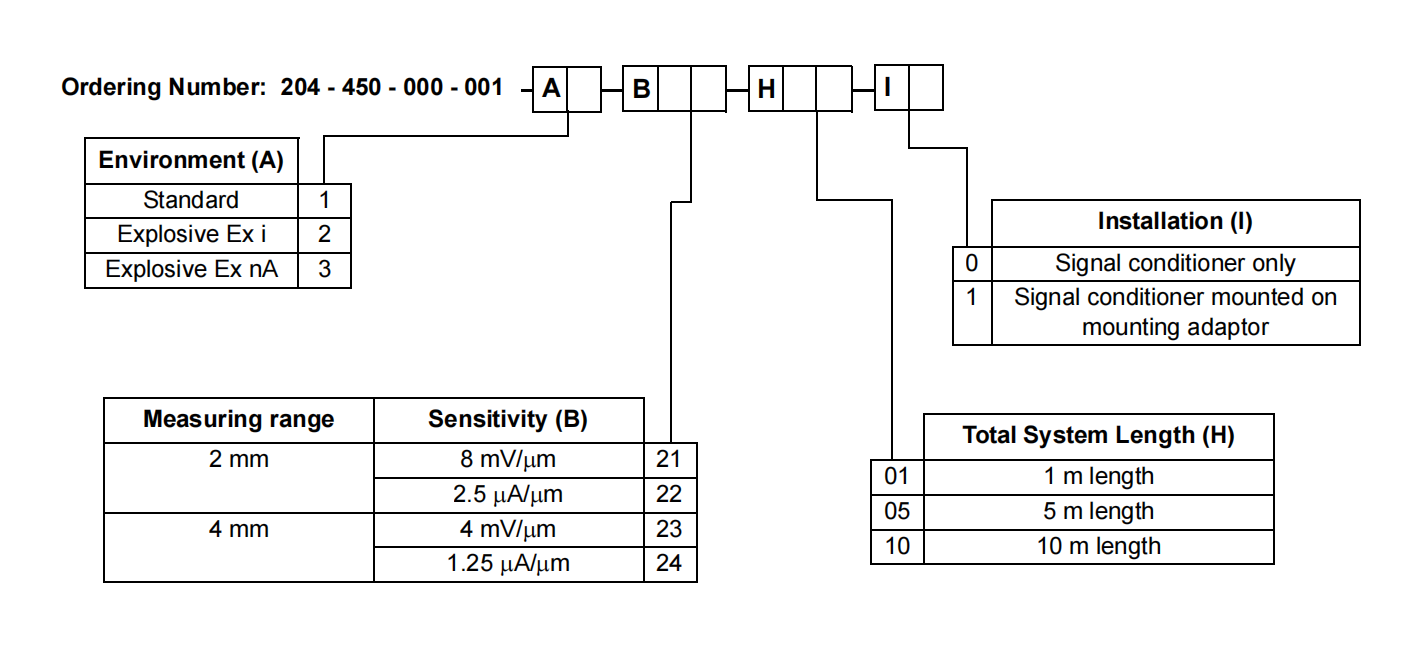
The IQS450 204-450-000-001 demodulates the reflected signal from the transducer and converts the impedance variation into a DC voltage output. The conditioner includes a linearisation circuit that ensures the output voltage is a linear function of the gap over the specified measuring range. For the IQS450 204-450-000-001, which is configured with ordering option B21, the sensitivity is 8 mV/μm (200 mV/mil) and the linear range is from 0.15 mm to 2.15 mm, corresponding to an output voltage from –1.6 Vdc to –17.6 Vdc. This negative‑going output is typical for eddy‑current systems and is compatible with most industrial data acquisition and protection systems.
The conditioner also features a current output (4‑20 mA or similar) which is available on other variants, but the IQS450 204-450-000-001 is specifically configured for voltage output. The output is short‑circuit protected, ensuring robustness against wiring faults.
The system’s total length (integral cable of the transducer plus extension cable, if used) must be matched to the conditioner’s trimming. The IQS450 204-450-000-001 is factory‑trimmed for a 1‑metre total system length (TSL). For a 1‑metre system, the minimum TSL is 0.9 metre, and the conditioner is calibrated to provide the specified sensitivity and linearity with that length. If the TSL is changed, the conditioner must be recalibrated.
Key Features and Capabilities
The IQS450 204-450-000-001 offers a comprehensive set of features that make it the preferred signal conditioner for industrial proximity monitoring:
Non‑contact Measurement: Based on the eddy‑current principle, allowing measurement without mechanical contact, ideal for rotating machinery.
Certified for Hazardous Areas: The conditioner is available in Ex i (intrinsic safety) and Ex nA (non‑sparking) versions for use in Zone 1, 2, and Class I Division 1/2 areas (though the IQS450 204-450-000-001 is the standard version for safe areas).
Temperature Compensation: The conditioner is temperature‑compensated to minimise drift over the operating temperature range, ensuring stable measurements.
Voltage or Current Output: This specific model provides a voltage output with high sensitivity (8 mV/μm), but the family supports both.
Short‑Circuit Protection: Outputs are protected against short circuits, preventing damage in case of wiring errors.
Wide Frequency Response: DC to 20 kHz (–3 dB) enables measurement of both static position and high‑frequency vibration.
Interchangeability: All components are interchangeable without recalibration, simplifying maintenance.
Flexible Power Supply: Operates from a DC supply, with a derating curve for high ambient temperatures.
Rugged Construction: Injection‑moulded aluminium housing with screw terminal connections, suitable for industrial environments.
Mounting Versatility: Designed for panel or DIN‑rail mounting, with optional brackets.
Intended Applications
The IQS450 204-450-000-001 is used in conjunction with TQ402/TQ412 transducers to monitor the following parameters in critical machinery:
Shaft Relative Vibration: Measuring the vibration amplitude of rotating shafts in steam, gas, and hydraulic turbines, compressors, pumps, and fans.
Axial Position (Thrust): Monitoring the axial displacement of shafts to detect thrust bearing wear or misalignment.
Eccentricity and Run‑out: Detecting shaft bow or imbalance during startup and operation.
Speed and Phase Reference: When used with keyphasor transducers, the conditioner can provide a pulse output for speed measurement.
General‑Purpose Displacement: Any application requiring precise, non‑contact measurement of metallic target position.
The system conforms to API 670 recommendations, making it suitable for machinery protection systems in the oil and gas, petrochemical, power generation, and marine industries.
Installation and Mounting Recommendations
Proper installation of the IQS450 204-450-000-001 is crucial for reliable operation. The following guidelines should be followed:
Mounting Location: Install the conditioner in a clean, dry location, away from direct heat sources, vibration, and excessive moisture. The ambient temperature should not exceed the derated limits.
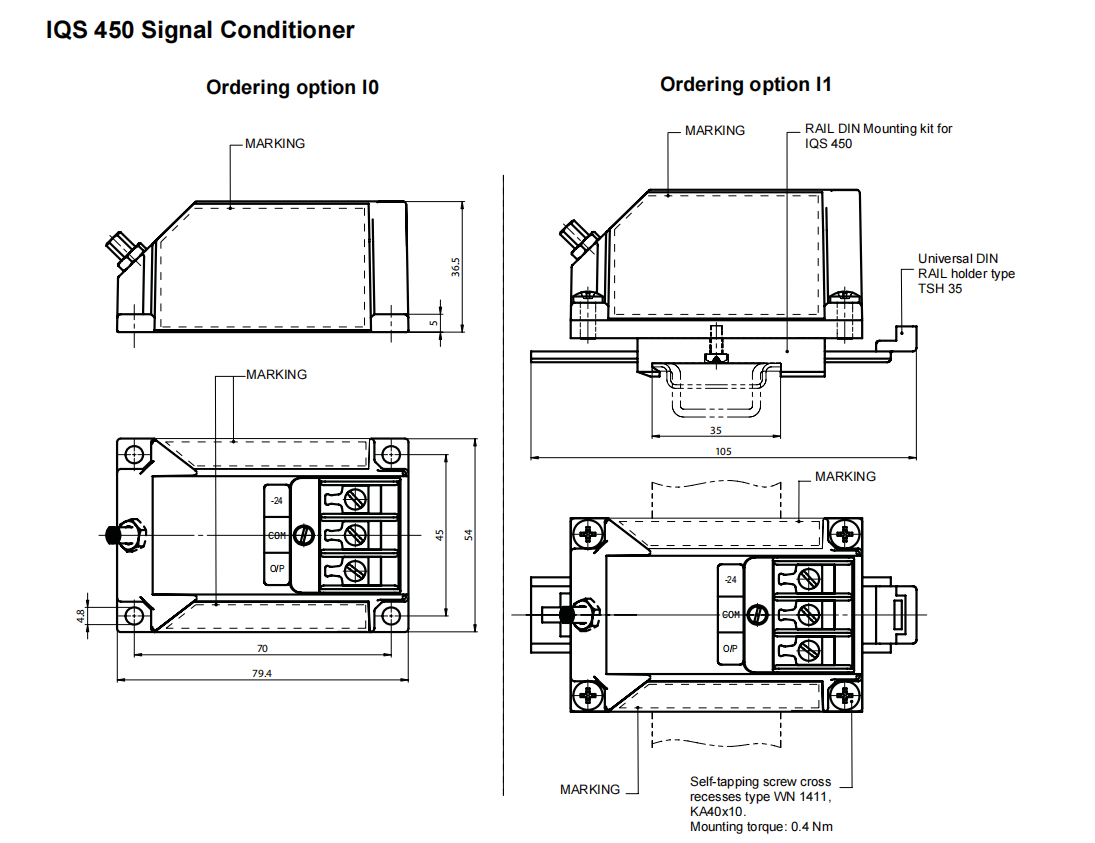
Panel Mounting: The conditioner is designed for panel mounting using the supplied screws or mounting brackets (available as accessories). Ensure adequate clearance around the unit for ventilation and wiring access.
DIN‑Rail Mounting: Optional DIN‑rail adapters are available for mounting on standard 35 mm rails.
Wiring: Use shielded twisted‑pair cables for power and output connections to minimise noise. Connect the shield to the earth terminal. Ensure the power supply voltage matches the conditioner’s requirements (typically +24 Vdc) and observe polarity. The screw terminal block accepts up to 2.5 mm² wire; tighten screws to the specified torque (typically 0.5 N·m).
Cable Connections: The transducer’s coaxial cable (or extension cable) connects to the stainless steel female socket on the conditioner. Hand‑tighten the connector – do not use tools. Ensure the connector is clean and dry.
Grounding: Connect the earth terminal to a reliable ground (protective earth) to ensure safety and reduce electromagnetic interference. The ground connection is essential for the conditioner’s shielding and for hazardous area versions (if applicable).
Cable Routing: Route the input coaxial cable away from high‑voltage power cables to avoid interference. Maintain a minimum separation of 100 mm from AC power lines and cross them at right angles if necessary.
Thermal Management: Ensure adequate airflow around the conditioner. If mounted in a confined enclosure with other heat‑generating devices, verify that the internal temperature does not exceed the derating limits. For ambient temperatures above +45°C, reduce the supply voltage as per the derating curve.
Calibration and System Verification
The IQS450 204-450-000-001 is factory‑calibrated for a specific total system length (1 metre) and target material (VCL 140 steel). In most cases, no field calibration is required if the system is used as delivered. However, the following procedures may be performed:
Verification of Output: Connect the complete system (transducer, extension cable, conditioner) and power it up. With the target at a known gap (using a feeler gauge or precision shim), measure the output voltage. It should correspond to the expected value from the performance curve. For example, at a gap of 1.15 mm (mid‑range), the output should be approximately –9.6 V.
Recalibration for Different Target Material: If the target material differs from VCL 140 steel, the system output will shift. Vibro‑Meter offers custom calibration for other alloys. The user must supply a sample of the target material (minimum Ø50 mm / 1 cm thick) for factory recalibration.
Field Calibration: While not recommended, a field calibration can be performed using a precision micrometer and a known gap set. However, this requires adjusting the conditioner’s internal potentiometers (if accessible), which is not typical for this sealed unit. Contact the factory for assistance.
Interchangeability Check: When replacing any component, ensure the new component has the same trimmed length code to maintain interchangeability. If not, the system must be recalibrated.
Maintenance and Troubleshooting
The IQS450 204-450-000-001 is a maintenance‑free device under normal operating conditions. However, periodic inspections are recommended:
Visual Inspection: Check the housing for damage, corrosion, or loose connections. Ensure the terminal screws are tight.
Connector Inspection: Inspect the coaxial connector for dirt, bent pins, or corrosion. Clean with contact cleaner if needed.
Output Verification: Periodically measure the output at a known gap to verify system accuracy. If drift is observed, check the power supply voltage and ambient temperature.
Cable Integrity: Inspect the transducer and extension cables for cuts, abrasions, or kinks.
Common issues and solutions:
No Output: Check power supply, fuse (if any), and wiring. Verify the transducer connector is fully mated.
Erratic Output: Check for electromagnetic interference, loose connections, or damaged cable. Ensure proper grounding.
Output Drift: Check ambient temperature – if exceeding derated limits, reduce supply voltage or improve ventilation. If drift persists, the conditioner may need recalibration or replacement.
Non‑linear Output: Verify the target material and gap are within the linear range. Check for target surface defects or non‑metallic coatings.
Accessories and Complementary Products
The IQS450 204-450-000-001 is typically ordered as part of a complete system. The following accessories are available:
Accessory | Description |
TQ402 Transducer | Forward‑mount proximity transducer (various thread and cable lengths) |
TQ412 Transducer | Reverse‑mount proximity transducer (for specific housings) |
EA402 Extension Cable | Extension cables in various lengths (0.5, 1, 2, 5, 10 m) |
Mounting Brackets | For panel or DIN‑rail mounting of the conditioner |
Junction Boxes | For housing connectors and providing strain relief |
Stuffing Gland SG 102 | For cable entry into enclosures |
Heat‑shrinkable Sleeve | For splash‑proof protection of cable connectors |
For the IQS450 204-450-000-001, no additional accessories are included; they must be ordered separately based on installation requirements.
Comparison with Other Variants
The IQS450 204-450-000-001 is one of several possible configurations of the IQS450 conditioner. The main variants are:
Output Type: Voltage (8 mV/μm) – B21; Voltage (4 mV/μm) – B23; Current (2.5 μA/μm) – B22; Current (1.25 μA/μm) – B24.
Total System Length: 1 m, 5 m, or 10 m – each with corresponding trimming.
Hazardous Area: Standard (safe area) – as this model; or Ex i / Ex nA versions (with different certification and entity parameters).
Power Supply: The conditioner can be ordered for various DC input voltages (e.g., +24 Vdc, ±15 Vdc) – though +24 Vdc is most common.
The IQS450 204-450-000-001 is a safe‑area, voltage‑output, 1‑metre system version, which is the most frequently used configuration for general‑purpose machinery monitoring.
Safety and Compliance Notes
The IQS450 204-450-000-001 is not certified for use in explosive atmospheres. For Zone 1/2 or Class I Division 1/2 installations, order the Ex‑certified versions (codes 2 or 3 for transducers, and corresponding conditioner variants).
The conditioner must be installed by qualified personnel in accordance with local electrical codes.
Ensure the power supply is isolated and fused appropriately (typically 1 A slow‑blow).
The unit is designed for indoor use only; if installed outdoors, a suitable weatherproof enclosure is required.
Do not operate the conditioner outside its specified temperature and voltage limits.