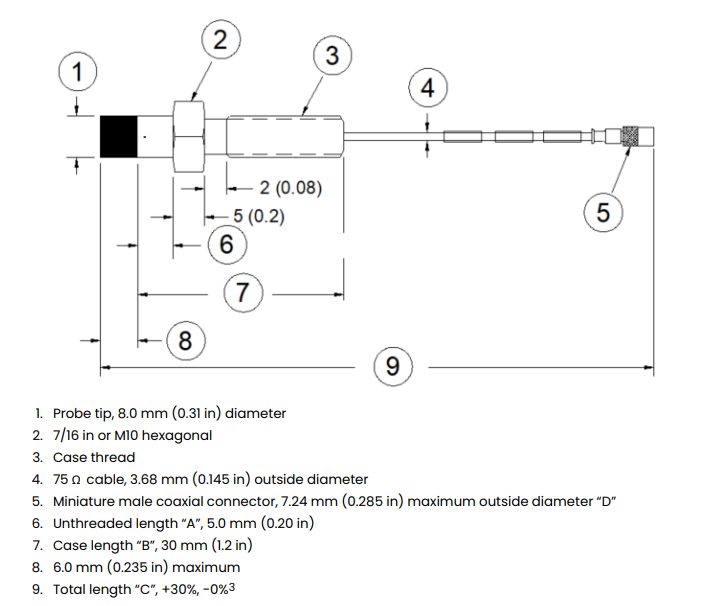
330105-02-12-10-02-05 is a reverse mount eddy current probe from the Bently Nevada 3300 XL series, with a total length of 1.0 meter (3.3 feet). This model builds on the reverse mount base configuration (3/8-24 UNF threads, 0.2‑inch unthreaded length, 1.2‑inch case length, standard ClickLoc connector and standard cable) by adding CSA, ATEX, and IECEx hazardous area approvals, making it suitable for intrinsically safe (IS) installations in explosive atmospheres. The reverse mount design allows the probe to be installed from inside the equipment outward, making it particularly suitable for turbomachinery bearing housings where internal routing is required.
With a total length of 1.0 m, this probe is typically used with a 4.0‑meter hazardous area approved extension cable (e.g., 330130-040-00-05) and a 5‑meter hazardous area approved Proximitor Sensor (e.g., 330180-50-05) to form a complete 5‑meter IS system (1.0 m probe + 4.0 m extension cable = 5 m system). This configuration is suitable for installations where the Proximitor Sensor is mounted in a safe area (e.g., a control room or non‑hazardous junction box) and the probe is installed in a hazardous area with internal‑to‑external routing.
Model Breakdown: 330105-02-12-10-02-05 Configuration Details
Following Bently Nevada’s part number coding system (refer to datasheet Pages 14, 36), the fields in this model number represent the following:
Field | Code | Parameter | Description |
Base Model | 330105
| 3300 XL 8 mm Reverse Mount Probe, 3/8-24 UNF thread, without armor | For installation from inside equipment outward, imperial thread |
Unthreaded Length (A) | 02
| 0.2 inches | Distance from probe tip to start of thread (fixed for reverse mount probes) |
Overall Case Length (B) | 12
| 1.2 inches | Total threaded length (fixed for reverse mount probes) |
Total Length Option (C) | 10
| 1.0 meter (3.3 ft) | Total probe cable length (including connector); for 5 m systems |
Connector & Cable Option (D) | 02
| Miniature coaxial ClickLoc connector, standard cable | Standard FEP‑insulated cable, gold‑plated ClickLoc connector, no connector protector |
Agency Approval (E) | 05
| CSA, ATEX, IECEx Hazardous Area Approvals | Certified for intrinsically safe installations in explosive atmospheres |
Key Configuration Note: This model differs from 330105-02-12-10-02-00 only in the approval option (05 instead of 00). Its reverse mount design and 1.0 m total length are suitable for hazardous area applications requiring internal‑to‑external installation and a 5‑meter IS system. The unthreaded length (0.2 in) and case length (1.2 in) are fixed for this reverse mount series.
Hazardous Area Approvals & Conditions of Safe Use
Hazardous Area Certifications
330105-02-12-10-02-05 carries the following hazardous area approvals, suitable for installations in major industrial regions worldwide:
Certification | Type | Area Classification | Temperature Class |
ATEX / IECEx | Ex ia IIC T4/T5 Ga | Zone 0, 1, 2 | T5 @ Ta = -55°C to +40°C
T4 @ Ta = -55°C to +80°C |
cNRTLus | Class I, Zone 0, AEx/Ex ia IIC T4/T5 Ga | Class I, Groups A, B, C, D
Class II, Groups E, F, G
Class III | Same as above |
In addition, the probe also meets ATEX/IECEx dust ignition protection (Ex ia IIIC T90°C … T280°C Dc). Refer to the datasheet Page 12 temperature schedule for specific temperature classes based on ambient temperature.
Conditions of Safe Use (Intrinsically Safe Systems)
When used in an intrinsically safe system, the following conditions must be observed:
Barriers/Isolators: Must be installed with intrinsically safe zener barriers per Bently Nevada drawing 141092, or with galvanic isolators.
Entity Parameters (when connected to approved Proximitor Sensor):
Ui = -28V
Ii = 140 mA
Pi = 0.91 W
Ci = 47 nF
Li = 1460 μH
Installation Environment: The Proximitor Sensor must be installed in a non‑hazardous area or within an approved explosion‑proof enclosure.
System Integrity: The probe, extension cable, Proximitor Sensor, and any connector protectors must all carry the same hazardous area approval rating. Mixing non‑approved components will void the certification.
Important: This probe must be used with hazardous area approved extension cable (e.g., 330130-040-00-05) and Proximitor Sensor (e.g., 330180-50-05) to maintain a complete 5‑meter intrinsically safe system.
Reverse Mount Features
What is a Reverse Mount Probe?
Standard probes are installed from outside the equipment inward, with threads at the front of the probe case and the probe tip facing inward. In contrast, a reverse mount probe has threads at the rear of the probe case; the probe is installed from inside the equipment outward, with the tip facing outward (typically toward the rotating shaft). In hazardous areas, this design offers several advantages:
Simplified bearing housing installation: The probe can be routed from inside the bearing housing outward, reducing leak paths and avoiding complex sealing in hazardous areas.
Easier sealing: Reverse mounting makes it easier to achieve oil sealing, preventing lubricant leakage along the probe, which is especially important for environmental safety in hazardous areas.
Suitable for space‑constrained exteriors: When external space is limited for standard probe installation, reverse mounting solves the problem from inside.
Fixed dimensions: Unthreaded length and case length are fixed for reverse mount probes (0.2 in and 1.2 in), simplifying selection.
No Armor or Connector Protector on This Model
This model does not include pre-installed armor or connector protectors. The cable is standard FEP, and the connector is exposed to the environment. In hazardous areas, connector protectors (order separately, suitable for hazardous area use) are strongly recommended to prevent oil mist or moisture ingress and maintain intrinsic safety sealing integrity.
Selection Tip: Reverse mount probes are often used in turbomachinery bearing housings. Connector protectors are strongly recommended to prevent oil mist ingress.
Application Scenarios & Selection Guide
330105-02-12-10-02-05 is suitable for the following typical applications:
Precise Total Length Matching for 5‑Meter IS Systems + Reverse Mount: Paired with a 4.0 m hazardous area approved extension cable (e.g., 330130-040-00-05) and a 5 m hazardous area approved Proximitor Sensor (e.g., 330180-50-05) to form a complete 5‑meter IS monitoring system. Ideal for installations where the Proximitor Sensor is mounted in a safe area (e.g., control room or non‑hazardous junction box) and the probe needs to be installed from inside the equipment outward.
Turbomachinery Bearing Housings in Hazardous Areas: In refineries, petrochemical plants, natural gas facilities (Zone 0/1/2), steam turbines, compressors, and gas turbines often require internal probe mounting. Reverse mount design allows the probe to exit the bearing housing from inside, avoiding external sealing issues, while hazardous area approvals ensure safety compliance.
Leak‑Prone Hazardous Area Applications: When used with appropriate seals, reverse mount probes effectively prevent lubricating oil leakage along the probe threads, reducing contamination risk in hazardous areas.
Space‑Constrained External Environments: When external space is insufficient for standard probe installation, reverse mounting provides an internal solution.
Suitable for IIC Gas Group: This probe is suitable for the most dangerous environments containing hydrogen, acetylene, carbon disulfide, and other IIC group gases.
Selection Notes:
Total Length Matching: Probe length + extension cable length = Proximitor Sensor total system length (5 m or 9 m). This 1.0 m probe must be used with a 4.0 m hazardous area approved extension cable to form a 5‑meter IS system.
System Accuracy: This model is used in a 5‑meter system, with DSL < ±0.025 mm, which is better accuracy than 9‑meter systems. Suitable for high‑precision hazardous area monitoring.
Installation Direction: Reverse mount probes are installed from inside the equipment outward. Ensure sufficient internal access for installation. Thread engagement should not exceed the datasheet maximum (0.563 inches).
Sealing Requirements: Use appropriate gaskets or O‑rings at the probe mounting point to prevent oil leakage. In hazardous areas, sealing integrity is critical for maintaining intrinsic safety performance.
Temperature Class Selection: Choose T4 or T5 based on the ambient temperature. T5 (-55°C to +40°C) is for lower ambient temperatures; T4 (-55°C to +80°C) covers a wider range.
Ambient Temperature: Standard probe is rated to +177°C. For higher temperatures, select an ETR high‑temperature reverse mount hazardous area probe (330195 series with approval option 05).
Connector Protection: In hazardous areas, connector protectors (order separately, suitable for hazardous area use) are strongly recommended to prevent oil mist or moisture ingress and maintain intrinsic safety sealing integrity.
Mechanical Dimensions & Installation
Probe Tip Diameter: 8.0 mm (0.31 in)
Thread Specification: 3/8-24 UNF-2A (reverse thread); recommended lock nut torque for first three threads: 7.5 N·m (66 in·lbf)
Overall Case Length: 1.2 in (30.5 mm)
Unthreaded Length: 0.2 in (5.1 mm)
Cable Outer Diameter: 3.68 mm (0.145 in) maximum
Connector Outer Diameter: 7.24 mm (0.285 in) maximum
Minimum Bend Radius: 25.4 mm (1.0 in)
Installation Drawing: Intrinsically safe system installation must strictly follow Bently Nevada drawing 141092, including barrier selection, grounding, and wiring practices.
Installation Tips: Before installation, inspect the mounting hole threads for cleanliness and depth. Reverse mount probes are installed from inside the equipment outward, with the lock nut tightened from the outside. Thread engagement should not exceed 0.563 inches. Use the recommended lock nut (part number 04301007) and tighten to the specified torque (7.5 N·m for the first three threads). Set the probe gap to the recommended -9 Vdc (approx. 1.27 mm), monitored via the Proximitor Sensor output voltage. In hazardous areas, all operations must comply with relevant explosion protection standards (e.g., IEC 60079-14).
Related Products & Compatible Configurations
This probe is typically used with the following hazardous area approved products to form a 5‑meter IS system:
Companion Product | Recommended Model | Description |
Extension Cable | 330130-040-00-05 | 4.0 m standard hazardous area cable, forms 5 m IS system |
Proximitor Sensor | 330180-50-05 | 5 m system panel‑mount hazardous area Proximitor |
Lock Nut | 04301007 | 3/8-24 lock nut with safety wire holes (no approval required) |
Mounting Bracket | 137492-01 | Aluminum threaded mounting bracket, 3/8-24 thread (no approval required) |
Connector Protector | 40180-02 (or 40113-02) | Connector protector kit, recommended for hazardous areas |
For other configurations, refer to the following reverse mount hazardous area probe options:
Model | Thread | Unthreaded Length | Case Length | Total Length | Cable Option | Approvals | Application |
330105-02-12-10-02-05 | 3/8-24 | 0.2" | 1.2" | 1.0 m | Standard | ATEX/IECEx | Current model, 5 m IS system, reverse mount |
330105-02-12-10-12-05 | 3/8-24 | 0.2" | 1.2" | 1.0 m | FluidLoc | ATEX/IECEx | Reverse mount with oil leak prevention, hazardous area |
330105-02-12-05-02-05 | 3/8-24 | 0.2" | 1.2" | 0.5 m | Standard | ATEX/IECEx | 9 m IS system reverse mount version |
330106-05-30-10-02-05 | M10×1 | 5 mm | 30 mm | 1.0 m | Standard | ATEX/IECEx | Metric thread reverse mount hazardous area version |
Matching Extension Cable: This probe must be used with a 4.0‑meter hazardous area approved extension cable (e.g., 330130-040-00-05) to form a complete 5‑meter IS system.
Inquiry & Technical Support
330105-02-12-10-02-05 is a reverse mount hazardous area model in the Bently Nevada product line, designed for 5‑meter IS systems requiring internal‑to‑external probe installation in hazardous areas. For pricing, lead time, or technical drawings, please contact us:
Online Inquiry: Click the “Request a Quote” button and provide the model number for a prompt response.
Technical Support: If you need assistance verifying whether this configuration meets your hazardous area reverse mount installation requirements, please describe the installation environment (hazardous area classification, equipment type, oil mist, available space, etc.) and we will help recommend the optimal configuration and confirm system certification integrity.