The Bently Nevada 330400 is a high-performance piezoelectric accelerometer designed for critical machinery monitoring applications where accurate casing acceleration measurements are essential, such as gear mesh monitoring, bearing health assessment, and general machine vibration analysis. This transducer is specifically engineered to meet the stringent requirements of American Petroleum Institute (API) Standard 670 for accelerometers, making it a trusted choice for the most demanding industrial environments.
The Bently Nevada 330400 provides a robust amplitude range of 50 g peak and delivers a sensitivity of 100 mV/g, ensuring precise and reliable measurement of vibration signals across a wide frequency spectrum. Its rugged construction, hermetic sealing, and extended temperature range make it suitable for use in harsh operating conditions, including those found in oil and gas, power generation, and heavy industrial applications.
This accelerometer is designed with a case-isolated configuration to prevent ground loop interference, and it operates on a nominal -24 V dc power supply with a 2 mA bias current. The Bently Nevada 330400 is available with either a ¼-28 UNF or M8 x 1 integral mounting stud, and it offers multiple agency approval options for installation in hazardous areas. The transducer is fully compliant with international EMC, RoHS, and ATEX/IECEx standards, ensuring both safety and environmental responsibility.
For installations where base strain sensitivity is a concern, a mounting base (API adapter) is supplied with the accelerometer to minimize measurement errors. The Bently Nevada 330400 is backed by Bently Nevada's extensive engineering support and is part of a comprehensive family of machinery protection and condition monitoring solutions from Baker Hughes.
Functional Description
The Bently Nevada 330400 accelerometer operates on the principle of piezoelectric sensing to measure casing acceleration. Inside the transducer, a piezoelectric element generates an electrical charge proportional to the applied acceleration. This charge is converted by an internal charge amplifier into a low-impedance voltage signal, which is transmitted via the output cable to the monitoring system. The sensitivity of the sensor is factory-calibrated to 100 mV/g (10.2 mV/m/s²) with a tolerance of ±5%.
The transducer is designed to measure vibration in the frequency range of 10 Hz to 15 kHz (600 cpm to 900,000 cpm) with a ±3 dB tolerance, and from 30 Hz to 10 kHz (1800 cpm to 600,000 cpm) with a ±10% tolerance. Its broad frequency response makes it particularly effective for detecting high-frequency vibration components associated with gear mesh, blade pass, and bearing defects.
The Bently Nevada 330400 is optimized for case-mounted applications on bearing housings or machine casings. Proper installation is critical to ensure accurate measurement; the transducer must be securely mounted to a clean, flat surface with a mounting torque of 4.1 N·m (3.0 ft·lb). The case-isolated design prevents ground loops, ensuring signal integrity in electrically noisy environments.
The accelerometer operates with a -24 V dc power supply and outputs a bias voltage of -8.5 V dc. The signal output is superimposed on this bias voltage, allowing the monitoring system to distinguish between the DC bias and the AC vibration signal. The Bently Nevada 330400 is capable of withstanding extreme environmental conditions, including temperatures from -55°C to +121°C, 100% condensing humidity, and shock loads up to 5000 g peak.
Hardware Characteristics
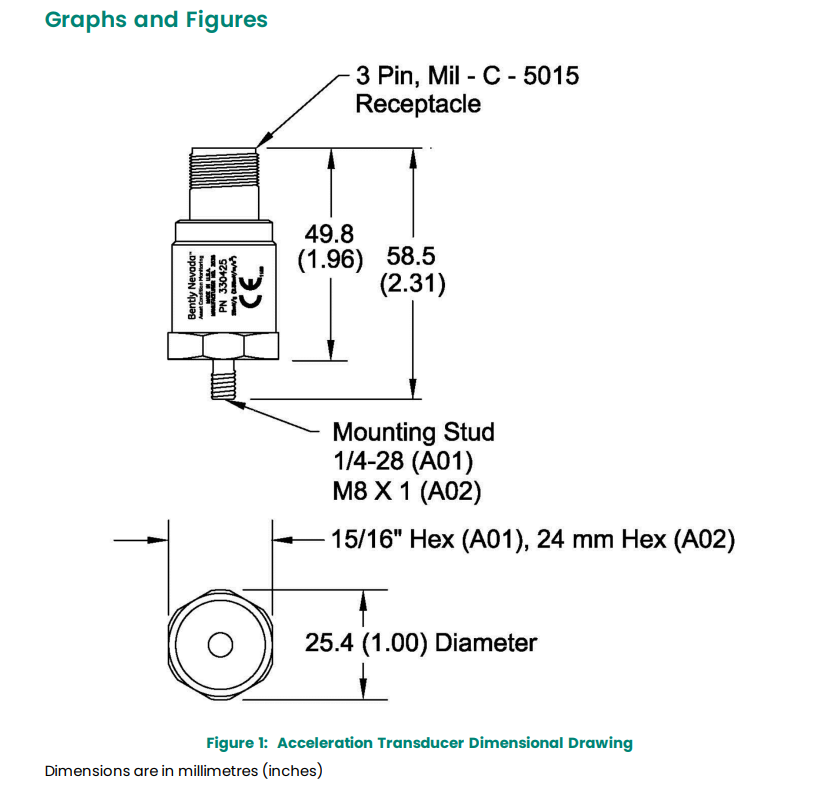
The Bently Nevada 330400 is a compact, hermetically sealed accelerometer with a diameter of 23 mm (0.93 in) and a height of 59 mm (2.3 in), including the mounting stud. It weighs approximately 99 g (3.5 oz). The transducer is constructed with a 316L stainless steel connector and case, providing excellent corrosion resistance.
The unit is available with two integral stud options:
The mounting surface must be prepared to a finish of 32 µin rms or better to ensure optimal mechanical coupling. Mounting torque is specified at 4.1 N·m (3.0 ft·lb). For applications requiring reduced base strain sensitivity, an optional mounting base (API adapter) can be used.
Connector
The Bently Nevada 330400 is equipped with a 3-pin MIL-C-5015 receptacle constructed of 316L stainless steel. This connector is compatible with the following cable options:
130539: 3-conductor shielded 18 AWG cable with fluorosilicone elastomer boot.
169253: 3-conductor shielded 22 AWG cable.
167103: 3-conductor shielded 22 AWG armored cable.
Cables are available in standard and custom lengths, with a maximum recommended length of 305 meters (1000 ft) without signal degradation. A mating connector (part number 00531080) is also available for custom cable assemblies.
Environmental Sealing
The Bently Nevada 330400 is rated IP68 (dust tight and watertight), ensuring reliable operation in harsh, wet, or dusty environments. The transducer is hermetically sealed to prevent moisture ingress and is designed for outdoor use in protected enclosures, with wiring routed through conduit. Optional splash boots are available for additional protection.
Installation Considerations
To ensure accurate and reliable measurements with the Bently Nevada 330400, careful attention must be given to installation practices. The accelerometer must be mounted on a clean, flat, and smooth surface (32 µin rms finish) on the bearing housing or machine casing. The mounting stud must be tightened to the specified torque of 4.1 N·m (3.0 ft·lb). Improper mounting can decrease the transducer amplitude and frequency response and may generate false signals that do not represent actual vibration.
For sensors with serial numbers NOT preceded by the letter "G" (shipped prior to April 2004), Bently Nevada strongly recommends using the Mounting Base (API adapter) to minimize base strain sensitivity. For sensors with serial numbers preceded by "G", the base strain sensitivity is significantly lower and the mounting base is not required but can still be used.
The accelerometer case is isolated from the mounting stud, which prevents ground loops. However, care should be taken to ensure that the cable shield is properly connected to the monitoring system's common ground. Cables should be routed away from high-voltage or high-current lines and protected from physical damage using conduit or cable trays.
For installations in hazardous areas (Ex ia IIC T3), the sensor must be powered only by a power supply unit with a limited energy electric circuit in accordance with the relevant standards (CAN/CSA C22.2 No. 61010-1-12, ANSI/UL 61010-1, or Class 2 as defined in the Canadian Electrical Code and National Electrical Code). The maximum cable length of 305 meters (1000 ft) should not be exceeded to avoid signal degradation.
Certifications and Approvals
The Bently Nevada 330400 is certified for use in a wide range of hazardous areas and complies with major international standards:
FCC: Complies with Part 15 of the FCC Rules.
EMC: Complies with EMC Directive 2014/30/EU.
RoHS: Complies with RoHS Directive 2011/65/EU.
China RoHS: Has an EFUP designation of 15 years (SJ/T 11364-2024).
ATEX: Complies with ATEX Directive 2014/34/EU for explosive atmospheres.
IECEx: Certified for international hazardous area use.
CSA: Certified for use in North American hazardous locations.
ABS: Approved for Marine Vessels, Offshore Units, and Mobile Offshore Units.
For detailed country-specific approvals, refer to the Approvals Quick Reference Guide (108M1756). Up-to-date certification documentation can be accessed through the Bently Nevada Media Library at bntechsupport.com.
When ordering the Bently Nevada 330400, use the following part number configuration: 330400-AA-BB, where:
Compatible Interconnect Cables
Cables are ordered as Part Number-AA, where AA = cable length in feet (standard lengths available: 6, 8, 10, 12, 15, 17, 20, 25, 50, 99). Custom lengths can be ordered in 1.0 ft increments.
Cable Part Number | Description |
130539 | 3-conductor shielded 18 AWG cable with 3-socket plug and fluorosilicone elastomer boot at one end, terminal lugs at the other end. Min length 2.0 ft, max 99 ft. |
169253 | 3-conductor shielded 22 AWG cable with 3-socket plug at one end, terminal lugs at the other end. Min length 2.0 ft, max 99 ft. |
167103 | 3-conductor shielded 22 AWG armored cable with 3-socket plug at one end, terminal lugs at the other end. Min length 3.0 ft, max 99 ft. |
Accessories
Part Number | Description |
127088 | 330400 and 330425 Accelerometer User Guide |
00531080 | Mating connector for 330400 and 330425 Accelerometers |
37439-01 | Mounting Base, ¼-28 to ¼-28 (reduces base strain sensitivity; for serial numbers NOT preceded by "G") |
37439-02 | Mounting Base, M8X1 to M8X1 (reduces base strain sensitivity; for serial numbers NOT preceded by "G") |
43217 | Accelerometer Mounting Kit (used with extension part 108576-01 and O-ring 04290422) |
Applications and Typical Use Cases
The Bently Nevada 330400 is specifically designed for critical machinery applications where casing acceleration measurements are required. Typical applications include:
Gear Mesh Monitoring – Detection of high-frequency vibration components associated with gear tooth wear, pitting, and cracking.
Bearing Health Assessment – Identification of bearing defects (spalling, brinelling, fatigue) through high-frequency vibration analysis.
Compressor and Turbine Casing Vibration – Monitoring of casing vibration in gas turbines, steam turbines, and centrifugal compressors to detect unbalance, misalignment, and looseness.
Pump and Motor Monitoring – Detection of cavitation, bearing wear, and mechanical faults in pumps and electric motors.
Wind Turbine Gearbox Monitoring – High-frequency vibration measurement for gearbox health monitoring.