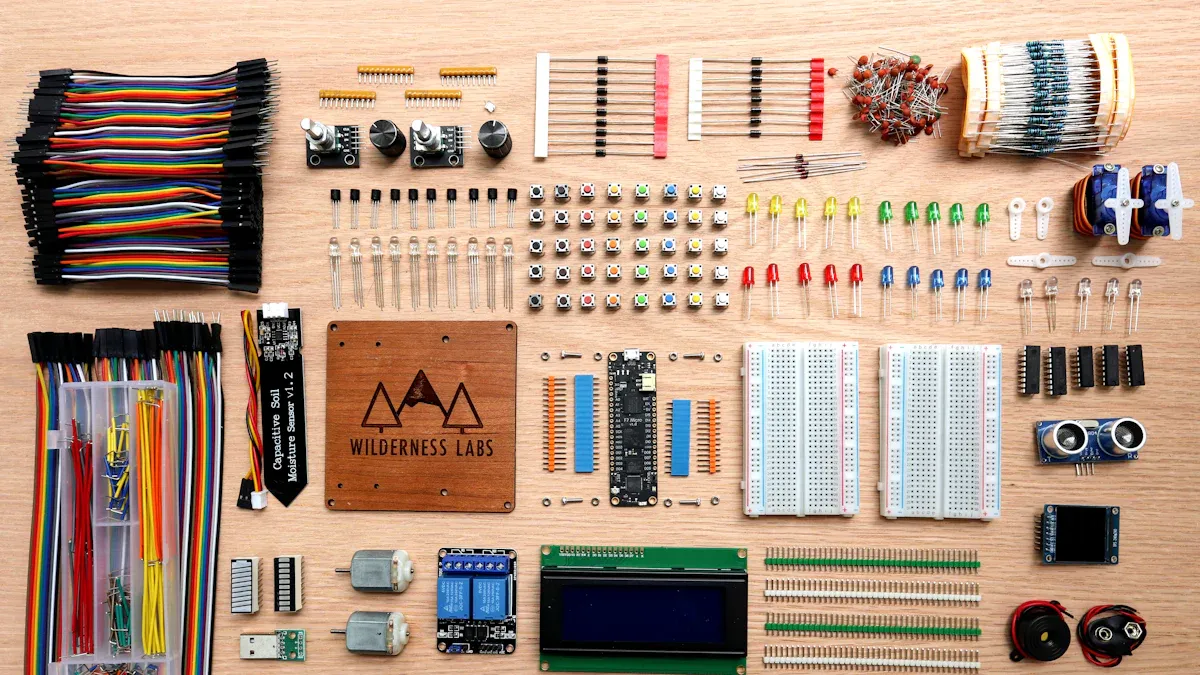
A sensing system helps you detect and measure changes in your environment or machinery. You use it to make your factory more efficient, control processes, and improve safety. Today, industries depend on sensors for tasks like real-time monitoring and quality control. These systems connect machines and operators, making quick adjustments possible. The global market for industrial sensors has grown fast because of Industry 4.0 and the push for automation. VM Sensing System sets a high standard in industrial applications with reliable solutions for automation and machinery health monitoring.
Key Takeaways
A sensing system detects changes in the environment or machinery, helping improve efficiency and safety in factories.
Choosing the right sensor type for your specific needs is crucial for achieving the best results in monitoring and control.
Sensor fusion combines data from multiple sensors, enhancing accuracy and reliability while reducing errors in measurements.
Regular maintenance of sensing systems is essential to catch problems early, ensuring accuracy and minimizing downtime.
Staying updated on new sensor technologies and trends helps businesses adapt and thrive in a rapidly changing industrial landscape.
Sensing system basics
Definition
A sensing system helps you detect changes in your environment or machinery. You use it to collect information, such as temperature, pressure, or movement. This information lets you make decisions or control machines automatically. In factories, a sensing system can spot problems early and help you avoid costly breakdowns. You rely on these systems to keep your operations safe and efficient.
Core components
Every sensing system has several important parts that work together. You can find these components in most industrial setups:
Industrial sensors: These devices pick up signals from the environment.
Photoelectric, proximity, and condition sensors: They detect objects, measure distances, or check the health of machines.
Limit switches: These switches help you control the position of moving parts.
Track and trace solutions: They let you follow products or materials through a process.
Connectivity solutions: These parts help your sensors talk to other machines or computers.
You can see how different types of sensors work in various applications in the table below:
Sensor Type | What It Does | Applications |
Position sensor | Detects position or orientation of an object | Robotics, automotive systems |
Pressure sensor | Measures force exerted by a liquid or gas | HVAC, automotive braking systems |
Temperature sensor | Monitors heat levels | Climate control, manufacturing |
Humidity sensor | Measures moisture content in air | Environmental control, farming |
Force sensor | Detects mechanical force applied to an object | Scales, industrial machines |
Vibration sensor | Detects & measures oscillations in machinery | Predictive maintenance, fault diagnosis |
Motion sensor | Detects movement or presence of nearby object | Security, automatic lighting |
Flow sensor | Measures rate of fluid movement | Water management, chemical processing |
Level sensor | Determines height of material within container | Inventory management, process control |
Tip: When you choose a sensing system, match the sensor type to your specific needs. This helps you get the best results for your application.
How it works
A sensing system follows a clear process to collect and use data. Here is how it usually works:
Signal measurement: The sensor picks up a signal from the environment, such as heat, light, or movement.
Signal amplification: The system boosts the weak signal so you can measure it easily.
Signal filtering: The system removes unwanted noise, making the data clearer.
Analog-to-digital conversion: The system changes the signal from analog to digital form, so computers can read it.
Data acquisition: The digital signal goes to a data acquisition system for storage and analysis.
Data processing: The system processes the stored data to help you understand what is happening and make decisions.
You can see that each part of the process plays a key role. The sensor collects the data, the system cleans and converts it, and finally, you get useful information to guide your actions. This step-by-step method makes a sensing system reliable and accurate for many tasks.
Types & technologies
Sensor types
You can find many types of sensors in a modern sensing system. Each sensor has a special job. Some measure temperature, while others check pressure or movement. The table below shows common sensor types, their main functions, and where you might use them:
Sensor Type | Function | Applications |
Position | Detects orientation or distance of an object | Robotics, automotive systems |
Pressure & Force | Measures force of liquid, gas, or mechanical pressure | Industrial machines, HVAC, scales, auto braking |
Temperature & Humidity | Monitors heat and moisture | Climate control, electronics, agriculture |
Vibration | Detects oscillations in machinery | Predictive maintenance, fault diagnosis |
Motion | Detects movement or presence | Security, automatic lighting |
Flow | Measures rate of fluid or gas movement | Water management, chemical processing |
Level | Determines height of material in a container | Inventory management, safety systems |
Tip: You should choose the right sensor type for your application to get the best results.
Sensor fusion
Sensor fusion means you combine data from different sensors to get better results. You use this method to improve accuracy and reliability in your sensing system. When you blend information from several sensors, you can:
Reduce errors and filter out false readings.
Improve localization by getting a complete view of your environment.
Make better decisions because you have more details.
Automate quality control and lower the risk of defects.
For example, if one sensor fails, the system can use data from other sensors to keep working. In smart factories, sensor fusion helps you monitor the environment more accurately. You can also use sensor fusion to check if a robot grips an object securely or to detect and recover from collisions.
Technology advances
New technology keeps making sensing systems better. Some recent advances include:
Advancement | Description | Impact |
Room-Temperature Quantum Sensors | Sensors that work at room temperature for magnetic field measurements | Makes quantum sensing easier for biology and electronics |
Control of Molecular Quantum States | Lasers align electron spins in molecules for detection | Helps you understand biological and material processes |
You also see improvements in force adjustment and grip security. Robots can now check if they hold objects safely without extra scans. They can measure weight and balance for better movement. Crash detection lets robots recover quickly from bumps or accidents. These advances help you get more reliable and efficient results from your sensing system.
Applications
Industrial uses
You see sensing systems everywhere in modern factories. They help you control machines, keep workers safe, and make products with high quality. Sensing systems give you real-time feedback, so you can spot problems before they stop production. You use them for tasks like predictive maintenance, robotics, and smart manufacturing. These systems also help you prevent gas and chemical hazards.
Here is a table that shows where you might use sensing systems in industry:
Application Area | Specific Uses |
Industrial Automation | Predictive maintenance, robotics, hazard prevention, smart manufacturing |
Healthcare Devices | Heart rate, blood pressure, temperature, and biosensor monitoring |
Automotive Systems | Self-driving sensors, tire pressure, emission sensors, parking assistance |
You can rely on the VM Sensing System for industrial automation, turbine monitoring, and vibration analysis. Its Unified Multi-speed analysis helps you find faults in machines that run at different speeds, which is important for complex equipment like turbines.
Machinery health monitoring
You use sensing systems to keep your machines healthy. These systems collect data about vibration, temperature, and other conditions. You can spot early signs of trouble and fix them before a breakdown happens. This approach helps you save money and avoid downtime.
You get real-time data to identify issues before they cause failures.
Predictive maintenance uses this data to plan repairs and keep machines running longer.
You can make smart decisions based on the latest information from your equipment.
The VM Sensing System supports you with advanced vibration analysis and condition monitoring. It works well with brands like Bently Nevada and EPRO. You can choose from models such as the 3300XL series and the PR6423 8mm Eddy Current Sensor. Each part goes through strict testing for reliability.
Other fields
You find sensing systems in many areas outside factories. In healthcare, you use them to monitor heart rate and blood pressure. In cars, they help with parking, safety, and self-driving features. These systems also play a role in farming, environmental monitoring, and smart homes.
Note: When you select a sensing system, check for compatibility with your current equipment. The VM Sensing System offers many model options and works with leading brands, making it easy for you to upgrade or expand your setup.
Challenges & trends
Data management
You face big challenges when you manage the huge amounts of data from modern sensors. Older systems often slow you down because they use batch processing, which creates delays and data silos. High data volumes can make costs rise quickly, especially with legacy pricing models. Sometimes, you see latency in data processing, which means you cannot respond fast enough. Network bandwidth limits and congestion also make it hard to send data where you need it.
Scaling issues with old systems
High costs for storing and processing data
Delays in getting and using data
Network problems that block data flow
The VM Sensing System helps you solve these problems. It uses cloud services for fast data management and connects with backend systems like ERP and CRM. You get real-time analysis and better support after you buy the product.
Reliability & accuracy
You want sensors that work well in tough places. Many sensors use solid-state designs, so they resist contamination and last longer. Capacitive and induction sensors give you accurate results, even in extreme conditions. Strong materials help sensors survive heavy vibration and high temperatures. Simulation testing finds weak spots before sensors go into use. Advanced circuit boards protect sensors from heat.
Characteristic | Description |
Highly reliable | Solid-state sensors resist contamination and last longer. |
Accurate | Capacitive and induction sensors work well in harsh environments. |
Robust | Strong materials handle vibration and temperature changes. |
Simulation tested | Testing finds and fixes weak spots before use. |
Heat protected | Circuit boards keep sensors working in high heat. |
Security & privacy
You need to keep your data safe. Some risks include default passwords, weak security during development, and unencrypted communication. Devices can be hard to update, and physical tampering is possible. Cyber threats can damage data and cause real harm.
You can protect your system by using network segmentation, endpoint protection, and continuous monitoring. Asset management and access control help you know which devices need protection. Multi-factor authentication and behavioral analytics add extra layers of safety.
Future trends
You will see sensors get smarter and smaller. Many new sensors can check themselves and process data on their own. Miniaturization lets you use sensors in more places, like smartphones and wearables. Multifunctional sensors measure many things at once, making your work easier. Integration combines different sensors into one system for better performance. Networking connects sensors through IoT, so you get real-time data and smart management.
Ongoing innovation and strong customer support matter. You need new technology to keep up with changing needs. VM focuses on continuous improvement and helps you with technical support, so you can trust your sensing system to grow with your business.
You rely on sensing systems to boost efficiency and reliability in your operations. Sensors help you monitor environmental conditions, prevent failures, and improve design. The VM Sensing System gives you solutions for healthcare, finance, and manufacturing by supporting secure data management and fast response.
Sensors track temperature, humidity, and gas levels for safety.
Early detection lets you fix problems before they grow.
Data from sensors helps you design better systems.
Development Area | Impact on Industry Standards |
MEMS Technology | Compact, high-performance sensors for many uses |
IoT Integration | Smart environments and better data communication |
Safety Regulations | Sensors in vehicles improve passenger safety |
Stay updated on new sensor technology. You can prepare for changes by building flexible systems, training your team, and using data-driven tools. These steps help you adapt and thrive as sensing systems evolve.
FAQ
What is a sensing system?
A sensing system helps you detect and measure changes in your environment or machines. You use it to collect data, improve safety, and control processes in real time.
How do you choose the right sensor for your application?
You should match the sensor type to your needs. For example, use a vibration sensor for machinery health or a temperature sensor for climate control. Check compatibility with your current equipment.
Can you use the VM Sensing System with other brands?
Yes, you can. The VM Sensing System works with leading brands like Bently Nevada and EPRO. You can easily integrate it into your existing setup.
Why is regular maintenance important for sensing systems?
Regular maintenance helps you catch problems early. You keep your system accurate and reliable. This reduces downtime and saves money.
What support does VM offer after you buy a sensing system?
VM gives you technical support, part verification, and replacement solutions. You can request test reports before shipment. The team helps you with any questions or technical challenges.