Operating critical rotating machinery on legacy protection systems introduces unacceptable risks. The dual threats of missed trips and false trips can lead to catastrophic failure or unplanned downtime. The Bently Nevada 3300 series, once the industry standard, has reached obsolescence. Sourcing replacement parts is increasingly difficult. Its analog-era diagnostic capabilities fall short of modern predictive maintenance requirements in high-stakes industries like oil and gas and power generation. Transitioning to the current standard requires a rigorous technical evaluation. This guide compares the Bently Nevada 3300 vs 3500 systems. We detail module-level differences, functional upgrades, and practical migration strategies. You will learn how the 3500 ENCORE upgrade path secures plant reliability while minimizing installation downtime.
Lifecycle Status: The 3300 system is officially obsolete with discontinued OEM support, whereas the 3500 system is the actively supported, globally deployed standard (over 85,000 installations).
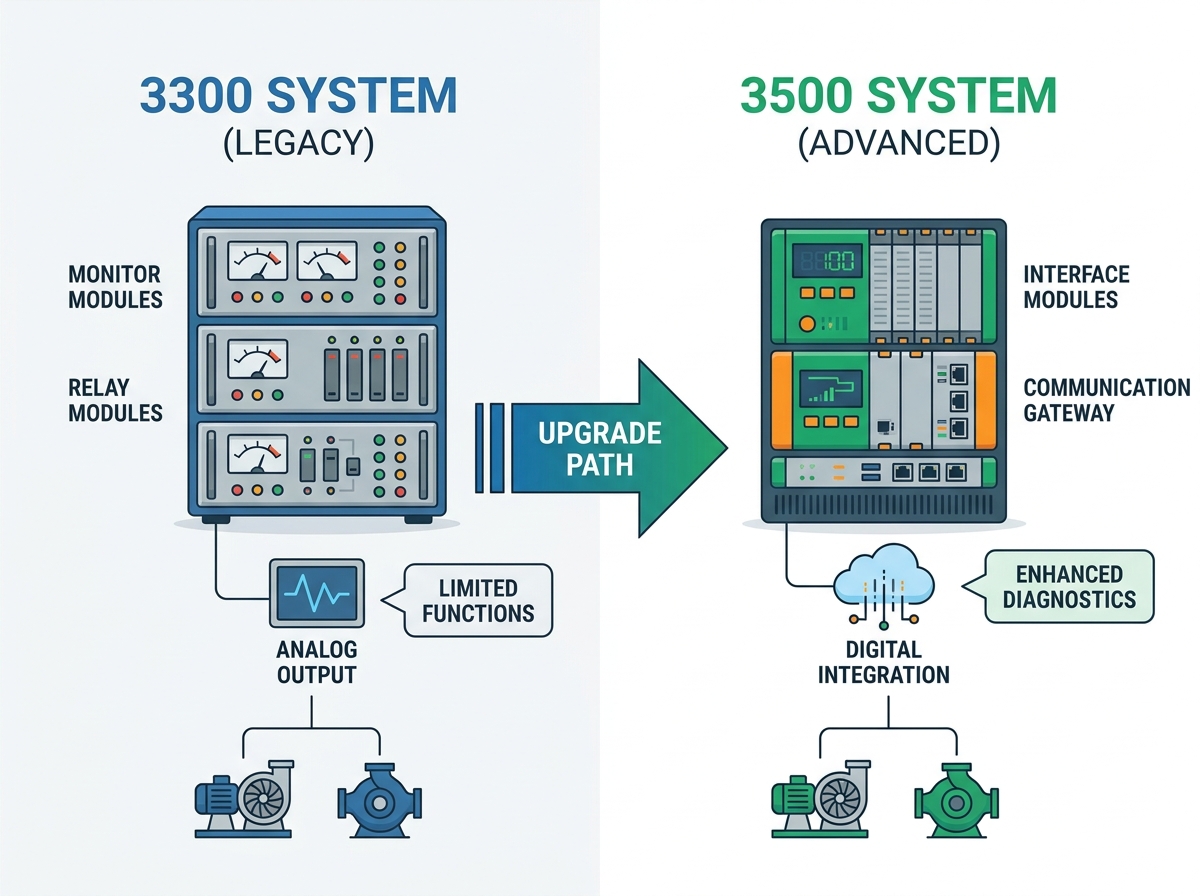
Architectural Shift: The 3500 system replaces the 3300’s hardware-limited architecture with a fully digital, software-configurable, high-density modular rack that supports SIL (Safety Integrity Level) certification.
Density & Footprint: Modern 3500 modules (e.g., the 3500/33 relay module) offer up to four times the channel density of legacy equivalents, drastically reducing required panel space.
Upgrade Efficiency: Migration does not necessarily require a complete "rip and replace"; the 3500 ENCORE system allows facilities to upgrade the rack while retaining existing field wiring, minimizing turnaround time.
Table of Contents
Toggle
Bently Nevada 3300 vs 3500: Architecture and Core Functions
API 670 compliance dictates strict standards for machinery protection systems. Both platforms historically addressed these standards for critical rotating equipment like turbines, compressors, and generators. However, the technological foundation of each system differs drastically. When you walk into a legacy control room, the 3300 racks stand out with their physical meters and hardwired backplanes. They did the job for decades. Now, they represent a massive blind spot for reliability engineers.
The Legacy 3300 System: Capabilities and Limitations
The 3300 system served as a reliable hybrid analog and digital platform. It provided basic vibration monitoring and trip functions. However, its architecture severely limits transient data capture. Communication protocols remain restricted by outdated serial connections. Hardware-based configurations make system adjustments rigid and labor-intensive. If you need to change a trip setpoint, you are often dealing with physical potentiometers or dip switches.
Facilities face escalating risks as hardware degrades. Backplane failures become more frequent with age. Relying on gray-market secondary sources for replacement modules introduces severe reliability concerns. OEM support no longer exists for these aging components. You cannot guarantee the calibration or integrity of a refurbished 3300 card pulled from a decommissioned plant.
The 3500 System: Modern Machinery Protection
The 3500 system utilizes a fully digital, rack-based architecture. Engineers designed it for continuous, online monitoring across heavy industries. It integrates seamlessly with condition monitoring software like System 1. This integration enables advanced diagnostics, shifting maintenance from reactive to predictive. You get high-resolution waveform data during machine startups and coast-downs.
The core objective of the 3500 system is maximizing reliability. It utilizes advanced voting logic to eliminate false trips. It achieves this without compromising on missed-trip prevention. Furthermore, the 3500 system offers functional safety upgrades. It supports SIL certification capabilities, a safety standard the 3300 lacks entirely. When you upgrade, you bring the protection scheme up to modern IEC 61508 standards.
Bently Nevada 3300 vs 3500 Modules: Channel Density and Performance
Comparing the physical and functional footprint of the modules demonstrates the scalability of the modern platform. Space efficiency matters in crowded control rooms. We often see facilities struggling to fit new instrumentation into existing panels.
Rack Space and Processing Power
The 3300 system relies on a distributed architecture with slower backplane communication speeds. Physical rack dimensions limit the number of channels per panel. The 3500 system centralizes communication and data processing through the Transient Data Interface (TDI) module. This centralization vastly improves data throughput and system responsiveness. The TDI handles all the heavy lifting for external communications, freeing up the monitor modules to focus purely on signal processing and alarm logic.
Relay and I/O Modules (3500/32M vs 3500/33)
Legacy 3300 relay modules offer limited channel counts and rigid programming. Modern 3500 options provide significant flexibility. The 3500/32M serves as the standard 4-channel relay module for basic applications. The 3500/33 is a 16-channel high-density relay module.
High-density modules consolidate space effectively. The 3500/33 is four times more space-efficient than legacy equivalents. This density is essential for complex voting logic applications where panel space is at a premium. You can map multiple monitor channels to a single relay output using software, rather than running physical jumper wires across the backplane.
Feature
Bently Nevada 3300
Bently Nevada 3500
Architecture
Hybrid Analog/Digital
Fully Digital
Relay Density
Low (Hardware limited)
High (Up to 16 channels per module)
Voting Logic
Hardwired, rigid
Software-configurable Boolean logic
SIL Certification
Not Supported
Supported
Data Interface
Distributed, limited
Centralized TDI Module
Communication and Integration Modules
The transition from legacy 3300 serial outputs to the 3500’s robust communication gateways marks a major upgrade. The 3500 supports Modbus TCP/IP, Modbus serial, and Ethernet/IP. It allows direct integration into modern Distributed Control Systems and SCADA environments. You no longer need protocol converters or custom gateway PCs.
Modern cybersecurity requirements demand strict network segregation. The 3500 system accommodates secure data diodes. This ensures safe data transmission when connecting Operational Technology networks to IT infrastructure. You can push condition monitoring data to corporate networks without exposing the protection rack to external cyber threats.
How Bently Nevada 3500 Improves Reliability, Redundancy, and Trip Protection
Fault tolerance prevents single points of failure. Evaluating how each system handles redundancy is necessary for critical asset protection. A single failed power supply should never take down your turbine protection system.
Advanced Voting Logic
The 3300 relies on hardwired voting logic. Changing trip conditions requires physical rewiring. The 3500 utilizes software-configurable, complex Boolean voting logic. Engineers can program AND, OR, and NOT logic combinations across multiple channels. This precision defines trip conditions accurately and prevents false shutdowns. For example, you can configure a trip only if two out of three radial vibration probes on a specific bearing exceed the danger threshold simultaneously.
Power Supply and Component Redundancy
The 3500 rack features dual-redundant power supply capabilities. If one power supply fails, the second assumes the load instantly. Redundancy extends to the module level. Facilities can install redundant TDI modules. This ensures continuous protection and data flow even during a component failure, addressing a major vulnerability of the 3300. We always recommend fully redundant power supplies for any API 670 application.
How to Upgrade from Bently Nevada 3300 to 3500
Migrating an obsolete system requires specific engineering approaches. Facilities must choose the path that aligns with their operational constraints. You have two main options depending on your outage window and budget.
The 3500 ENCORE System Upgrade
The ENCORE program is a form-factor replacement strategy. Technicians remove the 3300 internals and replace them with a 3500 Encore rack. The primary benefit is utilizing existing 3300 field wiring, terminal blocks, and panel cutouts.
This method effectively doubles channel capacity within the same physical footprint. It drastically reduces installation time and labor costs compared to a complete panel rebuild. You avoid the massive effort of pulling new home run cables from the machine deck to the control room.
Full Rack Replacement (Rip-and-Replace)
A complete panel overhaul is sometimes required. Degraded field wiring or a complete control room redesign necessitates this approach. The trade-offs include higher upfront labor and longer downtime. However, it results in a completely modernized, clean-slate installation free from legacy wiring issues. If your existing terminal blocks are brittle or your cabinet wiring is a mess, a full replacement is the better long-term choice.
Key Challenges in a Bently Nevada 3500 Upgrade
Executing a migration presents practical, on-the-ground challenges. Proper planning mitigates these adoption risks. You cannot just swap racks and hit the start button.
Downtime and Turnaround Planning
An ENCORE upgrade requires significantly shorter outage windows than a full replacement. Facilities must conduct Factory Acceptance Testing prior to shipment. Site Acceptance Testing is mandatory before startup to verify protection logic and relay mapping. We typically allocate three to five days for a full SAT on a standard turbine rack.
Sensor and Transducer Compatibility
Existing 3300-series proximitor sensors, eddy current probes, and seismic transducers are generally backward compatible. They connect directly to 3500 I/O modules. Technicians must verify loop impedance and signal integrity before connecting legacy field devices to the new rack. You should perform a full loop check, simulating signals at the proximitor to verify the rack reads the correct vibration amplitudes.
Training and Software Adoption
The human element is critical. Operators shift from reading physical 3300 panel meters to utilizing System 1 software interfaces. Instrumentation technicians and reliability engineers require specific training protocols. This training ensures they can leverage the new diagnostic data effectively. They need to understand how to navigate the 3500 Rack Configuration Software to adjust alarm setpoints or modify voting logic.
Bently Nevada 3500 Upgrade Costs, Benefits, and ROI
Provide the financial and operational framework for justifying the capital expenditure. Upgrading a protection system is a significant investment, but the cost of doing nothing is far higher.
The Hidden Costs of 3300 Obsolescence
Quantify the risks of relying on gray-market parts, extended downtime during a backplane failure, and the lack of OEM technical support. A single false trip on a base-load generator can cost hundreds of thousands of dollars in lost production. Sourcing a replacement 3300 monitor card from an unverified vendor might take weeks, leaving your machine unprotected or forcing a shutdown.
ROI of the 3500 System
Frame the return on investment around risk mitigation and operational efficiency. The 3500 system prevents catastrophic failures through reliable missed-trip prevention. It reduces false trips via advanced voting logic. Predictive maintenance via System 1 extends machinery lifespan. High-density modules like the 3500/33 reduce auxiliary hardware costs and panel space requirements.
Conclusion
The Bently Nevada 3300 is increasingly difficult to support in modern industrial environments, while the 3500 system provides the digital architecture, redundancy, diagnostics, and protection logic required for critical rotating machinery. Facilities with limited turnaround windows should consider the 3500 ENCORE upgrade, whereas plants undertaking broader DCS or control room modernization may benefit from a full 3500 rack replacement.
Established in 2010, Exstar is a professional supplier of industrial automation spare parts, specializing in turbine control, distributed control systems, sensing systems, emergency shutdown systems, turbine supervisory instrumentation, and programmable logic controllers. Its engineering-based sales team supports system architecture proposals, part-number selection, system testing, and after-sales service, helping industrial customers plan replacement and modernization projects more efficiently.
Initiate a comprehensive site audit to map existing 3300 I/O counts.
Assess the health and integrity of all existing field wiring.
Consult with a certified machinery diagnostics engineer to draft a migration proposal.
Schedule the upgrade during the next available planned outage window.
FAQ
Q: Can I still buy replacement parts for the Bently Nevada 3300 system?
A: The 3300 system is officially obsolete. While some refurbished parts exist on the secondary market, OEM support is discontinued. Relying on gray-market 3300 parts is a high-risk strategy for critical machinery protection.
Q: What is the Bently Nevada 3500 ENCORE system?
A: The ENCORE system is an upgrade solution. It replaces the 3300 internal hardware with 3500 technology while reusing the existing 3300 panel cutout and field wiring. This minimizes installation downtime and doubles channel capacity.
Q: Are existing 3300 proximitors and probes compatible with the 3500 system?
A: Yes, the 3500 system is backward compatible with most existing 3300-series proximitor sensors, eddy current probes, and seismic transducers. Technicians should verify loop integrity before connection.
Q: Does the 3500 system support SIL certification?
A: Yes. Unlike the legacy 3300 system, the 3500 machinery protection system supports Safety Integrity Level (SIL) certification. This meets modern functional safety requirements for critical applications.
Q: How does the 3500 system handle false trips compared to the 3300?
A: The 3500 system utilizes software-configurable, complex Boolean voting logic. This allows for precise trip condition definitions across multiple channels. It significantly reduces the occurrence of false trips compared to the 3300's hardwired logic.